As organizations move into 2026, the speculative phase of AI adoption has passed. We all remember the experimentation wave of 2024 and the industrialization efforts of 2025 - during which enterprise spending on generative AI reached $37 billion – have given way to a new operational reality.
However, for SaaS leaders, this marks a transition into the era of the Agentic Enterprise, where autonomous systems are no longer experimental add-ons but form the core operating logic of competitive organizations.
The critical implication for leadership is that agentic AI cannot be treated as a bolt-on feature or a marginal roadmap enhancement. It represents a structural shift - from a human + application model to an AI agent + API ecosystem. While 2025 focused on proving technical feasibility, 2026 is defined by the more complex challenges of production readiness and deep architectural integration.
If you don't rebuild now, you are building a legacy product by next year.
Why “Adding an AI Agent” Can Break Existing SaaS Architectures
Traditional SaaS platforms were designed as tightly coupled stacks combining data storage, business logic, and user interfaces optimized for human interaction. These systems rely on human-in-the-loop workflows, where users navigate initiate actions and coordinate processes manually.
For that reason, when companies attempt to “add an agent” on top of these legacy architectures, they encounter a hard structural limit – a legacy ceiling. Research shows that 86% of enterprises require significant technology stack upgrades to deploy AI agents effectively.
Request–Response vs. Goal–Driven Systems: The Core Architectural Mismatch
At the root of many failed agent deployments lies a fundamental mismatch in system logic.
Traditional software operates on a deterministic request-response model: a user performs an action, and the system returns a predefined result. However, agentic AI systems operate differently. They are goal-driven and proactive, capable of perceiving their environment, reasoning through ambiguous problems, and acting autonomously to achieve outcomes.
By 2028, agents are expected to evolve into autonomous partners that proactively shape decision-making rather than simply assist with information retrieval, as outlined by Deloitte’s projections on agentic AI in the enterprise.
Where Platforms Fail First
As organizations scale from isolated pilots to thousands of autonomous digital skills, several structural weaknesses consistently emerge.
Permissions and Access Control
Conventional role-based access control (RBAC) models are insufficient for agents that must query 10–20 core systems simultaneously to maintain operational context. In 2026, platforms require “Know Your Agent” (KYA) permission models that provide agents with governed, auditable access comparable to human users.
Workflow Engines and Feedback Loops
Many enterprises fall into an “80/20 trap,” where 80% of effort is spent building integrations and only 20% on training agents for intelligent workflows. Without a unified orchestration layer, agents cannot iterate autonomously or learn from outcomes.
Observability and Decision Traceability
Agent decisions made in opaque “black box” systems introduce significant legal and reputational risk. Production-grade platforms must log every step of an agent’s reasoning process—providing forensic decision traceability that enables auditing, failure analysis, and human oversight.
Data Contracts and Source-of-Truth Conflicts
Fragmented data landscapes lead agents to act on incomplete or inconsistent information. Effective deployment requires a convergence architecture that unifies operational and analytical data within a single cloud-native platform, ensuring real-time visibility for autonomous systems.
The Strategic Mistake: Treating Agents Like Chatbots
A common leadership misstep is equating agents with chatbots. Chatbots assist humans by retrieving or summarizing information. Agents, by contrast, independently execute multi-step tasks.
Currently, 77% of enterprise AI deployments focus on simple automation rather than true agentic collaboration, according to the Anthropic Economic Index. This indicates that many organizations still frame agents as replacement technology instead of autonomous teammates.
Sustainable impact requires rethinking entire workflows - spanning people, processes, and systems - rather than automating isolated tasks.
Non-Determinism Enters the Platform: Risk, Trust, and Control
The non-deterministic behavior of large language models (LLMs) remains a major barrier to enterprise trust. Even with deterministic configurations (temperature = 0), accuracy can vary by up to 15% across identical runs, as documented in recent research.
Reliability declines further when consistency is measured across multiple executions. For example, a GPT-4-based agent may achieve a 60% success rate on a single run (pass@1), but only 25% consistency across eight runs (pass@8), according to findings published on arXiv.
Managing this instability requires robust evaluation frameworks and the deployment of “guardian agents” that monitor, validate, and constrain autonomous decisions in real time.
What Must Change in a Production-Grade SaaS to Support Agents
To support a digital workforce, production-grade SaaS platforms are evolving their architecture into a three-layer model:
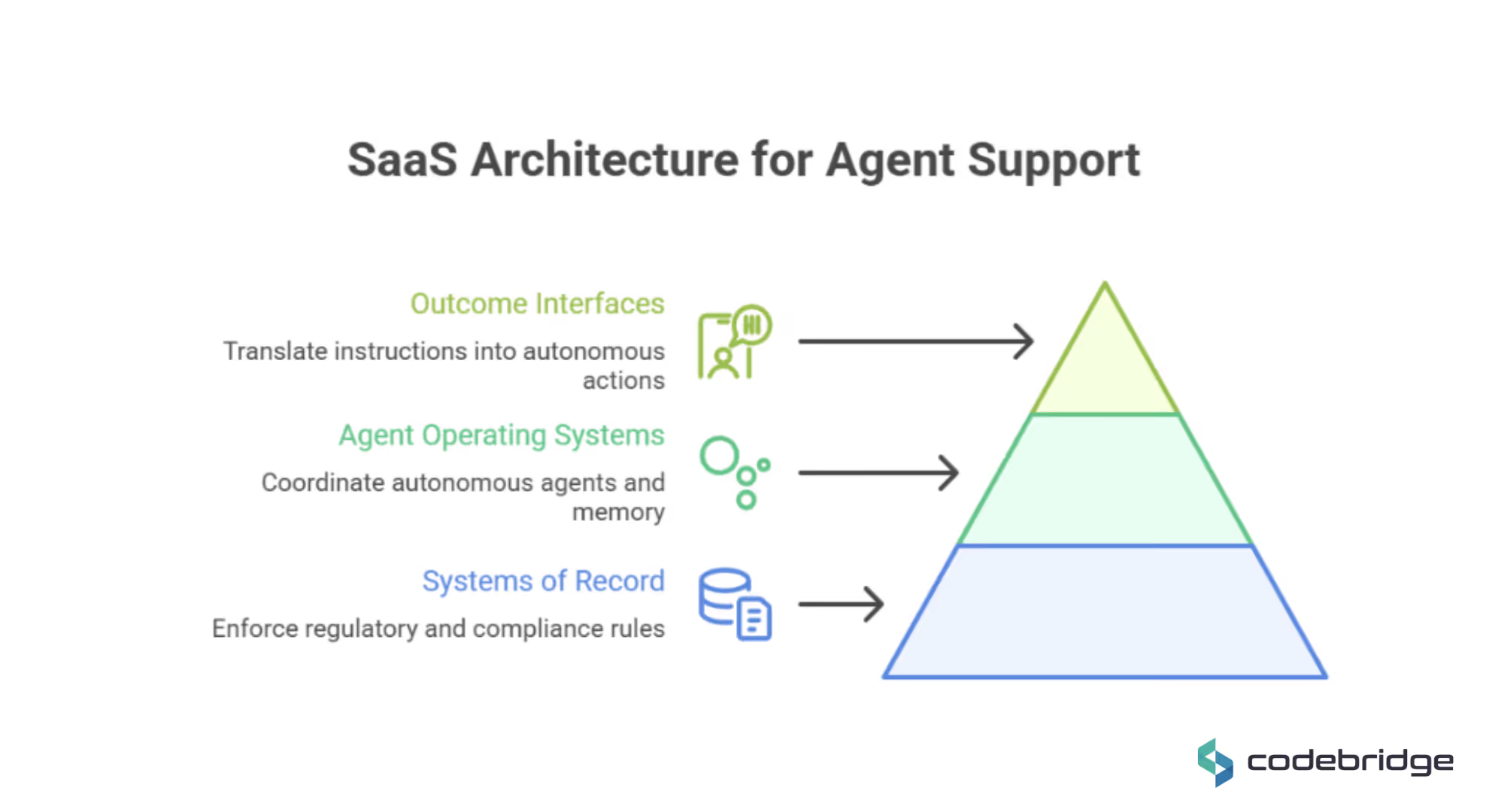
Systems of Record
These are the core data stores that enforce regulatory and compliance rules, ensuring that all actions are safe, auditable, and reliable.
Agent Operating Systems
Sitting in the middle, this layer handles planning, memory management, and fleet orchestration, effectively coordinating a workforce of autonomous agents.
Outcome Interfaces
The top layer translates high-level, natural language instructions into autonomous actions, making it easy for users to achieve results without manual intervention.
This shift in architecture also drives a rethink in pricing. Instead of charging per user seat, platforms are moving toward outcome-based pricing, where customers pay for work that gets completed rather than simply for access to the software.
Why Integration Strategy Matters More Than Model Choice
In enterprise SaaS, AI models are becoming increasingly commoditized — the real differentiator is how effectively they integrate into workflows and systems. That’s why, in the agentic economy, model choice is increasingly commoditized, while integration strategy becomes the primary differentiator. According to recent research, leading agents can exhibit up to 50x cost variation for comparable levels of precision.
Relying on a single model constrains adaptability. Instead, organizations benefit from building an agentic AI mesh capable of operating across multiple vendors and model types.
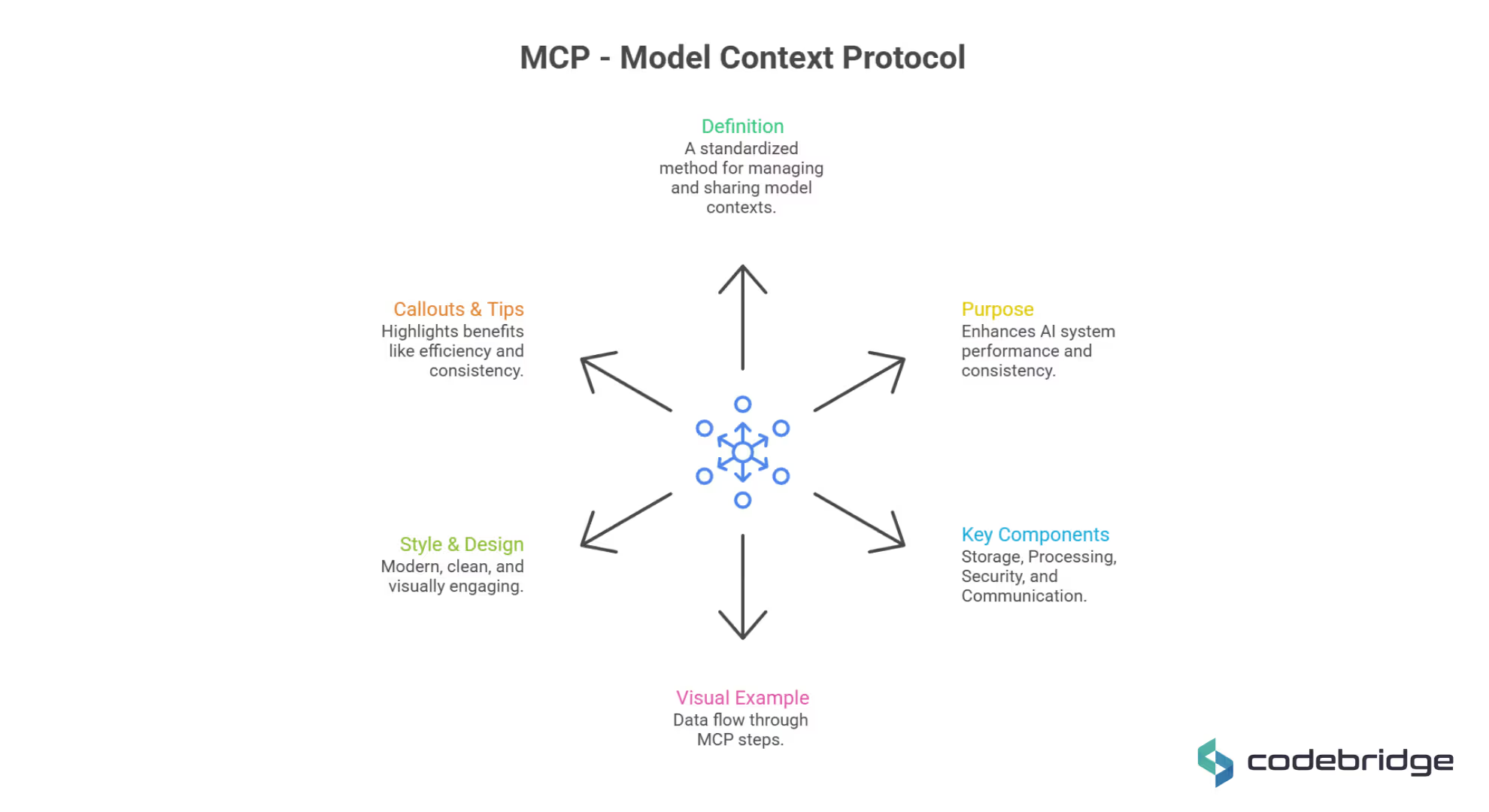
At Codebridge, this approach is supported through the use of open standards such as the Model Context Protocol (MCP) — an open-source framework introduced by Anthropic that provides a standardized way for AI agents to connect with external tools, databases, and data sources. Rather than building custom integrations for each system, MCP enables agents to access and act upon information across disparate platforms through a unified client-server architecture, correlating data seamlessly without vendor lock-in. By establishing a common protocol across different systems, MCP eliminates fragmented integrations and allows agents to retrieve real-time information, execute workflows, and maintain secure interactions with external sources.
A Pragmatic Approach to Agentic AI Integration (Codebridge’s Perspective)
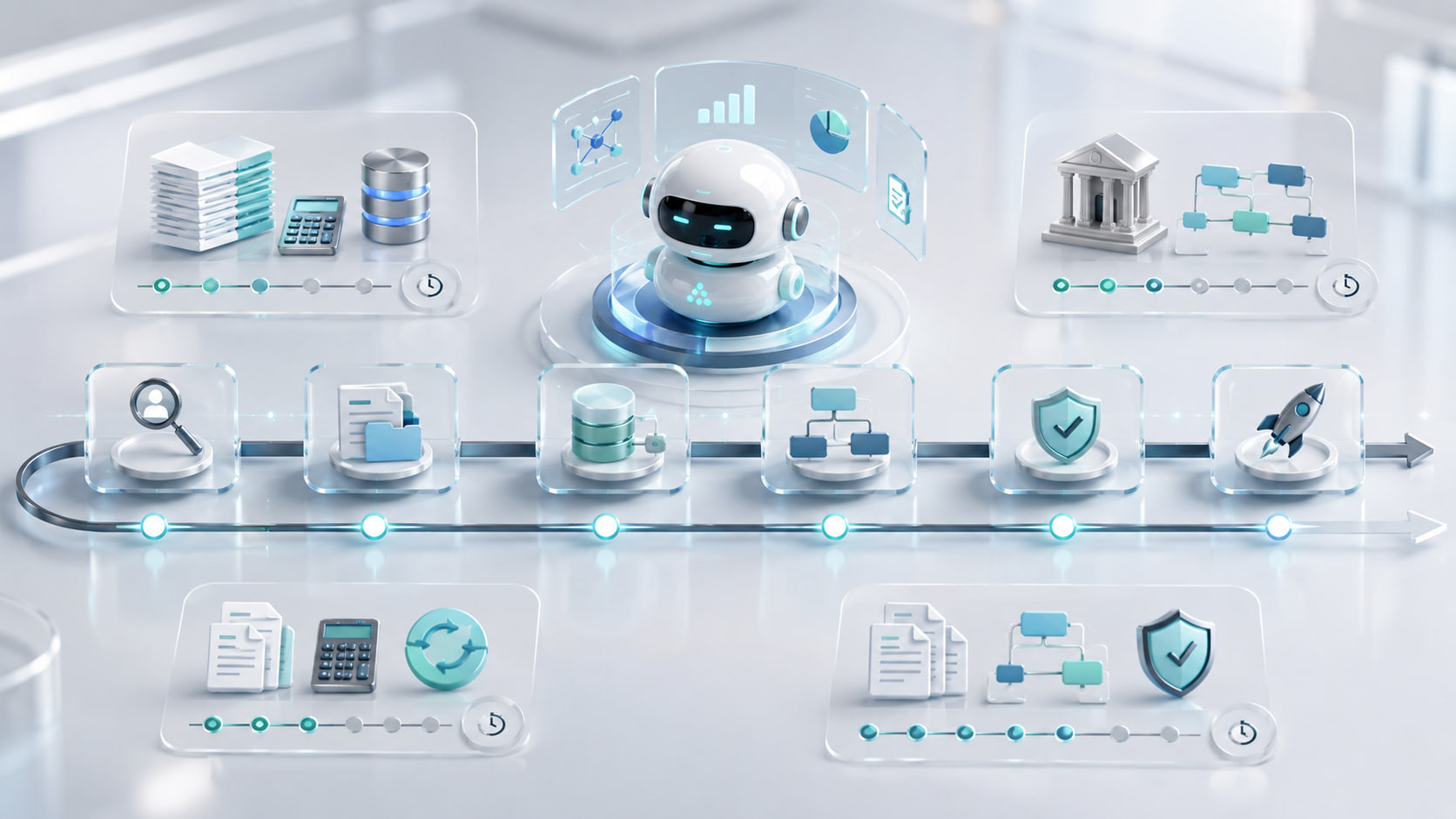
To avoid hype-driven failures, Codebridge recommends a phased transformation approach:
Overlay (Days 0–30)
Augment existing workflows with agents for repetitive, single-step tasks to generate early operational value.
As-a-Service (Days 30–90)
Leverage embedded agentic capabilities within established SaaS platforms, such as Salesforce Agentforce.
By-Design (12+ Months)
Re-architect core processes from the ground up as networks of collaborating agents, with human-in-the-loop oversight reserved for exceptions.
Executive Takeaways: What Breaks First in Your Platform?
- Workflows Over Bots
Redesign entire workflows, not isolated tasks, to achieve meaningful impact. - Invest in Evaluations
Onboarding an agent resembles hiring an employee. Agents require defined roles, training frameworks, and continuous performance feedback. - Standardize Early
Adopting open standards such as MCP helps prevent data silos and enables scalable interoperability. - Redefine Success Metrics
Move beyond traditional productivity measures toward metrics that capture total Return-on-Autonomy (RoA), including unit cost per transaction and first-pass yield.
Conclusion
The transition to the Agentic Enterprise is more than a technical upgrade; it is a fundamental shift in the value proposition of software. For the last two decades, SaaS has been a tool for human efficiency. In 2026 and beyond, SaaS must become an environment for autonomous execution.
The window for "experimental" AI is closing. Organizations that fail to re-architect their core processes around agentic collaboration will find themselves maintaining digital relics - platforms that require too much human effort to remain competitive. At Codebridge, we believe the path forward isn’t found in adding more features, but in building systems that can think, act, and scale independently.
The question for leadership is no longer if agents will run your enterprise, but whether your current architecture is robust enough to let them.











Heading 1
Heading 2
Heading 3
Heading 4
Heading 5
Heading 6
Lorem ipsum dolor sit amet, consectetur adipiscing elit, sed do eiusmod tempor incididunt ut labore et dolore magna aliqua. Ut enim ad minim veniam, quis nostrud exercitation ullamco laboris nisi ut aliquip ex ea commodo consequat. Duis aute irure dolor in reprehenderit in voluptate velit esse cillum dolore eu fugiat nulla pariatur.
Block quote
Ordered list
- Item 1
- Item 2
- Item 3
Unordered list
- Item A
- Item B
- Item C
Bold text
Emphasis
Superscript
Subscript