Most language models are stateless. Each request stands alone: the model reads the prompt in front of it, produces a response, and retains nothing once the exchange ends. A user who explained their preferences yesterday explains them again today. An agent working through a multi-step task begins each session with no record of the last one.
AI memory addresses this limitation. It gives an agent a way to store information from earlier interactions and retrieve it when a later one calls for it. This guide defines AI memory, separates it from the two concepts it is most often confused with (the context window and RAG), describes the types of memory an agent can hold, and explains where the value and the risks lie. It assumes no prior background.
What is AI Memory?
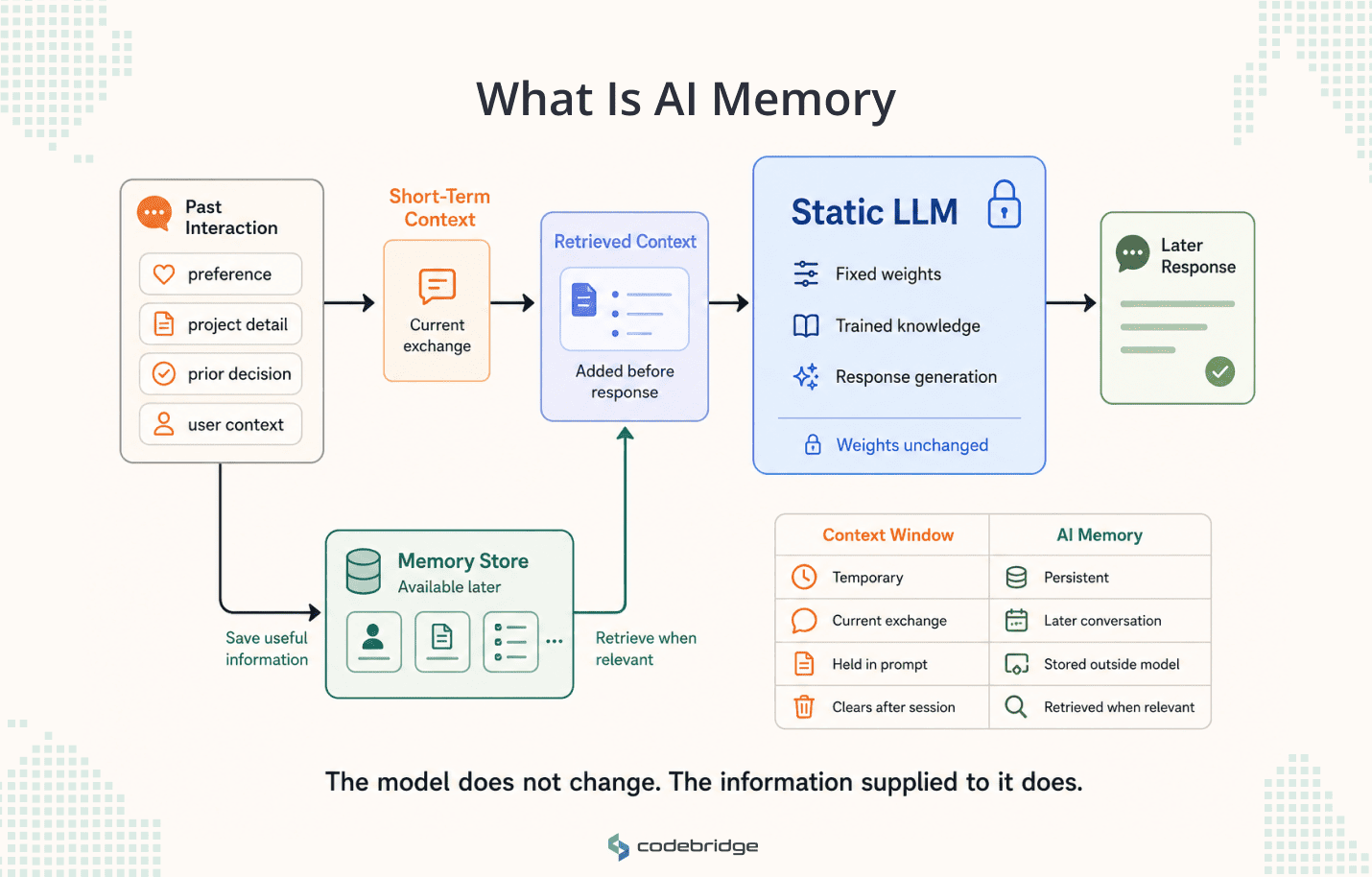
AI memory is an agent's capacity to store information from past interactions and return it to a later conversation when relevant. The distinguishing word is later. Information the model holds during a single exchange is ordinary short-term context. Memory is what remains available after that exchange closes.
One point of confusion deserves early attention. A large language model does not change when it remembers a user. Its knowledge is fixed during training, encoded in the billions of parameters known as weights, and those weights do not update in response to a conversation. An agent with memory writes the relevant details to a separate store, a database or a set of files that sits outside the model, and reads them back when the user returns.
Memory is therefore a layer added on top of a static model. The model generates each response through the same process it always uses. What changes is the information supplied to it before generation begins. This distinction underlies most of what follows.
AI Memory vs Context Window
The context window is the concept most often mistaken for memory. Both supply information the model uses, which accounts for the confusion, but they operate differently.
The context window is the model's working space for a single request. It contains the current prompt, the conversation up to that point, any documents provided, and the response under construction. It functions as short-term attention. When the session ends, the space clears and nothing persists on its own.
Persistent memory sits outside the window. At the start of a new session, an agent consults its memory store, selects what is relevant, and places it into the fresh context window before the model reads anything. The window remains temporary. Memory is the mechanism that refills it.
A frequent assumption holds that a sufficiently large context window removes the need for memory, on the reasoning that everything can be included in the prompt. As of early 2026, context windows range from roughly 200,000 tokens on some models to about one million on many current ones, with a small number of research models reaching considerably higher. Two limitations persist regardless. Re-sending months of history with every request raises cost and latency, because the full history travels each time. And models retrieve information less reliably when it sits in the middle of a long window, an effect documented in research under the name "lost in the middle." A larger window reduces the pressure on memory. It does not remove the need for it.
The types of AI memory
Human memory provides a useful reference, since AI memory adapts its categories from cognitive science. A person holds a phone number in mind long enough to dial it, then lets it go. That same person recalls a first day at a job years later, knows that Paris is the capital of France without recalling when they learned it, and rides a bicycle without attending to balance. These are four distinct forms of memory, and AI agents implement counterparts to each.
The reference many practitioners cite is the CoALA framework, published by researchers at Princeton in 2023, which formalized four memory types for language-model agents. The mapping to human memory is direct.
Short-term memory is the context window described above. The remaining three are forms of long-term memory that outlast a single session. Episodic memory records an agent's history with a specific user. Semantic memory holds the facts and domain knowledge it draws on. Procedural memory allows it to repeat a multi-step task without reasoning through each step again.
The types reinforce one another. Across many interactions, an agent can identify a pattern spanning numerous episodic records, such as a customer who consistently asks about shipping to Germany, and consolidate it into a general fact stored as semantic knowledge. This consolidation is how a memory system improves in usefulness over time without any retraining of the model.
Few agents require all four types. A support agent depends on episodic memory to track ticket history. A product assistant depends on semantic memory for specifications. A coding assistant depends on procedural memory for routines it has learned. Sound design matches memory to the task rather than adopting every type by default.
How AI memory works
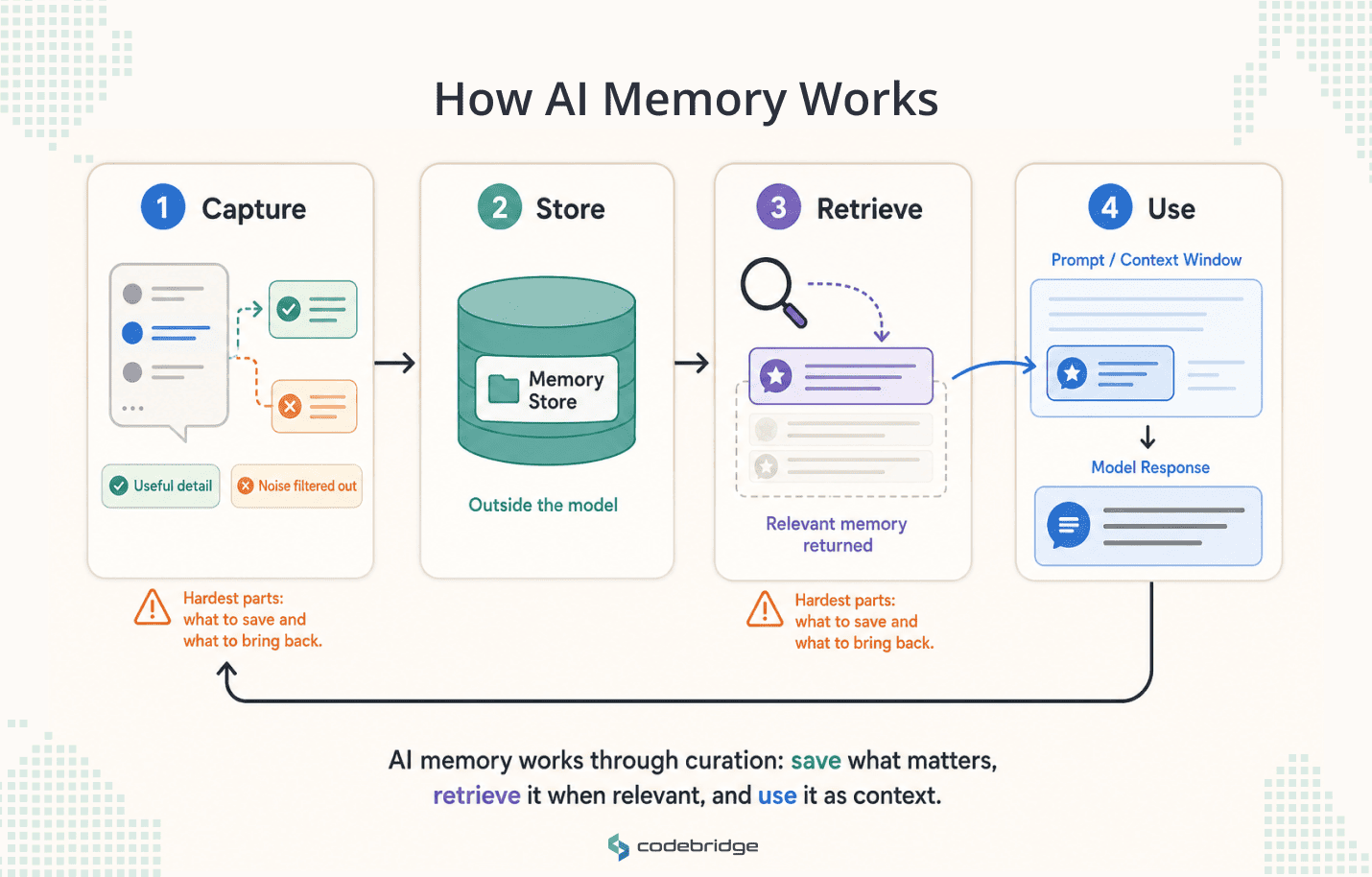
A memory system operates as a four-step loop. The difficulty concentrates in two of the steps.
- Capture. During or after a conversation, the agent determines what merits retention. A passing remark about the weather is noise; a stated dietary restriction is signal. This judgment accounts for much of the engineering effort, since indiscriminate saving fills the store with low-value entries.
- Store. The agent writes the retained information to durable storage. Anthropic's developer memory tool, released in September 2025, holds memories as files the agent can create, read, update, and delete. Other systems write to a database. In each case the store sits outside the model.
- Retrieve. When a session opens or a new question arrives, the agent searches the store for entries relevant to the moment and returns them. Retrieving the wrong entries causes as much harm as failing to save the right ones.
- Use. The retrieved memories enter the context window alongside the new prompt, and the model generates its response with that history available.
Two products show how differently teams handle capture and retrieval. OpenAI's ChatGPT divides memory into two systems: saved memories, which are facts a user explicitly asks it to retain, and referenced chat history, which draws on past conversations automatically without a prompt. The first is precise and straightforward to audit. The second is convenient and at times unpredictable, since the criteria for what it retains are not fully visible to the user. Anthropic's file-based approach keeps memories as readable files a developer can inspect, export, and roll back. Both address the same problem while trading control against convenience in opposite directions.
The governing principle is curation. Recording every message is simple and yields little value. A memory system earns its place by determining what matters and presenting it at the appropriate moment.
AI Memory vs RAG
RAG, or retrieval-augmented generation, is the second concept commonly confused with memory. The overlap has a basis, since both retrieve information and add it to the prompt. Their purposes differ.
RAG answers a question by fetching relevant passages from a knowledge base, such as a document set, a wiki, or a product catalog, and providing them to the model so its response rests on grounded facts. The knowledge base is typically shared and largely static. RAG responds to the subject of the question rather than the identity of the person asking.
Memory accumulates information about a particular user or an ongoing task, and it grows with each interaction. RAG draws on a body of external knowledge; memory draws on a history.
The two frequently operate together. An agent may use RAG to retrieve the correct return policy from company documentation while using memory to recall that a specific customer has returned three items this month. The retrieval mechanics resemble each other; the purposes remain separate.
What Powers Long-Term Memory
The store behind a memory system can take several forms, and the choice shapes what an agent recalls well. This section remains at the conceptual level; the engineering trade-offs belong in a dedicated article.
- Vector databases store text as numerical embeddings and retrieve by meaning rather than exact wording. A query about footwear can surface a stored memory about running shoes. This approach suits episodic and semantic memory.
- Knowledge graphs store entities and the relationships among them. They perform well when the connections carry the meaning, such as which individuals belong to which organizations and who reports to whom.
- Managed memory layers and frameworks package capture, storage, and retrieval into a service, which spares teams from building the infrastructure themselves.
Why Memory Matters for AI Agents
Memory justifies its added complexity in three respects.
The first is personalization. An agent that retains a user's preferences stops requesting them repeatedly. Anthropic describes a shopping assistant that recalls a returning customer's material restrictions and budget, then recommends within those constraints without a reminder. The effect is modest in isolation and substantial in aggregate, producing an experience that reads as attentive rather than generic.
The second is continuity across long-running work. An agent operating a task over many sessions can resume from the state the previous session recorded rather than reconstructing its context each time. A coding agent can continue a project from a recorded progress log instead of re-examining the full codebase.
The third is improvement through accumulated experience, where the evidence is quantified. Anthropic reports that Rakuten's long-running agents used memory to learn from each session and avoid repeating earlier mistakes, reducing first-pass errors by 97 percent. Anthropic further reports that Wisedocs incorporated cross-session memory into a document-verification pipeline and accelerated verification by 30 percent.
One qualification applies throughout. The model did not become more capable, and its weights never changed. Memory supplied better context, and better context produced better output. Stating this plainly guards against overstating what memory delivers.
Where AI memory breaks
Memory introduces failure modes absent from a stateless system. Identifying them separates a dependable deployment from one that behaves unpredictably in production.
- Stale memory. The agent retains a fact that has ceased to be true. A customer changed address six months ago, and the agent continues to ship to the previous one. Expiration policies and precedence for newer information address this.
- Memory drift and context pollution. Irrelevant saved details accumulate and degrade response quality. Deliberate curation and a defined forgetting strategy keep the useful entries and discard the rest.
- False recall. The agent states a memory it never stored, combining genuine entries with fabricated ones. Auditability limits the risk: a record of exactly what was saved, and when, allows fabrications to be caught.
- Memory poisoning. An attacker introduces instructions or false facts through a manipulated input, and the agent stores them as legitimate. Scoped permissions, input validation, and audit logs contain the exposure.
Anthropic's enterprise memory offering applies several of these mitigations directly, including scoped permissions, audit logs that record which session produced each memory, and the ability to roll back or redact history. These controls exist because the failure modes are practical concerns rather than hypothetical ones.
Privacy and trust
Memory entails storing data about people, which raises questions a single-session system never confronts. How long is a memory retained? Who can access it? Did the user consent to its storage? Both major providers offer controls to view, delete, and disable memory, along with a session mode that stores nothing. In any regulated environment, these controls and the retention rules behind them warrant careful review before deployment.
The road ahead
Two developments merit attention. The first is memory consolidation performed between sessions rather than within them, where an agent reviews recent work on a schedule, extracts what generalizes, and reorganizes its store before the next conversation. The second is a shift in how teams evaluate systems. A capable model paired with a well-maintained memory frequently outperforms a stronger model with no memory on specialized, long-running tasks. As agents move from answering isolated questions toward carrying out work over extended periods, the quality of the memory system approaches the quality of the model in importance.
Conclusion
AI memory is a store positioned alongside a static model that supplies the appropriate history at the appropriate moment. It does not constitute a more capable model, and treating it as one leads to inflated expectations. With the core concept in place, the surrounding topics, including memory types, RAG, architectures, and privacy, resolve into a set of design decisions that can be reasoned about directly.
If you are evaluating whether to add memory to an agent, or how to implement it without the failure modes described above, our team can help you scope the work.








Heading 1
Heading 2
Heading 3
Heading 4
Heading 5
Heading 6
Lorem ipsum dolor sit amet, consectetur adipiscing elit, sed do eiusmod tempor incididunt ut labore et dolore magna aliqua. Ut enim ad minim veniam, quis nostrud exercitation ullamco laboris nisi ut aliquip ex ea commodo consequat. Duis aute irure dolor in reprehenderit in voluptate velit esse cillum dolore eu fugiat nulla pariatur.
Block quote
Ordered list
- Item 1
- Item 2
- Item 3
Unordered list
- Item A
- Item B
- Item C
Bold text
Emphasis
Superscript
Subscript