A staff engineer at a 1,000-person fintech recently described the impossible math his leadership handed down: deliver exponentially more output without proportional headcount growth. His team's response? Scrambling to integrate AI tools while simultaneously coaching senior engineers on soft skills they'd never needed before. The productivity expectations had changed, but the hiring playbook hadn't caught up.
If you're a CTO or COO trying to scale your engineering organization in 2026, you've likely felt this tension firsthand. The senior engineers you desperately need are harder to find, more expensive to hire, and expect different things from their roles than they did even two years ago. Meanwhile, your board wants to know why you can't just "hire faster."
Here's the uncomfortable truth: the senior engineering talent market has undergone a structural transformation that most hiring strategies haven't adapted to. And the companies winning this war are playing by entirely different rules.
KEY TAKEAWAYS
Over 50% of engineering roles are now senior-level or above, shifting the talent pool dynamics.
Big Tech has created a closed-loop hiring system that prioritizes candidates from similar-scale companies, limiting your access to proven talent.
Interview processes have expanded 42% while time-to-hire has increased 24%, creating a lose-lose scenario for both sides.
Language-specific hiring is becoming obsolete,system design and architecture skills now matter more than stack expertise.
The junior-to-senior pipeline is breaking, creating a talent crisis that will compound over the next decade.
The Market Shift Nobody Prepared For
The conventional wisdom held that senior engineering roles were rare,that most job postings targeted mid-level or junior developers who could be molded into senior contributors over time. That assumption is now dangerously outdated.
According to Underdog.io's 2025 market analysis, more than half of all open software engineering positions now target senior-level or above. This isn't a temporary spike,it's a structural realignment of how companies build engineering teams.
The implications are stark. If you're competing for senior talent, you're not fishing in a small pond of specialized roles. You're competing against virtually every other scaling company in the market, all chasing the same limited pool of experienced engineers.
Meanwhile, the traditional talent pipeline has nearly collapsed. MEV's August 2025 report found that new graduates represent only 7% of Big Tech hires,down 25% from 2023. Companies have collectively decided that the cost of developing junior talent outweighs the benefits, creating a market where everyone wants seniors but nobody wants to create them.
An industry observer on Dev.to posed the question that should keep every CTO awake at night: "Ten years from now, who will be the senior developers reviewing AI code if nobody got hired as a junior in 2025?"
The Closed-Loop Trap
If you've tried hiring senior engineers from Big Tech recently, you've likely noticed something frustrating: they're not leaving. And when they do, they're going to other Big Tech companies.
This isn't coincidental. Post-2023 layoffs, major technology companies developed what the Pragmatic Engineer newsletter calls a "closed-loop talent market." Google, Amazon, and Microsoft now heavily prefer candidates from similar-scale firms, reasoning that only engineers who've operated at that level can handle their scaling challenges.
The diagram below illustrates how this closed-loop system affects talent flow across the market:
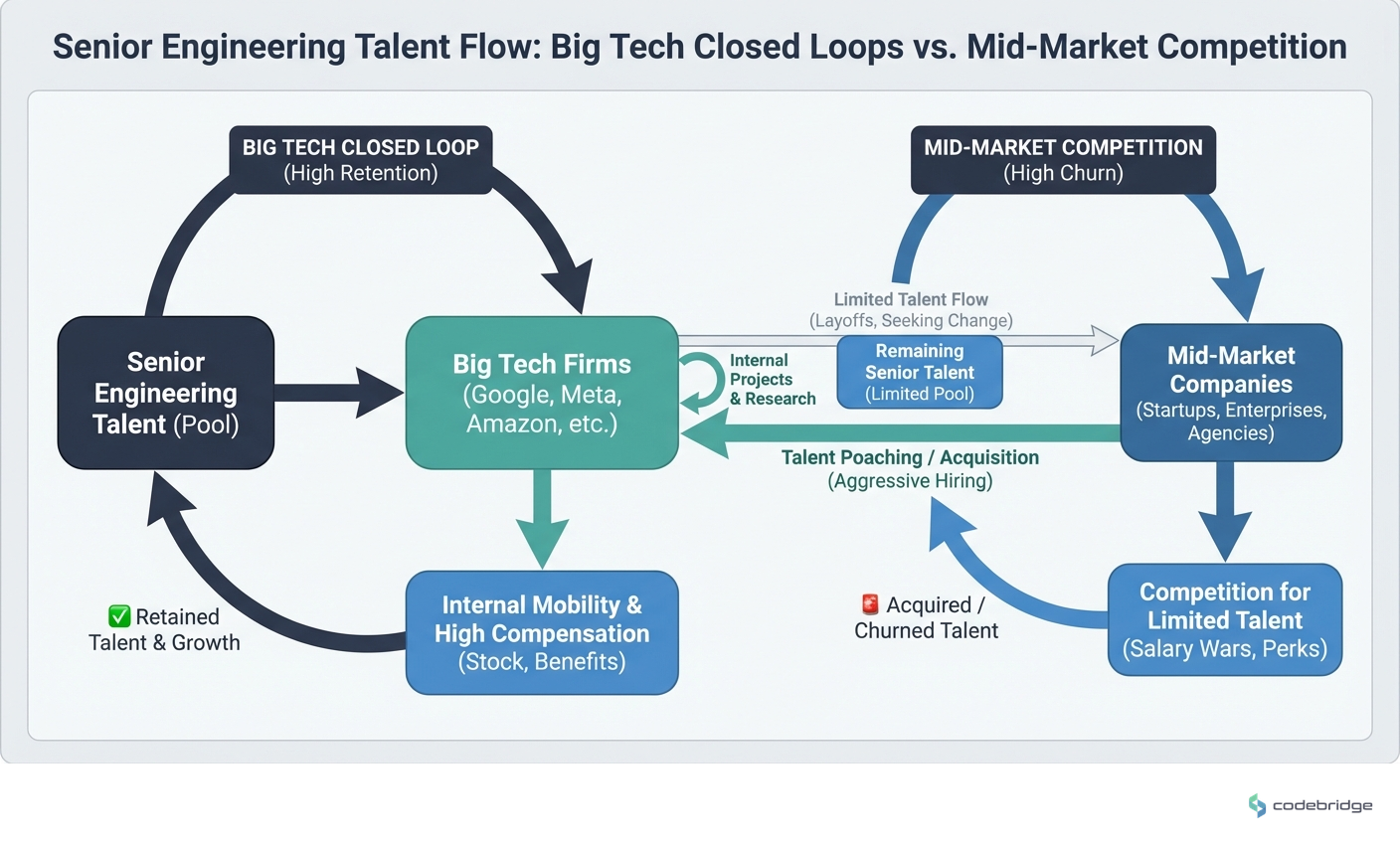
This creates a two-tier market. Tier 1 companies trade talent among themselves. Everyone else competes for the engineers who either couldn't get into Big Tech or chose not to pursue it. Neither group is inherently better or worse,but the dynamics are completely different.
A staff engineer with 12 years of experience recently described his job search after leaving a FAANG company in mid-2023. Despite his credentials, he took nearly a 50% pay cut to land at a Tier 2 company. The interview processes had become brutal: all-day take-homes, multiple rounds of LeetCode hard problems, and ATS systems that required him to run his resume through an LLM just to get callbacks.
"I used to get contacted by 15 recruiters a week," and now I have to hand over my resume to an LLM just so that it's tailored to the job.
Staff engineer with 12 YoE, Reddit r/ExperiencedDevs
The irony is painful: companies claim they can't find senior talent while simultaneously creating interview processes so demanding that qualified candidates either fail or opt out entirely.
What's Actually Changed About Senior Engineering Work
The skills that defined a senior engineer in 2023 are not the skills that define one in 2026. AI tools have altered the value equation, and the companies successfully scaling their engineering organizations have recognized this shift.
A recruiting professional planning to hire 50-100 senior engineers described the new reality: instead of spending hours writing thousands of lines of code or searching Stack Overflow for syntax, engineers can now use AI tools to handle what they called "the boring stuff." The implication for hiring is significant.
When scaling senior engineering teams, prioritize system design, architecture, DevOps, cloud, and observability skills over language-specific expertise. The ability to write Python is less valuable than the ability to design systems that scale.
This shift has made traditional hiring filters obsolete. A mid-senior full-stack engineer observed that FAANG companies have moved from generic LeetCode loops to team-specific matching. Google now does team matching before the final round. Facebook has role-specific interview loops. If a hiring manager is looking for SRE experience but your background is React.js, you probably won't get a callback,regardless of your overall seniority.
"'Python dev' 'React dev' etc is already boomer talk." Nobody would be hiring for languages anymore.
Developer discussing 2026 market, Reddit r/cursor
The comparison below shows how senior engineer evaluation criteria have shifted:
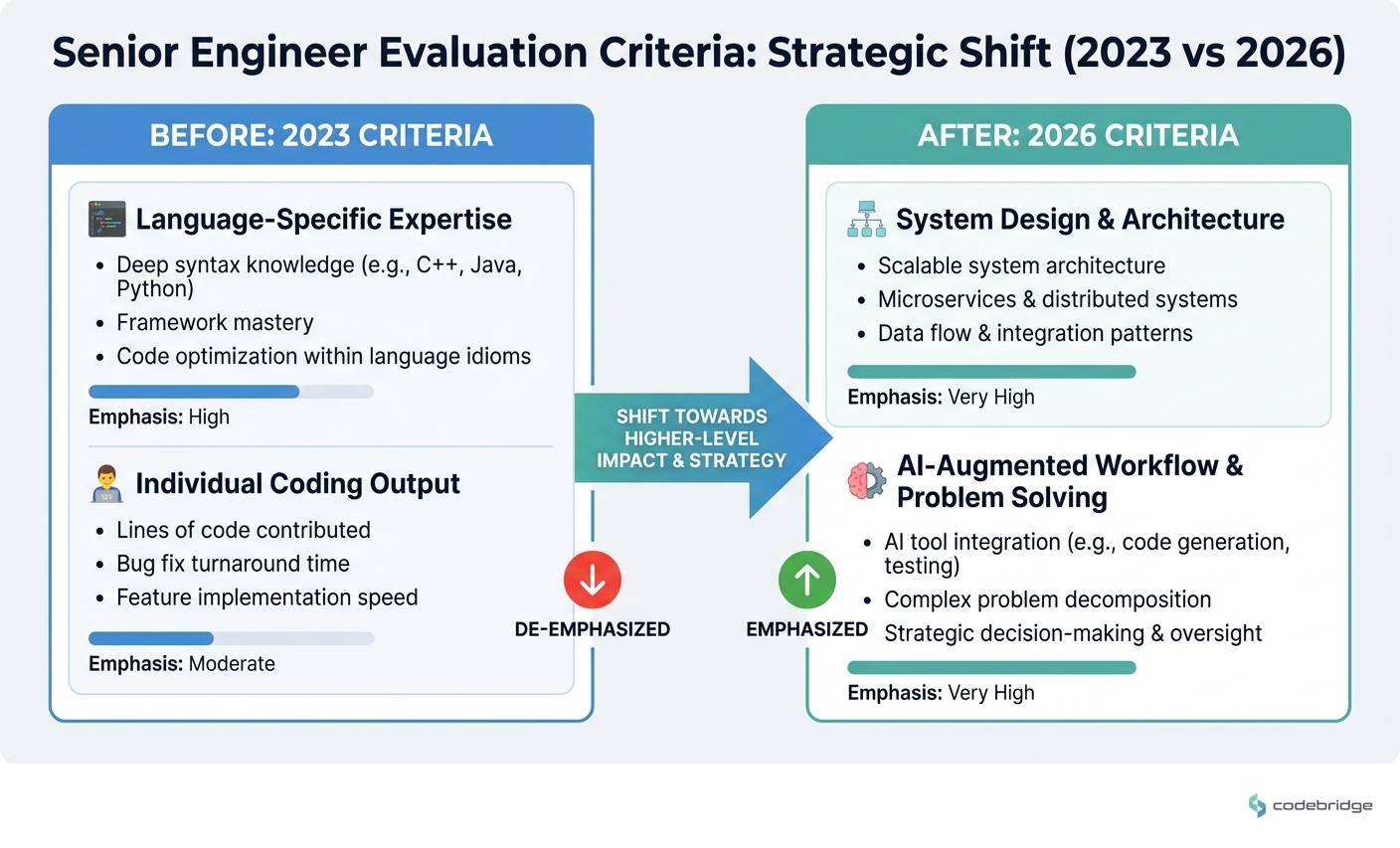
This doesn't mean technical skills don't matter. It means the type of technical skills that matter has changed. The engineers who thrive in 2026 are those who can architect solutions across stacks, not those who've memorized the syntax of a single language.
The Apple Exception (And What It Teaches Us)
While most Big Tech companies conducted mass layoffs in 2022-2023, Apple took a different path. According to Pragmatic Engineer's analysis, Apple's engineering headcount has grown 13% since 2022,making it the only major technology company to avoid significant workforce reductions.
More Apple expanded or maintained director-level positions while competitors cut them. This created exceptional leadership stability that directly supports their technical scaling initiatives.
| Company | Engineering Growth (2022-2025) | Director-Level Trend | Scaling Outcome |
|---|---|---|---|
| Apple | +13% | Expanded/Maintained | Stable leadership, consistent scaling |
| +16% | Reduced post-layoffs | Accelerated hiring but leadership gaps | |
| Industry Average | Flat to declining | reduced | Scaling challenges persist |
The lesson isn't that you need Apple's resources. It's that workforce stability and leadership continuity create compounding advantages in the talent market. Engineers talk to each other. Companies known for layoffs struggle to attract top talent even when they're actively hiring. Companies known for stability become talent magnets.
Google's approach offers another data point. After their 2023 layoffs, they accelerated hiring with a focus on senior roles, achieving 16% engineering headcount growth since 2022. But the layoffs created a trust deficit that continues to affect their employer brand.
The Remote Work Paradox
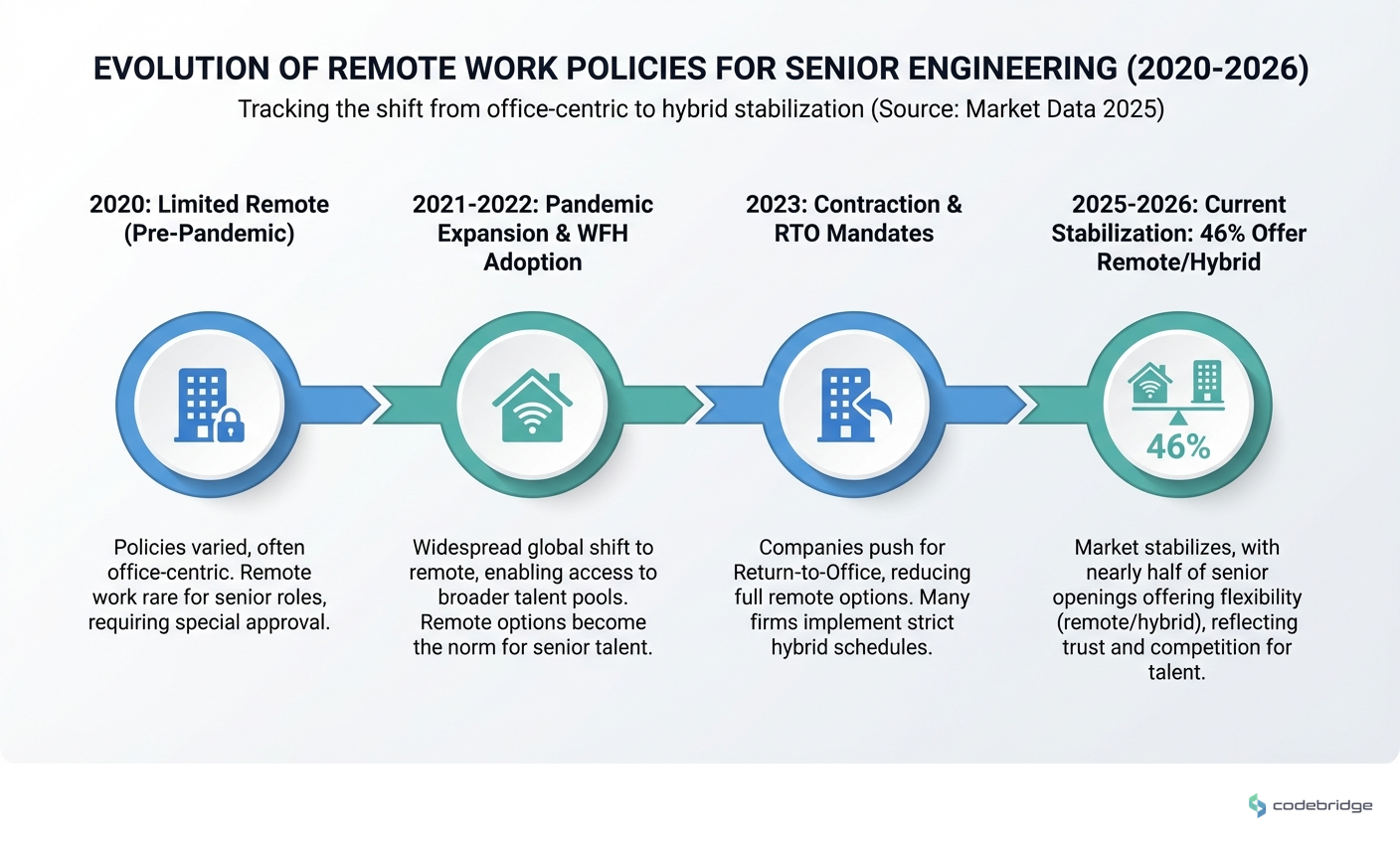
Here's a data point that should inform your hiring strategy: 46% of senior-level engineering openings now offer remote or hybrid work, compared to less than a third for junior roles.
This reflects a trust asymmetry. Companies believe senior engineers can be productive remotely in ways junior engineers cannot. If you're competing for senior talent and requiring full-time office presence, you're voluntarily removing yourself from nearly half the candidate pool.
However, there's a geographic concentration trend working against remote-first strategies for certain roles. According to Pragmatic Engineer, the majority of AI engineering jobs remain clustered in the SF Bay Area. If you're hiring for AI-adjacent senior roles, remote-first may actually be a disadvantage,the talent you want is already concentrated in a specific location and expects premium compensation.
The timeline below shows how remote work policies have evolved for senior engineering roles:
A Framework for Hiring Senior Engineers in 2026
Based on the market data and real experiences from engineering leaders, here's what's actually working:
1. Communicate Problems, Not Solutions
A senior Amazon engineer who led teams from 1997-2007 described a pattern he saw repeatedly: teams got stuck when leaders proposed specific solutions rather than communicating the large-scale business problem. The problem was "How do we handle scale?",not "How do we build a bigger faster database."
When recruiting senior engineers, lead with the problem space. The best candidates want to architect solutions, not implement someone else's predetermined approach. Your job descriptions and interview conversations should emphasize the challenges, not the tech stack.
2. Redesign Your Interview Process for Speed Without Sacrificing Quality
Research from Gem shows teams now conduct 42% more interviews per hire than in 2021, leading to a 24% increase in time-to-hire. The average time-to-hire in the UK technology industry has reached 4.9 weeks.
This extended process hurts you more than it helps. Senior engineers have options. Every additional interview round increases the chance they'll accept a competing offer. Consider:
- Consolidating interview rounds into single days when possible
- Replacing take-home projects with paid trial days
- Using asynchronous technical assessments that respect candidates' time
- Making decisions within 48 hours of final interviews
3. Hire for System Thinking, Not Language Proficiency
With AI handling much of the code generation, your senior engineers need to excel at what AI cannot: understanding complex systems, making architectural trade-offs, and translating business requirements into technical strategy.
Update your interview rubrics to weight:
- System design discussions over algorithm puzzles
- Architecture decision records from previous roles
- Experience with observability, DevOps, and cloud infrastructure
- Ability to articulate trade-offs across different technical approaches
4. Build Your Own Pipeline (Even If It Hurts Short-Term)
The industry's collective decision to stop hiring juniors will create a senior talent crisis within 5-10 years. Organizations that invest in junior developer programs now,despite the AI efficiency gains that make it seem unnecessary,will have a structural advantage when the pipeline truly dries up.
This doesn't mean hiring juniors at the same rate as 2020. It means maintaining some junior hiring to ensure you're developing the senior engineers you'll need in 2030.
5. Address the AI Productivity Expectation Explicitly
The fintech staff engineer's dilemma,management expecting multiplicative productivity gains without proportional headcount,is now universal. Your senior engineering candidates know this expectation exists. Address it directly in the hiring process.
Be honest about:
- What AI tools your team uses and how they're integrated
- How productivity is actually measured
- What support exists for engineers adapting to AI-augmented workflows
- Whether the productivity expectations are realistic given current tooling
The Path Forward
Remember that staff engineer at the fintech, coaching his team through impossible productivity expectations? His organization eventually found a path forward,not by hiring more senior engineers, but by rethinking what senior engineering work looks like in an AI-augmented environment.
They started alternating architecture and hard skill topics with softer topics in their coaching programs. They redefined productivity metrics to account for AI-assisted output. And they stopped trying to hire senior engineers who fit the 2023 mold, instead looking for candidates who could thrive in the 2026 reality.
The senior engineering talent market in 2026 rewards companies that adapt to its new rules: speed over process, system thinking over language expertise, honesty over hype. The Bureau of Labor Statistics projects 17% growth in software development employment over the next decade, with 140,100 annual job openings. The talent is out there. The question is whether your organization is structured to attract it.
Struggling to scale your engineering team?
Let's discuss how to redesign your hiring process for the 2026 talent market.
Diagnostic Checklist: Is Your Senior Hiring Strategy Broken?
Your time-to-hire for senior roles exceeds the 4.9 week industry average
Your job descriptions emphasize specific programming languages over system design capabilities
You require full-time office presence for senior engineering roles
Your interview process includes more than 5 separate rounds or sessions
You've had senior candidates accept competing offers while waiting for your decision
Your team has zero junior engineers in the development pipeline
You haven't updated your technical interview rubric since before AI coding tools became mainstream
Your productivity expectations for senior hires don't account for AI-augmented workflows
Candidates frequently ask about layoff history or workforce stability during interviews
REFERENCES













Heading 1
Heading 2
Heading 3
Heading 4
Heading 5
Heading 6
Lorem ipsum dolor sit amet, consectetur adipiscing elit, sed do eiusmod tempor incididunt ut labore et dolore magna aliqua. Ut enim ad minim veniam, quis nostrud exercitation ullamco laboris nisi ut aliquip ex ea commodo consequat. Duis aute irure dolor in reprehenderit in voluptate velit esse cillum dolore eu fugiat nulla pariatur.
Block quote
Ordered list
- Item 1
- Item 2
- Item 3
Unordered list
- Item A
- Item B
- Item C
Bold text
Emphasis
Superscript
Subscript