Last year, a marine submersible company made a decision that seemed innovative at the time: bypass traditional classification society oversight for their new composite carbon fiber and titanium pressure vessel design. Instead of going through DNV, ABS, or Lloyd's Register, they relied on a real-time hull integrity monitoring system. The problem? As one engineer later observed, "validation of such a system and proof of its efficacy was likely not based on large enough of a sample size of real-world proof data." The innovative monitoring couldn't replace what century-old validation processes had been designed to catch.
For those of us in marine R&D, this story lands differently. We've all felt the tension between moving fast with new technology and the glacial pace of third-party certification. But the answer isn't to sidestep validation,it's to streamline it without compromising what makes it valuable in the first place.
KEY TAKEAWAYS
Third-party validation isn't optional for marine tech,86% of technology buying decisions now involve 3+ stakeholders who demand independent verification.
Digital validation platforms cut cycle times by 50% without sacrificing rigor, as proven by leading life sciences implementations.
Trust builders outperform by 18 percentage points,companies that invest in validation infrastructure see measurably better outcomes.
Self-service validation leads to regret,buyers are 1.8x more likely to complete high-quality deals when combining digital tools with expert guidance.
The Hidden Cost of Validation Friction
Here's what the data reveals about our industry's validation challenge: 87% of technology buyers now consider independent expert content crucial to their decision-making. That's not a preference,it's a requirement. When you're selling ballast water treatment systems or marine monitoring equipment, your customers aren't just buying from you. They're defending that purchase to engineering leads, compliance officers, fleet managers, and procurement committees.
This creates a paradox for marine technology developers. We need third-party validation to close deals, but traditional validation processes weren't designed for the pace of modern product development. Classification society reviews, type approvals, and certification audits operate on timelines measured in months or quarters,not the weeks our product roadmaps demand.
The temptation is to treat validation as a checkbox exercise, something to rush through or work around. But the consequences of that approach extend far beyond a single product launch.
What Happens When Validation Fails
Consider what happened during a major Azure cloud infrastructure outage that affected marine operations globally. The root cause? An erroneous deployment that bypassed safety validations due to a software defect. The post-mortem insight was sobering: "It's never good enough to have a validator check the content and hope that finds all the issues... you have to assume the validator will be wrong, and be prepared to contain the damage WHEN it is wrong."
This principle applies directly to marine technology validation. Validators,whether human reviewers at classification societies or automated compliance checks,are independent code paths that will always miss something. The question isn't whether your validation process will have gaps. It's whether you've designed your systems to contain damage when those gaps appear.
The comparison below illustrates how different validation approaches handle inevitable failures:
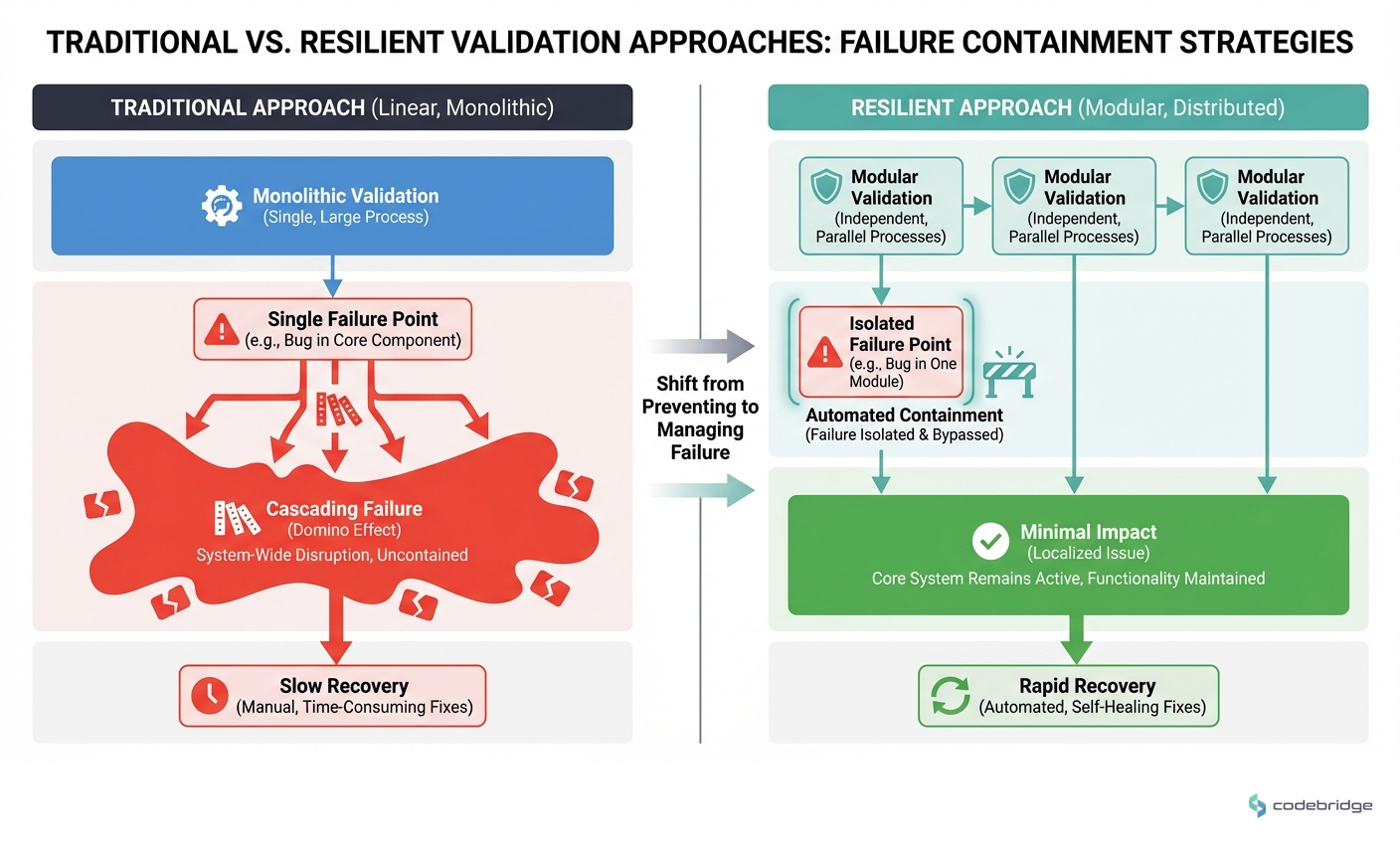
Traditional validation treats certification as a one-time gate. Resilient validation builds in continuous monitoring, staged rollouts, and rapid rollback capabilities. The difference isn't just philosophical,it's operational.
The Pattern: What Trust Builders Do Differently
Deloitte's research identifies a distinct cohort they call "trust builders",companies that achieve measurably better outcomes from new technology adoption. In the technology sector, 40% of companies fall into this category, compared to just 27% in non-tech industries.
What separates trust builders from the rest? They emphasize data governance, security protocols, reduced system hallucinations, and employee transparency,all elements that directly support third-party validation requirements. The payoff is significant: trust builders are 18 percentage points more likely to rank in the top third for technology benefits, including productivity and revenue gains.
"Blockchain doesn't replace verification standards,it makes them auditable." Off-chain verification establishes environmental legitimacy; on-chain tokenization adds transparency.
Developer discussion, Dev.to community
This insight from a blue carbon tokenization project in Indonesia captures the trust builder mindset perfectly. They weren't trying to eliminate third-party validation through technology,they were making it more efficient and auditable. Their approach coordinated marine environment monitoring (satellite imagery, underwater sensors, marine biologist assessments) with established verification registries like Verra and Gold Standard before adding blockchain transparency.
The lesson for marine technology: third-party verification through established methodologies must precede any technology layer. Innovation adds auditability but cannot substitute domain-specific validation.
The Counterintuitive Truth About Self-Service
Here's where many marine technology companies get it wrong. The assumption is that buyers want frictionless, rep-free digital experiences for evaluating new systems. The data tells a different story.
Self-service purchases lead to more purchase regret. Buyers are 1.8x more likely to complete high-quality deals when combining sales expertise with digital tools.
This finding from Foundry's research challenges the "automate everything" mentality. For complex marine systems,ballast water treatment, emissions monitoring, navigation equipment,buyers don't just want documentation and spec sheets. 46% of IT decision-makers explicitly say they need vendor assistance in evaluating products and services.
The implication for validation strategy: don't just provide certification documents and expect buyers to self-serve through the evaluation process. Build guided validation pathways that combine digital accessibility with expert support.
A Framework for Streamlined Marine Validation
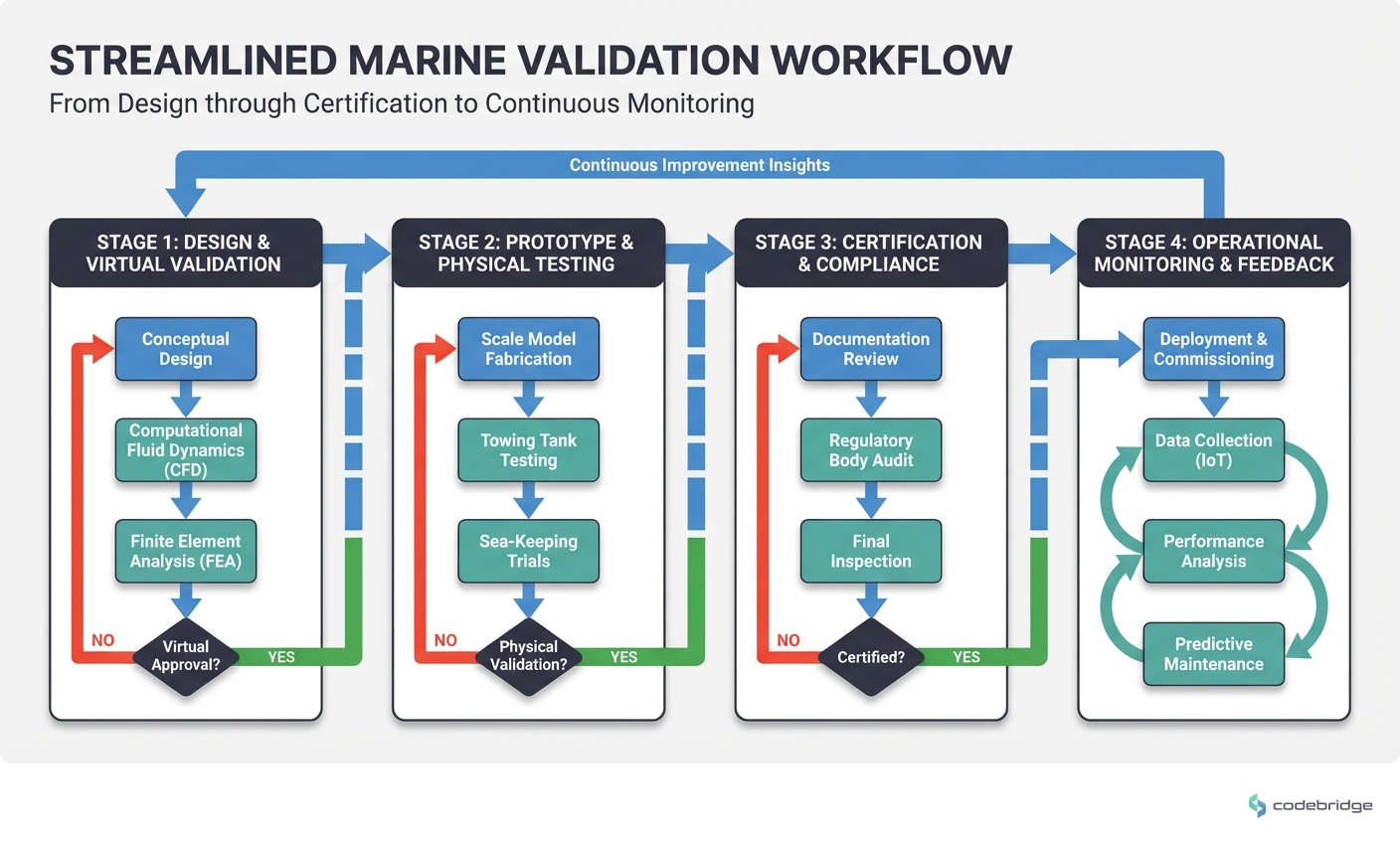
Based on what trust builders do differently and the patterns emerging from successful implementations, here's a practical framework for streamlining third-party validation without compromising rigor.
The following process flow shows how these elements connect in practice:
1. Front-Load Classification Society Engagement
Don't wait until you have a finished design to engage DNV, ABS, or Lloyd's Register. Modern classification societies offer early-stage design review services that can identify certification blockers before you've committed to an architecture. This is especially critical for novel materials or monitoring approaches where existing type approval frameworks may not directly apply.
2. Build Validation Documentation Into Development
The companies achieving 50% reductions in validation cycle times aren't doing it through shortcuts. They're using digital validation platforms with online test execution and remote approval workflows. When Kneat Solutions' customers (including 8 of the 10 largest life sciences technology firms) implemented this approach, they didn't sacrifice rigor,they eliminated the administrative overhead that made validation slow.
For marine applications, this means treating certification documentation as a continuous output of development, not a post-hoc exercise.
3. Design for Validation Failure Containment
The Google Chromecast certificate expiration debacle offers a cautionary tale. Original device authenticator code from 2013 didn't check certificate expiration dates, but a 2016 code change replaced custom code with standard libraries that did check expiration. No one noticed the incompatibility until devices started failing a decade later.
As one engineer involved noted: "Replacing a key, especially one on a read-only factory partition, carries lots of risk. Code like that takes a long time to test and validate."
For marine systems with 20-30 year operational lifespans, this lesson is critical. Plan for the entire device lifecycle including certificate renewal. Read-only factory partitions make field updates extremely complex and require multi-team coordination across weeks of testing.
4. Layer Technology on Top of Established Methodologies
AI-assisted validation is accelerating rapidly,over 50% of technology companies now use or trial AI for risk and compliance functions, up from 30% in 2023. But the successful implementations follow a consistent pattern: they use AI to accelerate existing validation workflows, not replace them.
This means AI can help with document review, test case generation, and compliance gap analysis. It cannot substitute for classification society expertise in novel marine applications.
5. Create Validation Artifacts That Serve Multiple Stakeholders
Remember that 86% of technology buying decisions involve 3+ stakeholders. Your validation documentation needs to serve the technical reviewer who wants test data, the compliance officer who needs regulatory mapping, and the procurement lead who needs vendor qualification evidence.
The quadrant below maps how different validation artifacts serve different stakeholder needs:
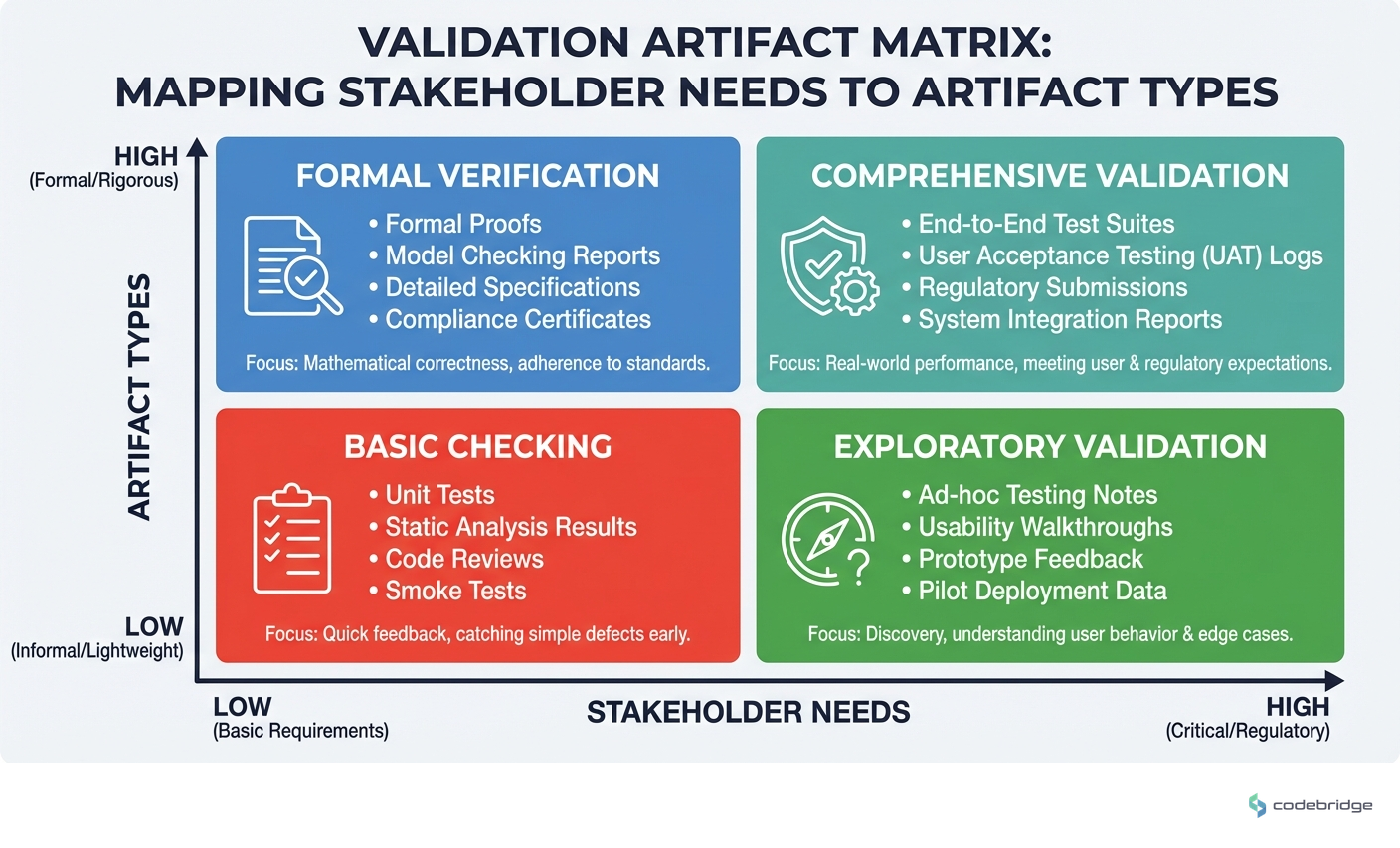
Single-purpose certification documents that only satisfy one audience create rework and delay. Design your validation outputs to be modular and reusable across stakeholder contexts.
The 2026 Validation Landscape
Three trends are reshaping how marine technology validation will work over the next 12-18 months:
AI-Assisted Compliance Acceleration: With 36% of generative AI cybersecurity initiatives now fully integrated at leading technology firms, expect classification societies to begin accepting AI-generated compliance documentation with appropriate human oversight. Early movers who establish AI-assisted validation workflows now will have significant cycle time advantages.
Digital Identity Verification for Marine Assets: Post-2025 forecasts show rapid growth in digital identity applications for asset verification. For marine equipment, this means moving toward continuous authentication rather than point-in-time certification,a shift that will require new validation frameworks.
Autonomous Validation Agents: Technology firms are exploring autonomous AI agents for validation at nearly twice the rate of non-tech companies (44% vs. 23%). For marine R&D, this suggests a future where routine validation checks are handled by AI agents, freeing human experts for novel certification challenges.
Closing the Loop
That submersible company's decision to bypass classification society oversight wasn't irrational. They were responding to real pressure: the tension between innovation speed and validation timelines that every marine technology developer faces. But the solution isn't to work around third-party validation,it's to work through it more efficiently.
The trust builders in our industry have figured this out. They're not spending less time on validation; they're spending that time more effectively. Digital platforms, front-loaded engagement, failure-tolerant design, and multi-stakeholder documentation aren't shortcuts. They're the infrastructure that makes rigorous validation sustainable at modern development speeds.
For safety-critical marine systems, third-party validation through established classification societies exists for a reason. The goal isn't to eliminate that validation,it's to make it fast enough that no one is tempted to skip it.
Evaluating your validation workflow?
Download our Marine Validation Efficiency Assessment to identify your biggest cycle time opportunities.
Diagnostic Checklist: Signs Your Validation Process Needs Attention
Your classification society engagement begins after design freeze, not during concept development
Validation documentation is created as a separate workstream from product development
You have no defined process for handling certification blockers discovered late in development
Your certification documents serve only one stakeholder type (technical, compliance, OR procurement)
Embedded systems include certificates or keys without documented renewal procedures for the full asset lifecycle
Your validation process assumes validators will catch all issues, with no failure containment strategy
You've considered bypassing traditional certification for novel monitoring or verification approaches without extensive real-world proof data
REFERENCES










Heading 1
Heading 2
Heading 3
Heading 4
Heading 5
Heading 6
Lorem ipsum dolor sit amet, consectetur adipiscing elit, sed do eiusmod tempor incididunt ut labore et dolore magna aliqua. Ut enim ad minim veniam, quis nostrud exercitation ullamco laboris nisi ut aliquip ex ea commodo consequat. Duis aute irure dolor in reprehenderit in voluptate velit esse cillum dolore eu fugiat nulla pariatur.
Block quote
Ordered list
- Item 1
- Item 2
- Item 3
Unordered list
- Item A
- Item B
- Item C
Bold text
Emphasis
Superscript
Subscript