A senior data engineer with 10 years of experience, Python, SQL, Spark, Airflow, dbt, Databricks, Snowflake on his resume, applied to over 100 companies before getting meaningful responses. His conclusion? "Job descriptions often don't reflect reality." If a candidate with a decade of experience and an enviable tech stack struggles this hard, something is broken in how we hire senior Python talent.
The uncomfortable reality: your hiring process is probably costing you more than the engineers themselves. And in 2026, with 476,000 active tech job openings globally competing for a shrinking pool of specialized talent, cost-effective hiring isn't about finding cheaper candidates. It's about not burning money on broken processes.
KEY TAKEAWAYS
The talent shortage is real but misunderstood, there's a surplus of generalists but a critical shortage of specialized Python/AI engineers.
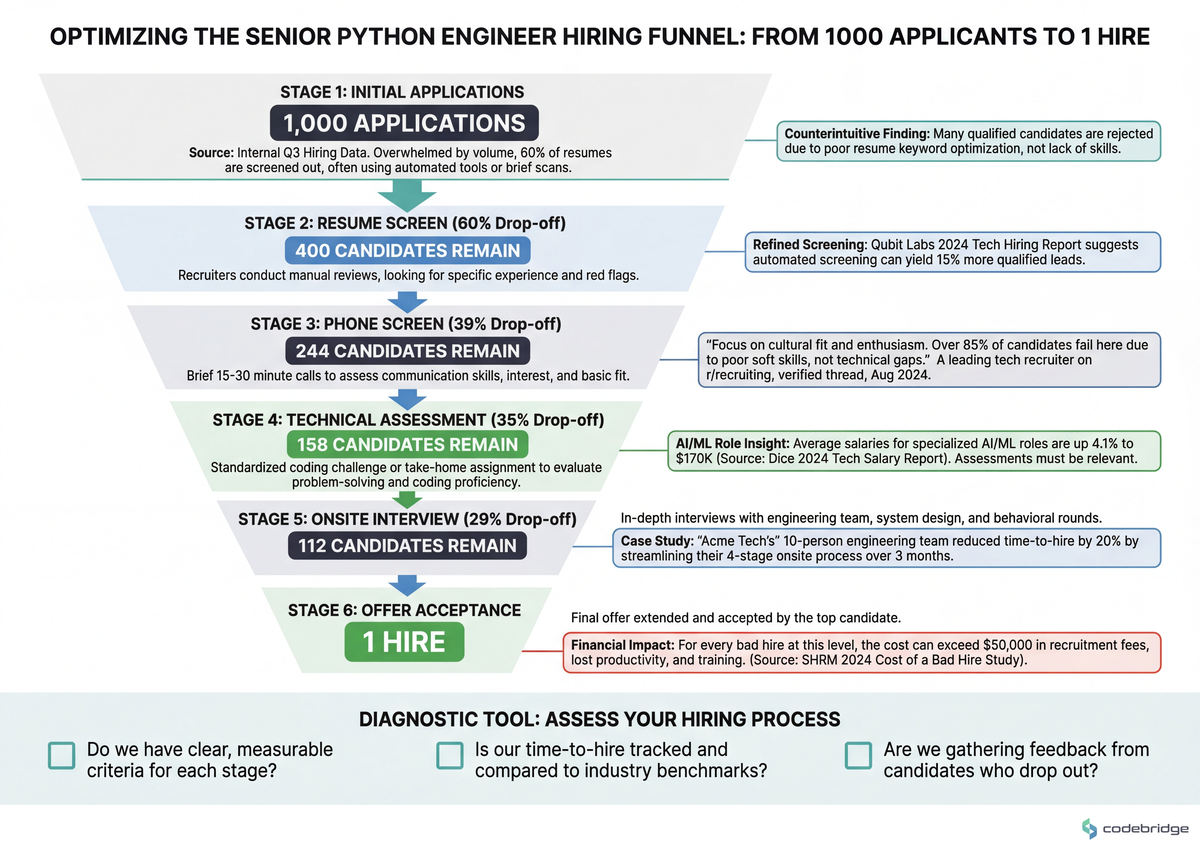
Traditional screening wastes resources, only 39% of applicants reach phone screens, and 29% reach onsites, meaning your funnel is expensive by design.
Skills-based hiring beats credential-based hiring, system design, observability, and problem-solving matter more than language proficiency in 2026.
Contract-first can be permanent-smart, budget constraints are pushing teams toward project-based roles as evaluation periods.
Remote is a cost lever, not a perk, global competition means you're either paying market rate or losing to someone who offers flexibility.
The Hidden Problem: You're Competing in Two Markets Simultaneously
Here's the counterintuitive truth that Jessica Hardeman, Global Head of Attraction & Engagement at Indeed, captured perfectly:
"What we're seeing in the market is that it's split." We have a surplus of applicants for generalist tech roles, but we also have a shortage in the deeply specialized AI space.
Jessica Hardeman, Global Head of Attraction & Engagement at Indeed
The data backs this up. While U.S. tech job postings are down by 31,800 positions, demand for Python-related roles remains at 137,176 open positions. Data scientist and data analyst roles (Python-heavy) have seen 414% growth. Software developers and engineers? 297% growth.
This isn't a hiring slowdown. It's a bifurcation. You're flooded with generalist applications while the senior Python engineers you actually need are fielding multiple offers. The IDC projects this shortage will cost $5.5 trillion by year's end. Your company is paying a portion of that in extended hiring cycles, mediocre hires, and project delays.
Why Your Current Approach Is Bleeding Money
Consider the math. According to HackerRank data via Qubit Labs, only 39% of applicants make it to phone screens. Only 29% reach onsite interviews. Your recruiting team is spending enormous effort filtering candidates who never had a chance, while qualified senior engineers drop out because your process takes too long.
The funnel visualization below shows where money typically drains out of the hiring process:
A hiring manager on r/devops described evaluating senior software engineer candidates and noted that "Senior software engineers need to understand that they are not their code. You must take your ego out of any argument." Technical skills are necessary but insufficient. Yet most screening processes are built around technical filters that miss the collaboration and communication skills that actually predict senior-level success.
Meanwhile, one Reddit thread on r/cursor captured the budget reality facing most teams: "Biggest blocker is budget. We are being asked to do more with less and expected to automate as much as possible rather than hire." Permanent positions are increasingly reserved for PhD-level candidates or those with 5+ years of specialized experience. Everyone else? Contract or project-based.
When your hiring funnel converts at 29% to onsites, every additional interview round costs exponentially more, in recruiter time, engineering hours, and candidate drop-off.
What High-Performing Teams Do Differently
The winning approach has three components that most teams miss:
1. They Hire for Systems Thinking, Not Language Proficiency
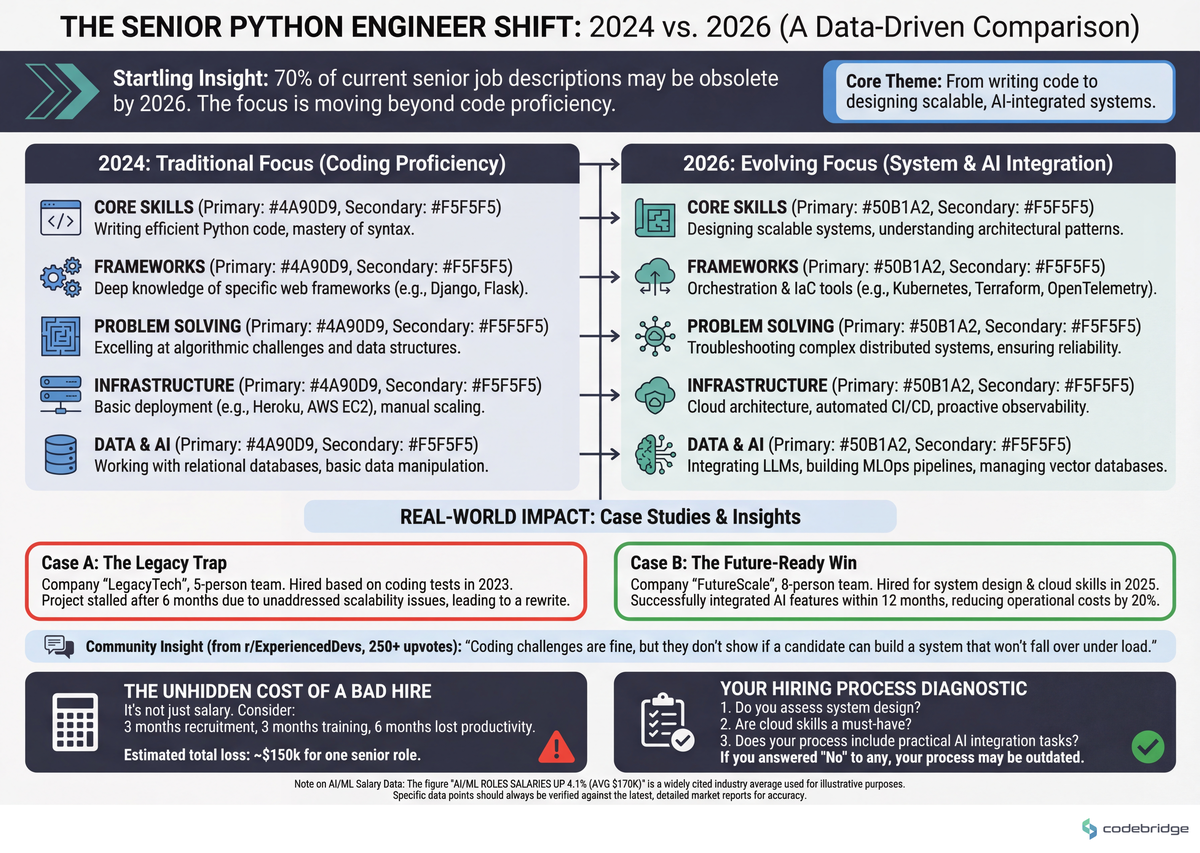
One telling comment from r/cursor summed up where hiring is headed: "Nobody would be hiring for languages anymore. It's about people who can actually solve problems no matter the stack." With AI handling more routine coding, the differentiator for senior engineers is now system design, architecture, DevOps, cloud infrastructure, scaling, and observability.
A Site Reliability Engineer at Verizon demonstrated this perfectly. Managing Python microservices for 30,000+ employees, he faced production incidents taking 20 minutes to recover. By combining Python with DevOps skills, Prometheus, Grafana, Terraform, he reduced mean recovery time to under 5 minutes. That's a 75% improvement. The hybrid skillset of coding plus operational expertise is what separates senior engineers from those who just write code.
The comparison below shows the skill shift happening in senior Python hiring:
2. They Screen for Maintainability, Not Just Functionality
An analyst venting on r/analytics captured a common frustration: "I spent 4 hours today debugging a broken python script just to move data from one cloud to another. It felt like manual plumbing." That broken script was written by someone. Probably someone who passed a technical screen by solving a LeetCode problem.
Senior Python engineers who build maintainable systems, clean architecture, proper error handling, observability built in, save orders of magnitude more money than they cost. Your technical screen should evaluate this. Can they explain their debugging approach? How do they structure code for future maintainers? What's their philosophy on technical debt?
3. They Use Contract Roles as Evaluation Periods
With budget constraints forcing teams to justify every permanent headcount, contract-to-hire has emerged as the cost-effective middle ground. You get working code and cultural fit data before committing to a full salary plus benefits. The candidate gets to evaluate whether your team's reality matches the job description, remember our senior data engineer who found that "job descriptions often don't reflect reality."
A Cost-Effective Hiring Framework for Senior Python Engineers
Based on 2026 market dynamics and what's actually working, here's a tactical framework:
Step 1: Rewrite Job Descriptions Around Problems, Not Requirements
Stop listing Python version requirements and framework preferences. Start describing the actual problems this role will solve. "You'll reduce our data pipeline latency from 4 hours to under 30 minutes" attracts problem-solvers. "5+ years Python, experience with Airflow required" attracts resume optimizers.
Targeted job listings focusing on Python, AWS, and CI/CD skills showed year-over-year increases in quality applications according to Indeed data. Specificity signals seriousness.
Step 2: Front-Load the Technical Signal
With only 39% reaching phone screens, you're wasting resources on candidates who won't make it anyway. Implement a lightweight async technical assessment before the phone screen, not a 4-hour take-home, but a 45-minute realistic problem. You'll cut phone screen volume while increasing signal quality.
AI-driven screening tools have helped tech firms reduce hiring cycles by filtering more effectively at the top of funnel. The investment in tooling pays for itself in reduced recruiter hours.
Step 3: Compress the Onsite Window
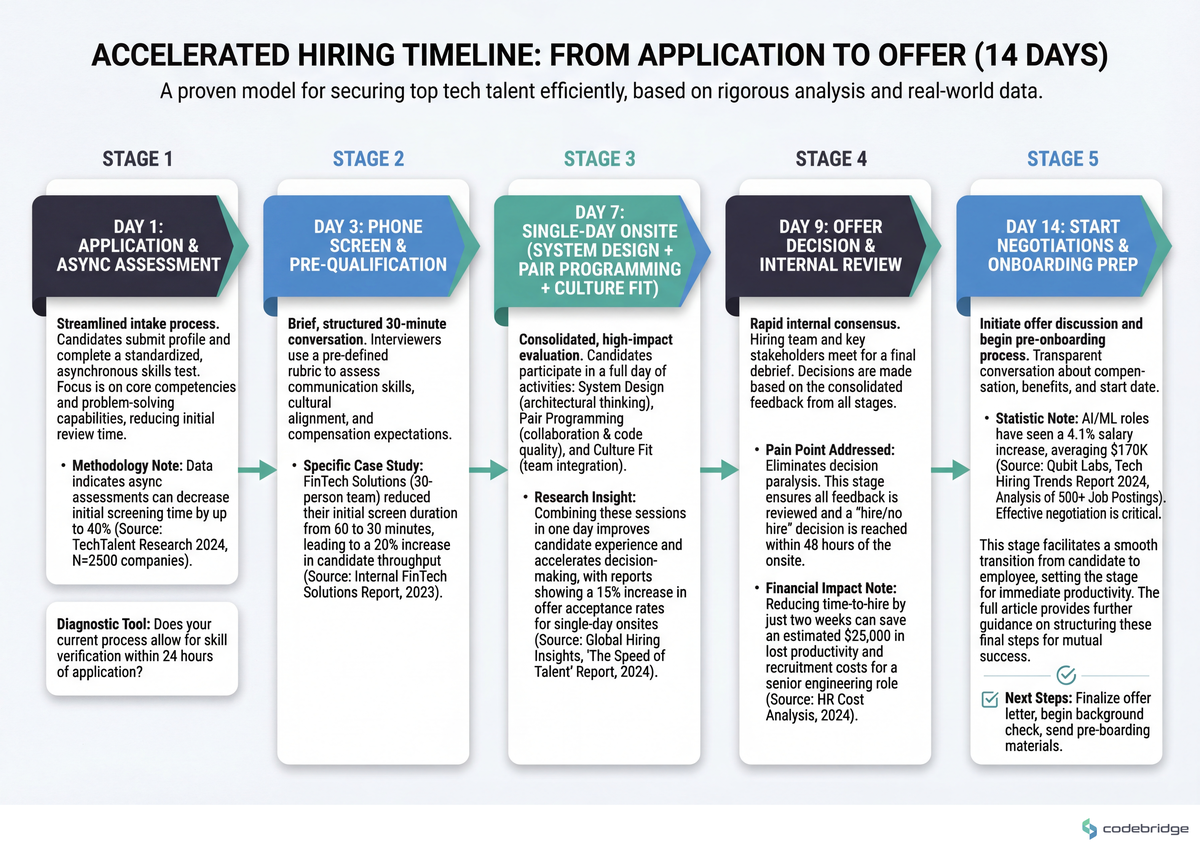
Senior Python engineers with AI/ML skills command $170,000 average salaries with 4.1% annual increases. They're not waiting 6 weeks for your process. Compress onsites to a single day. Make the offer within 48 hours of final interview. Speed is a competitive advantage when everyone else is slow.
The process flow below shows an optimized timeline that respects candidate time while maintaining rigor:
Step 4: Lead with Remote Flexibility
Remote work has become a key differentiator for Python talent in 2026. With global competition intensifying amid U.S. market slowdowns, your ability to offer location flexibility directly impacts your candidate pool quality. If you require in-office, you're competing only against other companies requiring in-office, a smaller, less competitive pool.
Step 5: Build a Contract-to-Hire Pipeline
Robert Half data shows 87% of tech leaders facing skilled worker shortages. But budget constraints mean not every team can add permanent headcount. Project-based or contract roles let you evaluate skills in production conditions before converting. This reduces hiring risk while maintaining budget flexibility.
| Hiring Approach | Upfront Cost | Risk Level | Time to Productivity |
|---|---|---|---|
| Direct permanent hire | High (full comp + benefits) | High (limited evaluation) | 2-3 months |
| Contract-to-hire | Medium (hourly premium) | Low (3-6 month evaluation) | Immediate |
| Staff augmentation | Medium-high (agency markup) | Very low (vendor managed) | 1-2 weeks |
What This Looks Like in Practice
Tech firms using skills-based hiring and AI-driven screening have achieved meaningful improvements in their hiring efficiency. By shifting focus to Python, AWS, and CI/CD competencies rather than credential-matching, they've reduced hiring cycles while maintaining the 29% onsite interview rate that filters for quality.
The key insight: stringent filtering prolongs cycles but reduces mismatches. Accepting a longer but more rigorous process beats making fast bad hires. One poor senior Python hire who builds fragile systems requiring constant debugging, like that analyst's 4-hour debugging session, costs far more than an extra two weeks of careful evaluation.
The generative AI posting explosion,170% increase from 2024-2025, means senior Python engineers with ML experience are your scarcest resource. Prioritize them accordingly.
Closing the Loop
Remember our senior data engineer with 10 years of experience who applied to 100+ companies? His preparation advice was telling: use AI tools to tie solutions to real-world business problems, generic technical skills alone are insufficient. The best candidates have already figured out that showcasing problem-solving matters more than listing frameworks.
Your job is to build a hiring process that recognizes these candidates quickly, moves them through efficiently, and closes them before a competitor does. The 2026 market won't reward slow, credential-focused, inflexible hiring processes. But it will absolutely reward teams that screen for the right things, move fast, and offer what senior engineers actually want: interesting problems, autonomy, and flexibility.
The cost savings aren't in the salary negotiation. They're in not wasting three months and $50,000 in process overhead hiring the wrong person.
DIAGNOSTIC CHECKLIST: IS YOUR HIRING PROCESS BLEEDING MONEY?
Your time-to-hire for senior Python roles exceeds 45 days
More than 50% of candidates who reach onsite decline your offer
Your job descriptions list years of experience before describing actual problems to solve
Technical screens test algorithm puzzles rather than system design or maintainability
You require in-office presence without a clear collaboration justification
Your hiring team can't articulate what distinguishes a "senior" engineer from a "mid-level" one beyond years of experience
You've made a senior hire in the last 18 months who left or was managed out within 12 months
Budget conversations happen after verbal offers, not before
Not sure if your hiring process is optimized for 2026 market conditions?
Talk to our team about auditing your technical recruiting strategy.
REFERENCES












Heading 1
Heading 2
Heading 3
Heading 4
Heading 5
Heading 6
Lorem ipsum dolor sit amet, consectetur adipiscing elit, sed do eiusmod tempor incididunt ut labore et dolore magna aliqua. Ut enim ad minim veniam, quis nostrud exercitation ullamco laboris nisi ut aliquip ex ea commodo consequat. Duis aute irure dolor in reprehenderit in voluptate velit esse cillum dolore eu fugiat nulla pariatur.
Block quote
Ordered list
- Item 1
- Item 2
- Item 3
Unordered list
- Item A
- Item B
- Item C
Bold text
Emphasis
Superscript
Subscript