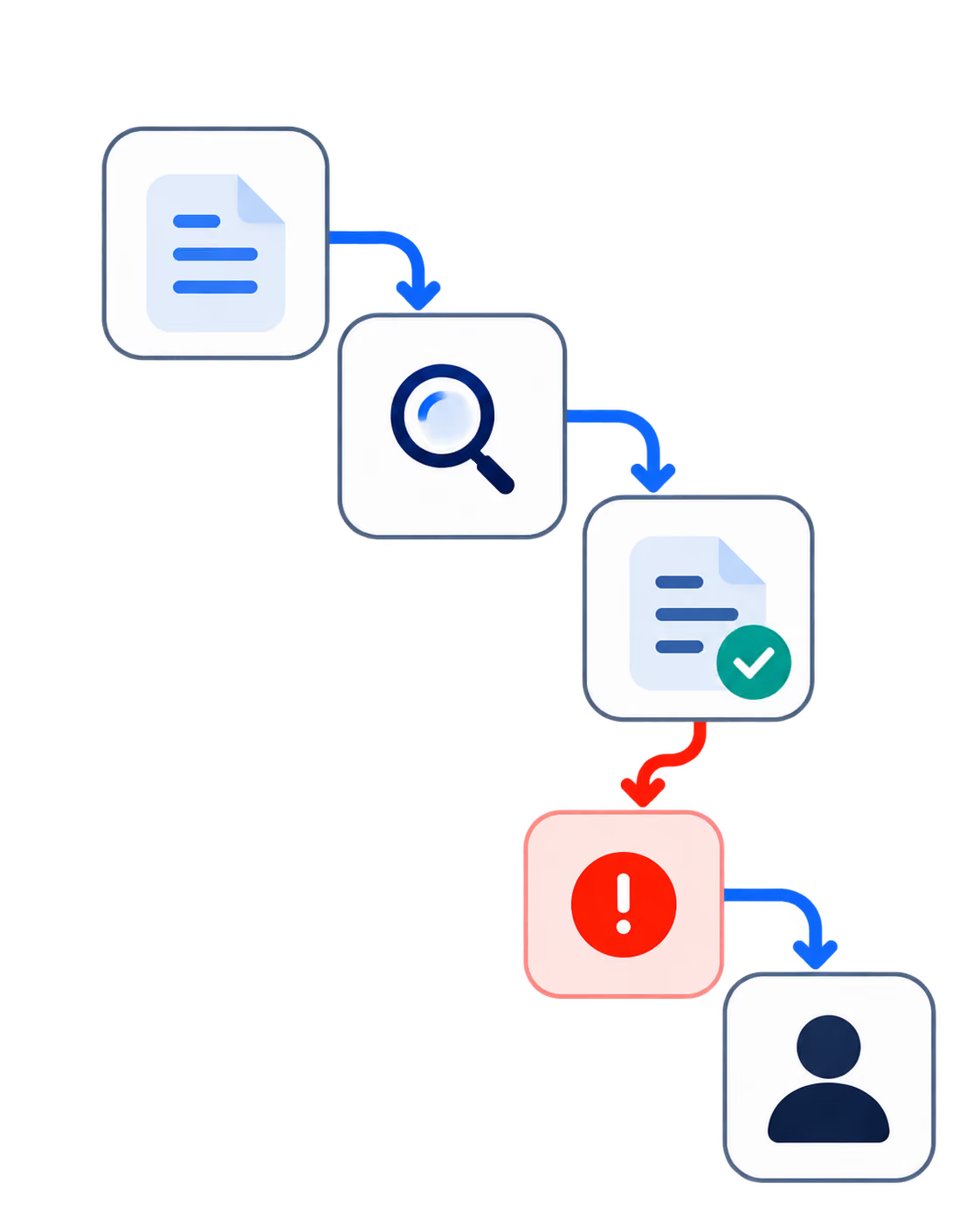
AI Answer Summary
Ten accounting firms and professional services organisations have publicly documented what happened when they put AI into production. Eight of those cases describe work that held, and two describe work that got retracted or refunded. Read together, the record on AI in accounting is narrower than the marketing around it: firms automated one approval workflow, one intake form, one research step. Nobody in the public record automated a practice.
The evidence quality varies more than the headlines do. Four of the small-firm cases come from Journal of Accountancy interviews published in August 2026, where named partners described the tool, the build time, and the cost. Two of the failure cases come from Associated Press wire reporting and the Financial Times. One widely repeated efficiency figure came from the company selling the platform, which is worth knowing before you put it in front of a partner board.
The gap in the record sits where most readers of this article work. Firms above 200 people issue press releases. Firms under ten talk to the trade press in useful detail. Firms between roughly 50 and 200 publish almost nothing, so a COO researching this decision ends up reading either enterprise announcements or sole-practitioner posts. But neither describes their firm.
How to Read an AI in Accounting Case Study
Before the cases, four questions. Apply these to every claim a client brings you, and they disqualify more numbers than they confirm.
Who measured it? A figure produced by the firm that did the work and a figure produced by the company selling the platform are different kinds of evidence. Both can be true. Only one of them survives a sceptical partner.
Against what baseline, over what period? "Thirty percent faster" needs a before. A firm that was tracking task-level time before it started has a baseline. A firm that was not is estimating, and estimates drift toward whatever justified the purchase.
Time saved, or money kept? This is where most case studies quietly fail. Hours freed on hourly work are not revenue. They become revenue when somebody sells the capacity, or they become margin when somebody removes the cost. Until one of those happens, a firm has bought slack, and slack does not show up on the realization report your Managing Partner reads.
Does the figure survive the fee guidance? A 30% time reduction on a fixed-fee engagement is margin. On an hourly engagement, the IRS now treats it as a billing question. Section 7 covers what changed.
Every case below is graded on the first question. Where a number came from a vendor, it says so in the sentence that carries it.
Five Examples of AI in Accounting That Worked
High Rock Accounting: a COO built the tool in an afternoon
High Rock Accounting runs client advisory, CFO, and tax advisory services out of Scottsdale, Arizona, with eight people and a vertical in technology companies. COO Ashley Rhoden was paying for a client satisfaction and net promoter score product she could not justify on cost, and she still wanted the feedback.
She built a replacement with Claude Code in four to five hours, wired into the firm's Karbon workspace. The application refreshes the active client list and surveys clients after major projects, or monthly, depending on the scores it returns. Feedback reaches the team faster than the paid product delivered it. Later, the firm's head of tax, Susan Wozena, who has no technical background, prototyped a client onboarding and tax organizer in a few hours.
CEO Liz Mason now runs an internal session that opens with ten minutes on what the team wants to stop doing by hand.
Measured by the firm. Cost: one team subscription plus low ongoing maintenance.
Source: Journal of Accountancy interviews published in August 2026
Agate CPA: a conversion number instead of a time-saved number
Agate CPA has six people across Atlanta and Rogers, Arkansas, and a niche in law firms. Co-founder Sarah Harris had a website enquiry form asking for name, email, and reason for interest. It produced sales calls and very few clients.
She rebuilt it with Lovable, embedded it with help from Claude, and routed the responses into ClickUp through the API. The new form asks whether the prospect owns the business, what industry it operates in, headcount, revenue, company age, whether they have worked with a CPA before, and why they are looking for a new one. Harris and cofounder Alicyn McLeod added CAPTCHA, rate limiting, traffic monitoring, and channel restrictions so the form could not be abused.
Conversions rose roughly 25%. Spend was minimal.
Measured by the firm. Note the security controls. They are the part that survives an IT review.
Source: Journal of Accountancy interviews published in August 2026
Public Trust CPA: internal controls got easier, not looser
Cheryl Hannafin runs Public Trust CPA as a sole proprietor in St. Petersburg, Florida, serving government and not-for-profit clients. Her nonprofit clients maintain rigorous approval processes, and those processes were slow because approvers had to log into systems they did not use.
She built a workflow in Microsoft Power Automate. Vendor invoices arrive at a dedicated client address, which triggers an approval request through Adobe Sign. Once the client approves, the workflow creates the bill in QuickBooks with the signed approval attached. The result is a complete audit trail and no new subscription, no new login, and no new software for the client.
Her description of her own approach is the most useful sentence in this entire article: she uses AI to build the plumbing rather than to handle client data. Incremental cost was zero, because she already had Microsoft 365 and Adobe.
Measured by the firm.
Source: Journal of Accountancy interviews published in August 2026
One Stop CPA: the review layer, stated out loud
One Stop CPA is a digital firm in Fort Lauderdale with four accountants and three non-accountants, working with doctors, real estate investors, and entrepreneurs in layered ownership structures. Founder Brian Davis runs a fixed five-step process: identify the client problem, run authority-based research in Blue J, apply his own interpretation, translate the result into client strategy, then generate the deliverable from a library of saved prompts in an enterprise ChatGPT account.
On a client who was selling a business and changing state residency at the same time, he reached a defensible answer in about two hours. He uses enterprise tooling only, so client data does not train the model.
His stated position: AI is a starting point, not the final answer, and he makes the decisions.
Measured by the firm. Worth noting because most case-study content omits the review step entirely.
Source: Journal of Accountancy interviews published in August 2026
Wiss & Company: the ten-month beta matters more than the percentage
Wiss & Company is a Top 100 firm in Florham Park, New Jersey, with roughly 450 accountants. It began testing an agent platform from Basis inside its Client Accounting Services practice in November 2023. Ten months later, in September 2024, the firm announced full deployment across the practice.
The figure attached to this case is a reduction of up to 30% in time spent on manual work. That number comes from the platform company and its model provider, not from Wiss. Treat it as a vendor-reported claim.
The verifiable and more useful fact is the sequence. Partner Paul Ursich noted that the firm already ran a private ChatGPT instance and had found Microsoft Copilot useful, and still treated end-to-end automation as a different problem requiring its own ten-month trial before commitment. A 450-person firm with an existing AI stack spent most of a year testing inside one service line.
Deployment confirmed by the firm. The 30% figure is vendor-reported.
What AI at Scale Looks Like: Three Big Four Cases
Even if you do not have this budget, the useful signal in these three cases is what each firm changed about pricing and hiring, because those are decisions a 90-person firm will face on a smaller scale.
KPMG has more than 95,000 auditors working in its Clara platform, and its internal audit assistant has handled over 2.19 million conversations since launching in October 2023. The firm has deployed automated agents into substantive procedures: expense vouching, the search for unrecorded liabilities, and accrued expenses testing. Its multi-year technology commitment has been reported at up to $2 billion.
EY put 150 agents in front of 80,000 tax professionals from March 2025, moved more than 1,000 agents into development or production during that year, and states a target of 100,000 by 2028 against annual AI spending above $1 billion. The detail worth your attention is the commercial model. EY's global vice chair for tax has described the firm's pricing as service-as-a-software. A Big Four tax practice is publicly moving off the hour.
PwC reports roughly 25,000 agents deployed across client operations since launching its agent platform in March 2025. In the same period, PwC US planned to reduce graduate hiring by about a third over three years, with an internal slide citing the impact of AI. The firm pointed to the pace of technological change and historically low attrition.
You should read the second and third cases together. The leverage model is what AI touches at a professional services firm. Pricing and the pyramid are downstream of capacity, and both of those firms have already adjusted.
Two Cases That Broke
Deloitte Australia: a A$440,000 report with a fabricated judgment quote
Deloitte Australia delivered a 237-page independent assurance review of the welfare Targeted Compliance Framework to the Department of Employment and Workplace Relations, under a contract worth A$440,000, roughly US$290,000. The department published it in July 2025.
Chris Rudge, a health and welfare law researcher at the University of Sydney, found that the report was full of fabricated references. It contained a quote attributed to a Federal Court judgment that the judgment does not contain, and citations to academic work that does not exist. A revised version appeared in October 2025 with the fabrications removed, the recommendations unchanged, and a new disclosure that Azure OpenAI GPT-4o had been used in writing it. Deloitte agreed to repay the final instalment of its fee.
The handling is the part worth studying. On 22 August, the day the Australian Financial Review reported the fake sources, Deloitte wrote to the department asserting that the problems were limited to the footnotes and the reference list. Correspondence released later showed the firm had not initially told the department that generative AI sat behind the errors. In a Senate forum on consulting integrity, Labor senator Deborah O'Neill said a partial refund looks like a partial apology for substandard work.
EY Canada: the same failure, fourteen months later
In May 2026, EY Canada withdrew a published study on fraud in loyalty programmes that its consultants had been using to market cybersecurity services. The research group GPTZero documented what was wrong with it: a citation to a McKinsey report that does not exist, more than half a dozen footnotes pointing to pages that were dead or did not support the claim, and the same $200 billion figure used for both the total size of the loyalty market and the value of unclaimed points. The Financial Times reported the findings.
EY said it was reviewing the circumstances that led to publication and that the study was not connected to client work.
This happened at a firm running the largest agent programme in the profession, fourteen months after its closest competitor made the same category of mistake in public. Capability arrived. Governance did not follow it.
A third failure worth one paragraph. Botkeeper, an AI bookkeeping platform that operated for eleven years and raised roughly $90 million, announced its closure in February 2026, two years after the abrupt shutdown of a comparable platform left small businesses without access to their records. Firms that had built client workflows on top of it lost those workflows and had a limited window to export their data. If your firm is exposed to a platform shutdown, the full account of what happened and what to do about it is here.
Read more: Automate Bookkeeping After Botkeeper
What the IRS Now Requires When Your Firm Uses AI
On 24 June 2026, the IRS Office of Professional Responsibility issued a bulletin applying Treasury Circular 230 to the use of AI in tax practice. It creates no new rules. It states that the existing duties of diligence, competence, and confidentiality already cover this, and that the final decision always rests with the practitioner.
The obligations that land on a firm COO:
Responsibility does not transfer to the tool. Practitioners keep full responsibility for AI-assisted work. The bulletin describes AI output as a starting point rather than a finished product, and says human scrutiny and editing are essential.
Due diligence now includes verifying citations. Facts, citations, and calculations produced by AI have to be checked. In tax practice, a fabricated authority supporting a return position exposes the preparer under IRC Section 6694 and Circular 230.
Technological competence sits inside competence. Practitioners have to understand both the tax law and the tools they use, including how the system generates content and where errors arise. The bulletin warns that a lack of technological competence can produce improper advice or flawed filings.
Billing changed. Charging a client for time not spent because of AI efficiencies raises the question of an unconscionable fee. The bulletin says cost savings should be reflected in client billing, AI use disclosed as appropriate, and cost reductions fairly credited to the client's account.
Firm leaders carry a documentation obligation. Firms have to adopt policies covering staff training, secure data handling, accuracy monitoring, and the vetting of third-party AI tools, with documentation showing they follow those policies.
Client data goes through approved systems only. The bulletin points to the civil and criminal penalties for unauthorised disclosure of return information and warns that public or unsecured platforms may expose confidential data.
How Codebridge Approaches This
The four questions at the top of this article are the ones we answer before a build starts, because a scope nobody can measure is a scope nobody can defend to a partner board.
We came out of KPMG, so the documentation and review obligations in the IRS bulletin describe the environment we were trained in rather than a compliance problem we discovered late. Three things follow from that in how we work. We prototype on your own data before you commit to a build, because a demo on somebody else's data tells you nothing about your ledger. We work to a fixed price and a fixed date. And your firm owns the code, which is the difference between the small-firm cases in this article, where the workflow belongs to the firm that built it, and the platform shutdown that took its customers' workflows with it.
If you want to find out whether one of your workflows fits that shape, book a 15-minute call. It leads to a fixed-fee three-week discovery, run on your data, and you keep what comes out of it.












Heading 1
Heading 2
Heading 3
Heading 4
Heading 5
Heading 6
Lorem ipsum dolor sit amet, consectetur adipiscing elit, sed do eiusmod tempor incididunt ut labore et dolore magna aliqua. Ut enim ad minim veniam, quis nostrud exercitation ullamco laboris nisi ut aliquip ex ea commodo consequat. Duis aute irure dolor in reprehenderit in voluptate velit esse cillum dolore eu fugiat nulla pariatur.
Block quote
Ordered list
- Item 1
- Item 2
- Item 3
Unordered list
- Item A
- Item B
- Item C
Bold text
Emphasis
Superscript
Subscript