AI Answer Summary
An AI readiness assessment is a structured review of whether your company can use AI in a specific workflow, product, or system without creating cost, risk, or operational problems. It examines the business case, the workflow itself, data quality, technology and integrations, governance, security, the people who will own the result, and how you will measure performance. You run it before you build, buy, pilot, or scale.
A strong assessment tells you which workflow is ready now, which gaps you have to close first, and which use cases should wait. The number matters far less than the gap map underneath it.
This guide explains what an AI readiness assessment is, why it matters, when to run one, how the process works, the nine dimensions it should cover, how to score readiness, what it should deliver, and what to do once you have the results.
AI Readiness is not a Buzzword Check
AI has developed rapidly, and many industry giants have already reached impressive levels of productivity with it. But many companies are only starting their AI journey and want to understand how to achieve similar results.
Those industry leaders did not have everything figured out from the beginning. They also started small, tested specific use cases, learned from the process, and grew step by step.
One of the most important parts of that journey is preparing the business for innovation and change. This is why an AI readiness assessment has become a crucial step in every serious AI roadmap.
In this article, we will look beyond the basic definition. We will explain what companies need to know about AI readiness assessment, when to use it, why it matters, what main areas it includes, and how it helps prepare workflows for production AI.
What is an AI Readiness Assessment?
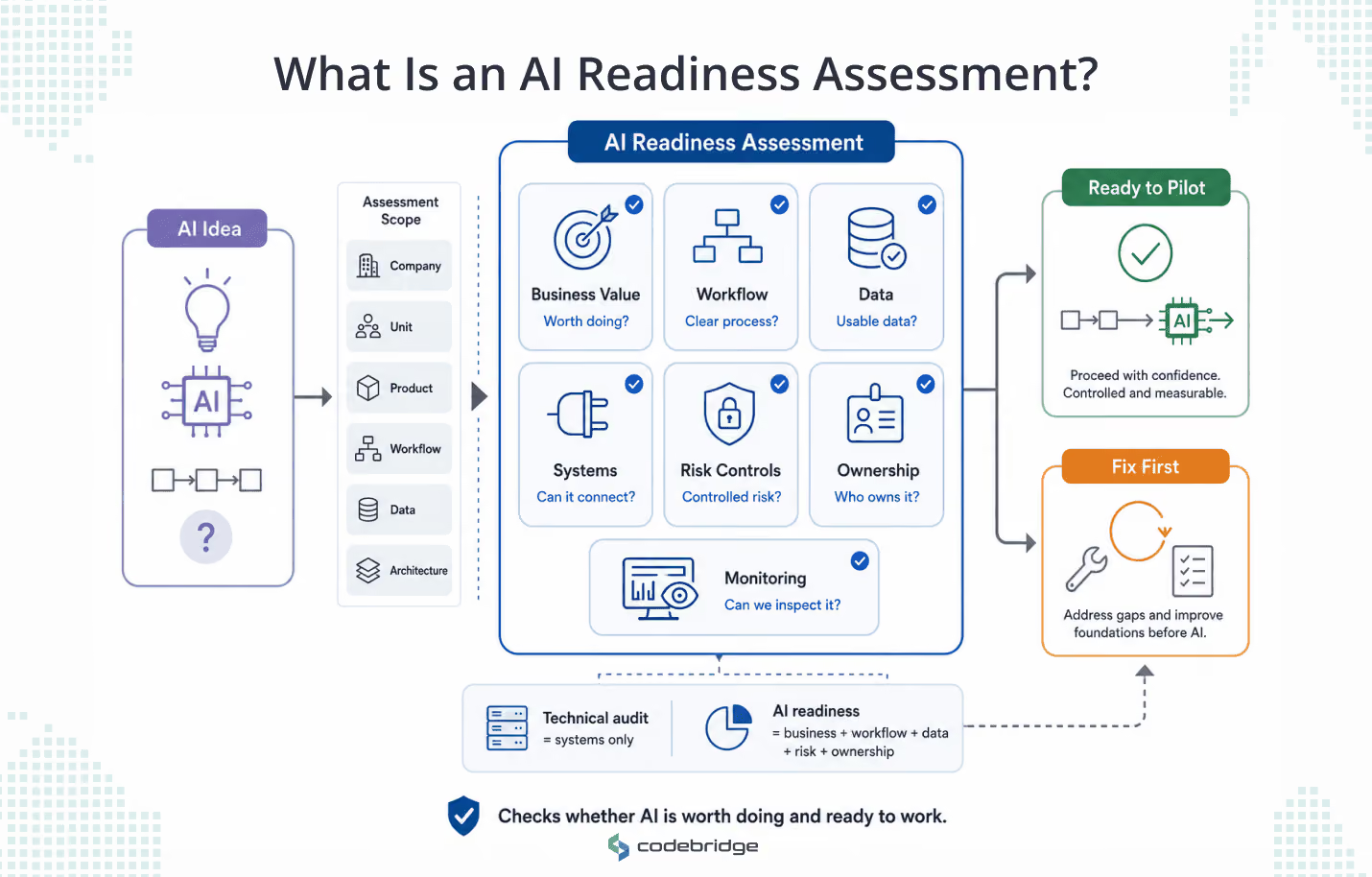
AI readiness assessment is a structured evaluation of how prepared an organization, team, workflow, or system is to adopt AI and get value from it. You can run it at several levels: across the whole company, inside a single business unit, around one product, on a specific workflow, or against a particular data environment.
The most useful version ties organizational readiness to a concrete use case, because that is where abstract readiness turns into real decisions.
A complete assessment looks at the business value behind the use case, the clarity of the workflow, the state of the data, the technology and integrations involved, governance and risk, security, compliance, the people and skills around it, who owns the result, the quality of the model output, and how the system will be monitored after launch.
That makes it broader than a technical audit. Because a technical audit asks whether your systems can support an implementation. A readiness assessment asks a harder set of questions, such as whether the use case is worth doing at all or whether anyone can describe the workflow consistently.
People use several adjacent terms, and they are not interchangeable. The table below separates them.
Readiness should come first, as the other reviews answer narrower questions once you have decided a workflow is worth the effort.
Why Companies Need an AI Readiness Assessment
There are a lot of reasons why AI initiatives stall, and these reasons can be predicted. The assessment exists to catch them before they cost you.
To Avoid AI Projects with Unclear Business Value
AI should attach to a measurable outcome, such as lower handling time, faster reporting, or fewer manual reviews. Readiness starts with a baseline and a target you can defend. The risk of skipping this step grows with the ambition of the project.
Gartner predicts that over 40% of agentic AI projects will be canceled by the end of 2027, citing escalating costs, unclear business value, or inadequate risk controls. That warning lands hardest on advanced, autonomous use cases, but the root cause is in a project that cannot name the value it creates.
To Avoid Automating an Unclear Workflow
AI cannot improve a process nobody can describe. When a workflow runs on undocumented knowledge held in a few people's heads, AI can only expose this gap and often very loudly. This is exactly why the workflow clarity has to come before model selection.
To Avoid Building on Weak or Scattered Data
We have data, and the data is ready, are different statements. AI needs the right data, from a known source, with enough context, fresh enough for the decision, with permissions you can enforce. We go through this in depth in the companion piece, Data Readiness for AI: The First Audit Before You Build Anything.
To Avoid Governance and Security Gaps
AI introduces exposure that ordinary application security does not fully cover. It may include sensitive data leaking through outputs or prompt injection. The OWASP Top 10 for LLM Applications catalogs these risks, and frameworks such as NIST's AI Risk Management Framework and ISO/IEC 42001 give you a structure for managing them.
To Avoid Pilots That Cannot Scale
Some pilots work because the environment is small, manual, and protected. But scaling can easily change everything. Because production needs real integration, monitoring, cost control, and someone who owns the system when it breaks. A pilot who ignores those conditions tends to stay a pilot.
When to Run an AI Readiness Assessment
Run the assessment before AI creates commitment. That means before budget, vendor signature, and before any compliance exposure you cannot walk back.
Concretely, run one:
- Before selecting an AI vendor
- Before building a custom AI system
- Before adding AI to a core workflow
- Before AI touches sensitive, regulated, or customer data
- Before launching a pilot, and again before scaling one that worked
- Before introducing AI agents or any autonomous action
- Before connecting AI to internal systems such as CRM, ERP, EHR, billing, support, or analytics
- When teams are already using AI informally, and you have no view of it
- When leadership wants AI but cannot name the first use case
Here are two examples that will help you better understand that timing:
The first example is a sales team that wants an assistant to research accounts and draft outreach. They should assess readiness before that assistant reads CRM records, opens past email threads, or proposes a message to a customer.
The questions you answer first are whether the CRM data is trustworthy and where a human signs off before anything leaves the building.
The second example is a healthcare product team that wants AI to summarize clinical notes. They would assess readiness before sensitive data, audit trails, access control, and clinical review are handled casually.
In that setting, the cost of finding the gaps after launch is measured in more than rework.
How an AI Readiness Assessment Works

Remember that a useful assessment produces concrete and clear decisions, not observations. By the end, you should know what is ready, what is risky, what you have to fix, and which use case moves first.
We determined six steps that can get you there:
Step 1: Choose the workflow.
Resist the urge to assess the whole company unless you are running a strategic maturity review. For implementation, you must pick one concrete workflow. It might be a sales research, support triage, claims intake, or an internal knowledge search.
Step 2: Define the business outcome.
Name the metric you want to move and where it stands today. For instance:
- "Cut reporting delay from three days to one."
- "Reduce manual review hours by 40%."
A target you can measure is the difference between a project and an experiment.
Step 3: Map the current workflow.
Write down who does the work now, which systems they touch, which decisions they make, where the delays sit, and where risk shows up. This map does more diagnostic work than any tooling choice.
Step 4: Assess readiness across the nine dimensions.
This is the core of the assessment and the subject of the next section. The dimensions run from business and workflow through data, technology, governance, security, people, model quality, and production operations.
Step 5: Score readiness and find the gaps.
A score helps you prioritize. It is not a certificate. The real output is the gap map: the specific things standing between this workflow and a safe launch. For the full diagnostic version, work through the AI Readiness Checklist for 2026: 40 Questions Before AI Touches Your Workflow.
Step 6: Decide the next move.
The honest outcomes must be wider than just a "go” signal. You must have a thought-through next move(and a plan B for risk management). You might proceed to a pilot, fix data first, delay the use case, or pick a different workflow with higher readiness.
The 9 Dimensions of AI Readiness
This is the part that decides everything else. A vendor can demo a model in twenty minutes, but what a demo cannot show you is whether your business can run that model in a real workflow next quarter, after the pilot budget is gone and the person who championed it has moved on. Readiness lives in nine places, and a workflow is only as ready as its weakest one.
These 9 dimensions are nine separate ways a sound-looking AI project falls apart. Most failures trace back to one or two of them, and they are rarely the ones the team was worried about. Read the table first, then spend your time on the dimensions that look weakest for your use case.
1. Business Readiness: Is This Worth Doing?
AI is the most expensive way to solve a problem you have not defined, and business readiness is the discipline of defining it before you spend.
When companies say "we need an AI strategy", "our competitors are using it", or "the board asked about AI," it is already a wrong framing that wastes business’ budget. None of those statements contains a baseline, which means the project can never prove it worked. A use case that cannot show value cannot defend its cost, and twelve months in, that is the conversation that ends it.
But a ready team talks differently. It names the metric, where that metric sits today, the improvement that would justify the investment, and the person who owns that number.
Great examples: "Cut manual account research from forty-five minutes per account to under five, across thirty reps, with a human approving every message before it sends".
Bad example: "Add AI to sales"
2. Workflow Readiness: Can Anyone Describe the Work?
AI operates on the steps of a real process, and it inherits whatever confusion those steps already contain.
The fastest readiness test costs nothing. Ask three people who do the work to describe the workflow separately. If you get three different answers, your workflow might be broken, and AI cannot automate this kind ofsystems.
AI surfaces the disagreement instead, usually at the worst moment, in front of a customer or an auditor. A surprising share of what teams call AI problems are undocumented processes.
Mapping the workflow is how you find out whether AI has a job at all. A usable map names:
- Every step from start to finish, and who performs it today
- The steps that need human judgment, and the ones that simply repeat
- Where exceptions happen, and how often
- Where a human approves before the work continues
- The steps AI must never touch
That last line is especially important. Readiness is not only about deciding where AI helps. It is deciding, in advance, where AI has no authority. The organizations that get real value tend to redesign the workflow around AI rather than bolt it onto the process they already had, a pattern McKinsey has tracked among its highest performers. Bolt AI onto a broken process, and you get a faster broken process.
3. Data Readiness: Will the Data Hold the Weight?
Data readiness is a dimension that sinks the most projects, and the one teams underestimate most consistently. "We have the data" and "the data is ready for this use case" are different claims, and the distance between them is where AI projects go to die.
Here is the reframe that helps. Data that is fine for a dashboard can be unfit for an AI agent that acts on it. A dashboard tolerates a stale field or a missing note because a human reads it and fills the gap. An agent does not. It produces a confident, fluent, wrong answer from the same gap, and no error message tells you it happened. The failure is silent, which is what makes it dangerous.
For a specific workflow, AI-ready data needs five things:
- A source of truth. You know which system wins when two of them disagree.
- The right freshness. "Updated nightly" can be fine for a report and useless for a decision someone makes at two in the afternoon.
- Context, not just fields. The model needs to know what a value means, not only that it exists. A status code with no legend is noise.
- Enforceable permissions. You can control and log who and what reads the data.
- A legal basis. Privacy, consent, and contractual terms allow this use, not just some use.
Most real workflows pull from several systems rather than one tidy database, so the problems concentrate at the seams where those systems meet. Because this dimension carries so much weight, we gave it a full treatment of its own. The data readiness audit walks a single workflow through eight gates, from "we have data" to a clear go, pilot, or stop decision.
4. Technology and Infrastructure Readiness: Can AI Reach the Work?
A model that works in a sandbox and a model that works where your business runs are separated by everything in this dimension.
AI rarely works alone. To do anything useful, it has to reach the systems that hold the work: CRM, ERP, EHR, the data warehouse, the support platform, internal APIs. The common failure is a polished assistant that cannot safely connect to any of them, so it lives forever as a demo someone shows at the all-hands, and nobody uses it on Monday. Cisco's 2025 index found that the organizations able to scale AI invested in this foundation early, and that most cannot, which is exactly why so many pilots stall short of production.
The questions that decide it are unglamorous and concrete. Are the APIs you need reliable, or do they fall over under load? Is identity and access management clear enough to give AI scoped, auditable access? Can the system meet the latency the workflow needs and scale as usage grows? Then the one that surprises finance: how will you watch cost? AI bills scale with tokens, not with request counts, so a feature that looked cheap in a pilot can become a line item nobody forecast. And what happens when the AI service is slow or down? A workflow with no fallback path is a workflow you have quietly made fragile.
5. Governance and Risk Readiness: Who Answers When It is Wrong?
The moment AI enters a real workflow, governance stops being a policy document and becomes an operational question with a name attached to it.
One diagnostic tells you almost everything. Ask the room: if this AI makes a harmful recommendation, who is accountable? If the question produces silence or a round of glances, the use case is not ready, however good the model is. Accountability, nobody has claimed, is accountability that does not exist.
Real governance readiness means you have answered the operational questions before launch: which risk category this workflow falls into, who approves the use case, what human oversight it requires, what documentation and audit trail you need, and what the escalation path is when something goes wrong.
The major frameworks give you structure rather than answers. NIST's AI Risk Management Framework organizes the work into Govern, Map, Measure, and Manage. ISO/IEC 42001 treats AI governance as a management system you maintain and improve, not a one-time review. In the EU, the AI Act sets explicit obligations for high-risk systems, with its core requirements taking effect in August 2026.
If your workflow touches regulated or high-impact decisions, its classification belongs inside the readiness review, not in a compliance conversation after the build. Confirm how your own use case is classified in your jurisdiction; this guide is a framework, not legal advice.
6. Security Readiness: What Can It Be Made to Do?
Large language models break an assumption that ordinary application security depends on. A normal application keeps instructions and data apart. An LLM reads both through the same channel, which means a user or a document the model ingests can smuggle in instructions the system was never meant to follow. That is prompt injection, and you cannot fully patch it away,because it exploits how the model works rather than a bug you can close.
The risk grows the moment AI can act. Once a model can call tools, send messages, or change records, its reach becomes the attack surface. The defense is boundaries: treat every input as untrusted, validate outputs before you act on them, scope tool permissions to the minimum the workflow needs, and log every sensitive action. The OWASP Top 10 for LLM Applications is the reference worth designing against. The risks that bite hardest inside a business workflow:
A workflow is ready on this dimension when its inputs, outputs, tool access, logging, and incident response are controlled. It is not ready when the model can read sensitive data or trigger an action with no boundary between "suggest" and "do."
7. People, Skills, and Ownership Readiness: Who Owns It on a Bad Day?
AI adoption is an operating-model change that arrives disguised as a technology project. The technology is the easy part. The hard part is that real people now have to use, trust, question, and maintain a system that behaves probabilistically.
The signature failure here is the diffusion of ownership. Everyone experiments, the pilot looks alive, and then nobody owns the result. After launch, someone has to review outputs, handle the exceptions the model cannot, update prompts and evaluation logic as the workflow shifts, retrain users, and pick up the phone when it breaks. Leave those responsibilities unassigned, and the system degrades quietly until someone notices the outputs got worse three weeks ago.
Readiness looks like a short, boring list of names:
- a business owner accountable for the outcome
- a technical owner for the system itself
- a reviewer who checks outputs and catches drift
- a support owner for when something fails
- a clear escalation path for cases that exceed the workflow
There is a softer requirement underneath the roles. Users need to know when to trust the output and when to challenge it. A team that trusts AI blindly and a team that ignores it entirely both waste it, in opposite directions. Readiness includes preparing people for the judgment the new workflow now asks of them.
8. Model, Evaluation, and Quality Readiness: How Will You Know It is Good?
"The answers look good in testing" is the most dangerous sentence in an AI project, because it usually means someone read five outputs, liked them, and shipped.
Eyeballing a handful of responses is not evaluation. Evaluation is a defined standard you can check against repeatedly as the system changes. For your specific use case, that means knowing what a good output actually looks like, holding a set of test cases that includes the hard and adversarial ones, naming the failure types that matter most, and setting an error rate you can live with.
A summary that is 95 percent accurate is excellent for internal notes and unacceptable for a clinical record. The threshold is a business decision, not a technical default.
Two things turn evaluation from a launch checkbox into a real capability. First, a way to catch the failures that matter: hallucinations stated with total confidence, and outputs that are biased or unfair in ways a casual read slides right past.
Second, a gate on change. Every model update and prompt edit shifts behavior, sometimes invisibly, so someone has to approve and re-test before changes reach production. A team is ready here when it can describe its evaluation criteria, its test set, its thresholds, and how it will keep watching quality after launch, not just on the day of it.
9. Production Operations Readiness: Can You See What It is Doing?
AI in production fails in a way ordinary software does not. A normal system that breaks usually throws an error. An AI system that breaks often returns a clean, confident, well-formatted answer that happens to be wrong. The failure looks exactly like success, so you cannot wait for something to blow up and tell you.
The only defense is visibility. A multi-step AI workflow is a distributed system, and you have to trace it like one: what the model received, what it retrieved, which model version ran, which tools it called, what it produced, what failed, how long it took, and what it cost. Without that trac,e you can see the final output but not how the AI reached it, and a system you cannot inspect is a system you cannot fix or improve.
This is increasingly a solved problem in toolig, if you plan for it before launch instead of after the first incident. The OpenAI Agents SDK captures fine-grained traces of model and tool calls, and the OpenTelemetry GenAI semantic conventions are converging on a vendor-neutral standard for that telemetry, though the conventions are still maturing and worth treating as versioned infrastructure rather than a fixed schema. The test is blunt: before you launch, can you trace inputs, retrieval, model and tool calls, outputs, errors, latency, cost, and user feedback? If you only learn about a bad output when a customer complains, you launched without this dimension.
What an AI Readiness Assessment Looks Like in Practice
Two workflows show how the dimensions interact. Both stay general; the point is the pattern, not a specific product.
A Sales Research Assistant
A sales team wants AI to research target accounts, summarize buying signals, and draft personalized outreach. Readiness here turns on CRM data quality, the freshness of deal stages, clear account ownership, a reliable record of past relationship history, approved messaging, permission to use customer data, and a human approval step before anything is sent.
In a low-readiness version of this team, CRM notes are inconsistent, deal stages are months stale, account ownership is fuzzy, and the assistant has no trustworthy source for relationship history. It produces fluent outreach built on bad context, which is worse than no outreach.
In a ready version, the assistant pulls from approved sources, summarizes account context, flags what it is unsure about, proposes a next step, and waits for a person to approve before sending. The human keeps the authority that matters.
A Regulated Healthcare Workflow
A HealthTech team wants AI to summarize clinical, administrative, or patient information. Readiness turns on sensitive-data handling, access control, audit logs, clinical or expert review, regulatory classification, human oversight, documentation, traceability, and an incident response path.
In a low-readiness version, the team treats the feature like an ordinary productivity tool even though it touches sensitive information and high-impact decisions. That is how a useful tool becomes a liability.
In a ready version, the team has defined data access, human oversight, traceability, documentation, risk classification, and auditability before launch. In the EU, work such as this can fall under the AI Act's high-risk requirements, whose core obligations for high-risk systems take effect in August 2026, so regulatory classification belongs in the readiness review rather than after it. Confirm how your own use case is classified in your jurisdiction rather than assuming.
How to Score AI Readiness
A readiness score is a decision tool, not a grade. It helps leaders see which workflows are ready, which need work, and which should wait. Keep the model simple. Score each of the nine dimensions on a three-point scale.
A 0 means not ready: the dimension is unknown, undocumented, or carries high risk. A 1 means partially ready: the basics exist, but real gaps remain. A 2 means ready enough to move with clear controls in place.
Add the scores for a rough read, but spend your attention on the pattern. A workflow that scores well everywhere except security and governance is telling you exactly what to fix first.
Two cautions. The score is not an exact science, so do not present it as one. And a high score is not a guarantee. It means you understood the workflow well enough to start with your eyes open. The full version of this exercise lives in the AI Readiness Checklist for 2026: 40 Questions Before AI Touches Your Workflow.
Common Mistakes
Assessing the company and ignoring the workflow. A company-wide view helps strategy, but AI gets implemented inside workflows. Skip the workflow, and the readiness score stays abstract.
Starting with tools instead of problems. A vendor demo is not a readiness assessment. Start with the business value, the baseline, and the workflow as it actually runs.
Treating data readiness as "we have data." AI needs data that is accurate, fresh, contextual, accessible, governed, and permissioned for this use. Volume is not readiness.
Ignoring integrations. Plenty of promising ideas die because the system cannot connect safely to CRM, ERP, EHR, billing, support, or analytics. The integration is part of the use case, not a detail to handle later.
Skipping authority boundaries. AI needs explicit limits: what it can read, what it can suggest, what it can prepare, what it can execute on its own, and what it must escalate. Leaving this implicit is how a helpful assistant takes an action nobody approved.
Measuring model quality but not workflow impact. A model can produce clean output while the workflow stays slow, risky, or expensive. Judge the workflow, not just the answers.
Forgetting monitoring and support. AI in production needs eyes on quality, cost, latency, usage, failures, and user feedback. A system you cannot see is a system you cannot fix.
A Short Readiness Checklist
This is the fast version. Run these questions before AI touches a workflow, and treat any "we are not sure" as a gap to close.
For the full diagnostic, with all 40 questions mapped to the nine dimensions, work through the AI Readiness Checklist for 2026: 40 Questions Before AI Touches Your Workflow.
How AI Readiness Connects to Data Readiness
Data readiness is one of the nine dimensions, and it is frequently the one that decides whether AI works in a real workflow. It also tends to hide the most surprises.
Clean data is not the same as AI-ready data. AI needs data with a known source, enough context, the right freshness, enforceable permissions, and a clear owner. Most useful workflows pull from several systems rather than one tidy database, which means the data problems multiply at the seams.
Missing context is the quiet failure mode: the model produces a confident answer built on an incomplete picture, and no error message tells you it happened. Weak access control adds a second problem, since data AI can reach without boundaries becomes a security and compliance risk.
The Open Data Institute's framework for AI-ready data captures part of this, with dimensions covering dataset properties, metadata, infrastructure, and governance. The practical lesson for a business workflow is narrower and sharper: judge your data against the specific use case in front of you, not against an abstract quality standard. Data that is perfectly adequate for a dashboard can be unfit for an AI agent that acts on it.
Because this dimension carries so much weight, we gave it its own treatment. Data Readiness for AI: The First Audit Before You Build Anything walks through an eight-gate audit that takes a single workflow from "we have data" to a clear go, pilot, or stop decision.








Heading 1
Heading 2
Heading 3
Heading 4
Heading 5
Heading 6
Lorem ipsum dolor sit amet, consectetur adipiscing elit, sed do eiusmod tempor incididunt ut labore et dolore magna aliqua. Ut enim ad minim veniam, quis nostrud exercitation ullamco laboris nisi ut aliquip ex ea commodo consequat. Duis aute irure dolor in reprehenderit in voluptate velit esse cillum dolore eu fugiat nulla pariatur.
Block quote
Ordered list
- Item 1
- Item 2
- Item 3
Unordered list
- Item A
- Item B
- Item C
Bold text
Emphasis
Superscript
Subscript