Logo Codebridge
AI

Codebridge Featured on Selective Industry List of Top AI Agent Development Companies in 2026, Honoring Architecture-First Engineering and Production-Grade Governance

Konstantin Karpushin
Last update:
June 18, 2026
|
3
min read
Share
text
Link copied icon
table of content
Man with short brown hair and beard wearing a white collared shirt against a dark background.
Myroslav Budzanivskyi
Co-Founder & CTO

Get your project estimation!

Codebridge Featured on Selective Industry List of Top AI Agent Development Companies in 2026, Honoring Architecture-First Engineering and Production-Grade Governance

We are proud to announce that Codebridge has officially been recognized on the elite list of Top AI Agent Development Companies in 2026. This prestigious market honor highlights our dedication to moving past simple, fragile prototypes to build robust, secure, and production-ready autonomous systems for modern enterprises. As forward-looking corporate entities look to transform complex business operations, our inclusion on this list confirms Codebridge’s specialized position as a trusted engineering partner. Organizations seeking to design resilient automation boundaries, integrate secure multi-agent systems, and deploy highly audited control planes can click here to explore our comprehensive suite of custom AI agent development services designed to drive long-term digital growth.

Moving Beyond Prototypes to Production-Grade Agentic Systems

At Codebridge, our software engineering philosophy is built on the clear reality that an AI agent's operational life begins after deployment. While many development groups struggle by focusing entirely on basic prompt engineering or short-term model demos, we design autonomous software systems built to withstand the complex constraints of live enterprise workflows. We treat custom AI agent development as a strict infrastructure discipline rather than a collection of non-deterministic experiments. By mapping out clear authority models, hard tool-execution boundaries, and rigorous data-handling rules right from the architectural phase, we deliver intelligent systems that protect digital workflows, reduce token bloat, and maintain consistent operational safety.

Architectural Framework and Specialized Service Pillars

Our engineering teams utilize a robust, modern technology stack to build systems capable of executing multi-step business actions with controlled autonomy. By orchestrating advanced model frameworks, retrieval-augmented generation (RAG) pipelines, and state-persistence engines like LangGraph, we deploy specialized agent fleets that seamlessly integrate with legacy CRMs, ERPs, and secure internal databases.

To ensure complete scalability, auditability, and deterministic safety across all complex workflows, Codebridge delivers its technical capabilities through five core agent engineering pillars:

  • Multi-Agent Workflow Systems and Hierarchical Orchestration: We build advanced multi-agent architectures using the Coordinator Pattern to decompose large operational objectives into distinct sub-tasks handled by hyper-focused agent specialists.
  • Custom Tool Integration and Guardrailed Action Execution: We design secure API bridges that permit autonomous agents to update system states, issue database writes, and interact with software tools under strict parameter constraints.
  • AI Agent Lifecycle Management and Identity Control Planes: We assign unique, cryptographically verifiable digital identities and granular access rights to every production agent to ensure clear tracing and a restricted blast radius.
  • End-to-End AI Agent Observability and Replayable Tracing: We implement deep logging layers that map every single agent run, detailing exact model context, retrieved knowledge assets, tool inputs, and step-by-step decision records.
  • Human-in-the-Loop (HITL) Triggers and Escalation Policies: We embed absolute safety backstops into agentic design patterns, guaranteeing that high-risk or ambiguous transactions are automatically paused and escalated for human verification.

Structured Delivery Method Built for Regulated Industries

The reliability of Codebridge's engineering methodology is validated across complex, high-stakes industries, including FinTech, HealthTech, EdTech, and compliance-heavy SaaS, where unstructured operational mistakes create major regulatory exposure. We execute our engagements through a rigid, 5-phase Agent Development Lifecycle (ADLC) that spans deep data audits, intentional behavioral blueprinting, production-grade containerized building, extensive golden-dataset benchmarking, and gradual staged rollouts. By providing fully decoupled code bases, comprehensive runtime logging, and robust rollback pathways, Codebridge ensures that enterprise clients maintain full ownership, visibility, and control over their intelligent software infrastructure.

About Techreviewer.co

Techreviewer.co is an established independent market research and business-to-business analytical platform that reviews and ranks top-performing technology service providers globally. The platform utilizes a transparent, criteria-based evaluation process to score candidate organizations on objective parameters, including checked client reviews, verified project portfolios, specialized technical expertise, and overall market presence.

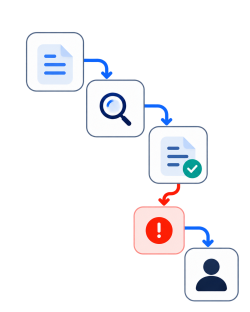
Planning to move AI agents beyond a prototype?

Before connecting agents to live workflows, review the architecture around them: data access, tool permissions, escalation logic, observability, and rollback paths.

Book an AI agent architecture review

What is an AI agent development company?

An AI agent development company builds AI systems that can use tools, access data, support decisions, and act inside business workflows with controlled autonomy.

What are custom AI agent development services?

Custom AI agent development services design and build agents around a company’s specific workflow, data, systems, rules, and risk requirements.

How do AI agents differ from chatbots?

Chatbots mainly answer questions. AI agents can also retrieve data, call tools, update systems, trigger workflows, and escalate decisions when needed.

What makes an AI agent production-ready?

An AI agent is production-ready when it has clear goals, reliable data access, secure integrations, authority boundaries, human review, monitoring, and ongoing ownership.

Why is governance important in AI agent development?

Governance matters because AI agents may access data, use tools, and influence business actions. It defines limits, accountability, review rules, and error handling.

What is human-in-the-loop in AI agent systems?

Human-in-the-loop means a person reviews, approves, corrects, or overrides the agent at defined points in the workflow, especially in higher-risk cases.

How should companies choose an AI agent development partner?

Choose a partner that understands workflows, integrations, security, governance, observability, and long-term support, not just model demos.

What industries benefit most from AI agent development?

Industries with complex workflows, heavy information flows, repetitive decisions, and high operational pressure benefit most, including FinTech, HealthTech, SaaS, logistics, support, and compliance-heavy operations.

Heading 1

Heading 2

Heading 3

Heading 4

Heading 5
Heading 6

Lorem ipsum dolor sit amet, consectetur adipiscing elit, sed do eiusmod tempor incididunt ut labore et dolore magna aliqua. Ut enim ad minim veniam, quis nostrud exercitation ullamco laboris nisi ut aliquip ex ea commodo consequat. Duis aute irure dolor in reprehenderit in voluptate velit esse cillum dolore eu fugiat nulla pariatur.

Block quote

Ordered list

  1. Item 1
  2. Item 2
  3. Item 3

Unordered list

  • Item A
  • Item B
  • Item C

Text link

Bold text

Emphasis

Superscript

Subscript

AI
Konstantin Karpushin
Rate this article!
Thank you! Your submission has been received!
Oops! Something went wrong while submitting the form.
83
ratings, average
4.9
out of 5
June 17, 2026
Share
text
Link copied icon

LATEST ARTICLES

Ignition Integrations for Accounting Firms: What Syncs After a Proposal Is Signed?
October 27, 2026
|
17
min read

Ignition Integrations for Accounting Firms: What Syncs After a Proposal Is Signed?

What Ignition's integrations sync after a proposal is signed, how native connections, Zapier and the Ignition API compare, and what to test before go-live.

by Konstantin Karpushin
Legal & Consulting
Read more
Read more
Karbon Integrations: What Syncs, in Which Direction, and When to Go Custom
October 27, 2026
|
13
min read

Karbon Integrations: What Syncs, in Which Direction, and When to Go Custom

Compare Karbon integrations by data, sync direction, and workflow. Learn when native connections, Zapier, or custom development fit your accounting firm best.

by Konstantin Karpushin
Accounting
Read more
Read more
Sage Intacct Integrations: 7 Workflows to Automate, and When You Need Custom Development
October 26, 2026
|
13
min read

Sage Intacct Integrations: 7 Workflows to Automate, and When You Need Custom Development

Explore seven Sage Intacct integration workflows, compare prebuilt connectors with custom APIs, and learn when automation or AI agents make sense for your team.

by Konstantin Karpushin
Accounting
Read more
Read more
Invoice Validation: Checks, Common Failures, and What to Automate
October 26, 2026
|
16
min read

Invoice Validation: Checks, Common Failures, and What to Automate

Which invoice validation checks to run, what a passed check proves, why invoices fail or cannot be verified, and what to automate around the ERP you already have.

by Konstantin Karpushin
Accounting
Read more
Read more
Invoice Approval Workflow: Design, Thresholds, and Controls
October 20, 2026
|
14
min read

Invoice Approval Workflow: Design, Thresholds, and Controls

How to design an invoice approval workflow that holds: matrix tiers, segregation of duties, exception routing, and which invoices should never be auto-approved.

by Konstantin Karpushin
Legal & Consulting
Read more
Read more
Non-PO Invoice: Examples, Approval Process, and What to Automate
October 20, 2026
|
14
min read

Non-PO Invoice: Examples, Approval Process, and What to Automate

What a non-PO invoice is, the five situations behind a missing PO, how to verify and approve each one, a worked example, and what AP teams can automate safely.

by Konstantin Karpushin
Accounting
Read more
Read more
Audit Documentation Checklist: 25 Checks Before Review and Sign-Off
October 14, 2026
|
11
min read

Audit Documentation Checklist: 25 Checks Before Review and Sign-Off

A 25-point audit documentation checklist mapped to AS 1215, AU-C 230 and ISA 230, with review stages, statuses and a downloadable template for your firm to use.

by Konstantin Karpushin
Accounting
Read more
Read more
Best Accounts Payable Automation Software in 2026: 7 Tools Compared and When to Go Custom
October 14, 2026
|
17
min read

Best Accounts Payable Automation Software in 2026: 7 Tools Compared and When to Go Custom

Seven AP automation tools compared on strengths, limitations, pricing and fit, plus a seven-invoice test to run before you buy, and when to go custom instead.

by Konstantin Karpushin
Accounting
Read more
Read more
Vendor Statement Reconciliation: How to Find, Explain, and Resolve AP Discrepancies
October 13, 2026
|
17
min read

Vendor Statement Reconciliation: How to Find, Explain, and Resolve AP Discrepancies

How vendor statement reconciliation works, a worked example, why supplier balances differ from AP, and who approves each fix when a firm reconciles for clients.

by Konstantin Karpushin
Accounting
Read more
Read more
Audit Workpapers: How to Build Review-Ready Files and What to Automate
October 12, 2026
|
18
min read

Audit Workpapers: How to Build Review-Ready Files and What to Automate

What audit workpapers must contain, a worked example, PCAOB, AICPA and ISA documentation rules compared, and how to automate preparation with a full trail.

by Konstantin Karpushin
Accounting
Read more
Read more
Logo Codebridge

Let’s collaborate

Have a project in mind?
Tell us everything about your project or product, we’ll be glad to help.
call icon
+1 302 688 70 80
email icon
business@codebridge.tech
Attach file
By submitting this form, you consent to the processing of your personal data uploaded through the contact form above, in accordance with the terms of Codebridge Technology, Inc.'s  Privacy Policy.

Thank you!

Your submission has been received!

What’s next?

1
Our experts will analyse your requirements and contact you within 1-2 business days.
2
Out team will collect all requirements for your project, and if needed, we will sign an NDA to ensure the highest level of privacy.
3
We will develop a comprehensive proposal and an action plan for your project with estimates, timelines, CVs, etc.
Oops! Something went wrong while submitting the form.