

Why 80% of Beauty Salons Struggle with Retention and How Mobile Apps Change the Game in 2026
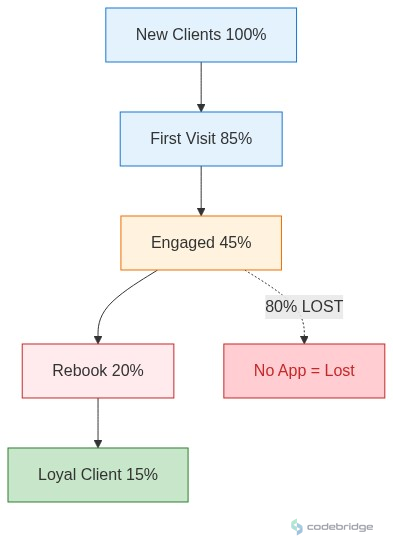
Here's a stat that should stop every salon owner cold. 80% of salons[1] report client retention as their primary challenge. Not finding new clients. Keeping the ones they already have. And yet most beauty businesses still pour money into acquisition while ignoring the app-based tools that could lock in loyalty. The beauty tech market is racing toward $79.87 billion in 2026[2]. Salons without mobile strategies aren't just behind. They're invisible.
Key Takeaways
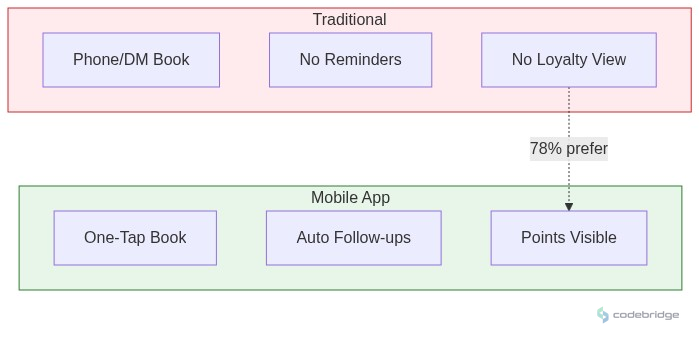
- 78% of customers[3] now use beauty apps to book salon appointments. No app means losing three-quarters of potential bookings.
- The salon software market hits $1.69 billion by 2030[4] with 10.9% annual growth. Early movers capture market share.
- Beauty salon apps added 22 million users[4] while generating $54 billion in revenue. The infrastructure exists. Adoption wins.
- Ulta Beauty saw a 9% year-over-year increase[2] in app downloads by February 2026. Even giants are doubling down on mobile.
- Nearly 80% of users[3] prefer booking beauty services through mobile apps over any other channel.
The Problem Most Miss
Conventional wisdom says growing a salon chain means opening more locations. More chairs. More staff. More overhead. But here's what the data actually reveals. The bottleneck isn't acquisition. It's retention. Salons spend heavily to bring clients through the door once. Then those clients vanish. Why? Because there's no system keeping them engaged between visits.
Ulta Beauty figured this out years ago. Their mobile app doesn't just let customers browse products. It creates an ecosystem. Personalized recommendations. Easy rebooking. Loyalty points visible at a glance. The result? That 9% jump in downloads[2] isn't luck. It's strategy. When a client can rebook their next hair coloring appointment in 30 seconds while still in the salon chair, they do it. When they have to remember to call next month, they don't.
For hair coloring and permanent makeup specialists, this matters even more. These services require regular touch-ups. A client who gets microblading needs a follow-up. Someone maintaining platinum blonde needs toner every six weeks. Without automated reminders and one-tap rebooking, these repeat visits slip away. The lifetime value of each client drops dramatically.
What the Data Shows
The numbers paint a clear picture. 78% of customers[3] use apps to book salon appointments. That's not a trend. It's the new baseline. Salons still relying on phone calls or Instagram DMs are fighting with one hand tied behind their back. The convenience gap is real, and clients notice it.
Look at what's happening in the broader market. Online beauty sales are rising 9.8% in 2026[2], with e-commerce penetration hitting 41%. Consumers expect digital experiences everywhere. When they can order skincare with two taps but have to play phone tag to book an appointment, frustration builds. That frustration drives them to competitors with better systems.
While this data comes primarily from mature markets like the U.S. and Western Europe, these patterns are even more pronounced in emerging markets like Eastern Europe. Belarus and neighboring countries are leapfrogging traditional booking methods entirely. Mobile-first populations expect app-based experiences. Local payment integrations like ERIP and Russian payment systems make in-app transactions seamless. The opportunity for early movers is significant.
StyleSeat and Glamsquad prove the model works. These platforms give independent beauty professionals and small chains the same mobile infrastructure that major retailers spent millions building. 50% of salon customers[1] already use mobile apps for bookings. The other 50% will follow as app experiences improve. The question isn't whether to build mobile capabilities. It's how fast you can implement them.
The 2026 Shift
Trend 1: Subscription-based beauty services explode. Monthly manicure subscriptions. Quarterly color touch-up packages. Permanent makeup maintenance plans. Mobile pros on platforms like StyleSeat[5] are already offering these. Why now? Post-pandemic clients crave predictability. They want beauty maintenance on autopilot. Apps make subscription management effortless for both sides.
Trend 2: On-demand home services go mainstream. Glamsquad built a business on bringing beauty to clients' homes and offices. In 2026, this accelerates. Busy professionals don't want to commute for a blowout. They want the blowout to come to them. Apps enable scheduling, routing, and payment for mobile services that would be logistically impossible otherwise.
Trend 3: Interactive shopping changes product sales.58% of consumers[2] are now open to shopping via livestreams. For salons selling professional hair color products or aftercare items, this opens new revenue channels. Imagine a colorist demonstrating toner application live through the salon app. Clients watch, learn, and buy products without leaving the app. That's where this is heading.
Practical Framework
Here's how to turn these insights into action. No vague advice. Specific steps with measurable benchmarks.
- Implement one-tap rebooking. Target benchmark: 40% of appointments should be rebooked before the client leaves. Ulta's app success shows this works. Make the next appointment the default, not the exception.
- Build automated reminder sequences. Push notifications at 7 days, 3 days, and 24 hours before appointments. For hair coloring clients, add a "time for a touch-up" reminder at 4-6 weeks post-service based on their specific treatment.
- Create a points-based loyalty program. Award points for bookings, referrals, and product purchases. Benchmark: 25% of active app users should redeem points monthly. This drives both retention and engagement.
- Enable in-app payment with local options. For Eastern European markets, integrate ERIP, card payments, and popular local e-wallets. Remove every friction point between "I want this" and "I paid for this."
- Launch subscription packages. Start with your highest-margin recurring service. For permanent makeup, offer annual touch-up plans. For hair coloring, monthly root maintenance subscriptions. Target: 15% of clients on subscription within six months.
- Add service history tracking. Show clients their color formulas, past treatments, and before-and-after photos. This data keeps them with you. It's harder to switch salons when your entire beauty history lives in one app.
- Integrate staff scheduling with client preferences. Let clients book their preferred colorist or technician directly. Benchmark: 60% of bookings should be with a specific staff member. This builds personal loyalty, not just brand loyalty.
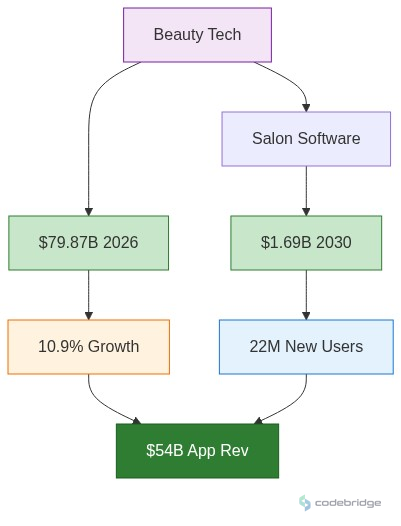
The bottom line? Mobile apps aren't a nice-to-have for salon chains anymore. They're the infrastructure that makes retention possible at scale. The $54 billion[4] already flowing through beauty salon apps proves the model. The only question is whether your business captures its share or watches competitors take it.
References
- Wifitalents, Salon Industry Statistics: Reports, 2026
- Freeyourself, Beauty App Usage Growth Statistics, 2026
- Digittrix, Must-Have Features for Beauty & Salon Apps, 2026
- NimbleAppGenie, Beauty Salon Statistics, 2026
- SendWork Blog, Mobile Beauty Trends, Innovations and Opportunities, 2026
Heading 1
Heading 2
Heading 3
Heading 4
Heading 5
Heading 6
Lorem ipsum dolor sit amet, consectetur adipiscing elit, sed do eiusmod tempor incididunt ut labore et dolore magna aliqua. Ut enim ad minim veniam, quis nostrud exercitation ullamco laboris nisi ut aliquip ex ea commodo consequat. Duis aute irure dolor in reprehenderit in voluptate velit esse cillum dolore eu fugiat nulla pariatur.
Block quote
Ordered list
- Item 1
- Item 2
- Item 3
Unordered list
- Item A
- Item B
- Item C
Bold text
Emphasis
Superscript
Subscript








.avif)


.avif)

.avif)