


The Mobile Conversion Paradox in Real Estate Apps
Here's a statistic that should give every PropTech founder pause: while 76% of homebuyers now use mobile devices for their property search, mobile conversion rates in real estate sit at a dismal 2.49%—less than half of desktop's 5.06%. This means the channel where your users spend the most time is also the one leaking the most leads. For teams building mobile-first real estate apps, understanding this paradox isn't optional—it's the difference between an app that generates pipeline and one that simply generates downloads.
Key Takeaways
- The mobile-desktop conversion gap is real: Despite 76% mobile search behavior, desktop converts at more than double the rate—your mobile UX must work twice as hard.
- CRM integration isn't a nice-to-have: Agents using integrated CRM systems see a 41% increase in lead conversions.
- Custom apps outperform big-box platforms: Private-label mobile apps are achieving 300% conversion gains over marketplace listings by eliminating data leakage.
- Speed directly impacts revenue: Fast-loading mobile experiences correlate with 30% higher conversion rates in real estate contexts.
- 2026's competitive edge is AI-driven lead scoring: 54% of agents report AI helps identify high-quality leads—baking this into your app architecture now creates defensible advantage.
The Problem Most Miss
Most real estate app teams obsess over feature parity with Zillow or Realtor.com. They build extensive listing databases, integrate mortgage calculators, and add neighborhood data. But they overlook a fundamental structural issue: mobile users behave differently than desktop users, and treating mobile as "desktop, but smaller" destroys conversion potential.
The counter-intuitive reality is that mobile's high usage doesn't translate to high conversion. Users browse extensively on mobile but often switch to desktop to complete high-stakes actions like submitting contact information or scheduling tours. This isn't a flaw in user behavior—it's a signal that mobile experiences aren't yet meeting the trust and usability thresholds required for real estate decisions. The startups winning in 2026 aren't building feature-complete mobile apps; they're building mobile apps that excel at the specific moments where conversion happens.
There's another blind spot: data ownership. When agents generate leads through Zillow or Realtor.com, that data flows to the platform first—and often gets resold to competing agents. Custom mobile apps solve this by creating direct channels between agents and buyers, but only if the app experience is compelling enough to pull users away from the aggregators they already know.
What Data Shows
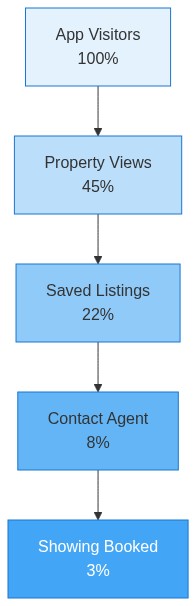
The performance gap between average and top-tier real estate platforms is significant. According to Promodo's 2025 Real Estate Marketing Metrics report, the average real estate website conversion rate sits at 4.7%, while top performers like Zillow and Realtor.com exceed 5%. That 0.3% difference sounds marginal until you calculate it against lead volume: for an app generating 100,000 monthly visitors, that gap represents 300 additional captured leads per month.
The mechanics behind these top performers reveal actionable patterns. HomeStack's implementation data shows that mobile apps combining buyer analytics, push notifications, super search functionality, and virtual tours with CRM integration achieved lead conversion rates soaring by 300% alongside a 60% reduction in property search times. The correlation between reduced friction (faster searches) and increased conversion isn't coincidental—it reflects how mobile users make decisions.
Organic search remains a significant acquisition channel, converting at 3.2% in real estate. However, this channel's effectiveness depends heavily on where users land post-search. Mobile users arriving from organic search who encounter slow-loading or confusing app experiences bounce at dramatically higher rates than desktop users facing the same friction. The optimization opportunity lies not in driving more organic traffic, but in ensuring the mobile app experience matches the intent that brought users there.
The 2026 Shift
Three interconnected trends are reshaping real estate app strategy this year, and all of them favor teams with strong mobile UX foundations. First, AI-powered lead identification is moving from enterprise-only to standard feature. With 54% of agents already reporting that AI helps identify high-quality leads, apps that integrate predictive lead scoring into their core architecture will capture disproportionate agent adoption. The technical implication: your app's data model needs to support behavioral signals that feed AI qualification from day one.
Second, the exodus from big-box platforms is accelerating. Agents have realized that Zillow's business model—which sells their leads to other agents—fundamentally conflicts with their interests. Custom private-label mobile apps that offer concierge-level experiences while keeping data ownership with the agent are achieving the 300% conversion gains documented by HomeStack. This creates an opening for PropTech startups that can deliver premium mobile experiences at scale.
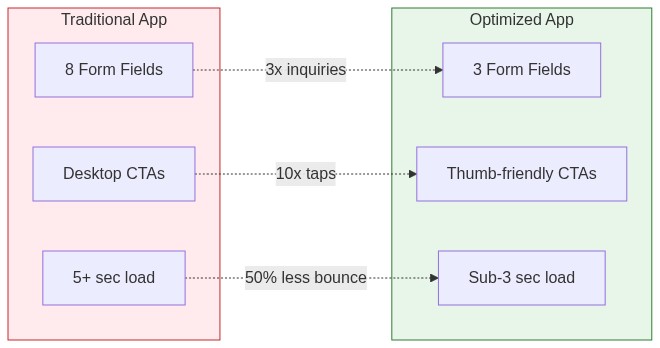
Third, mobile-first design has evolved from best practice to survival requirement. With 80% of real estate traffic now mobile-influenced, apps that fail to optimize for mobile-specific behaviors—thumb-friendly navigation, progressive disclosure of property details, one-tap contact actions—will lose to competitors who do. The teams seeing 30% higher conversion rates from fast-loading pages aren't just optimizing for speed; they're optimizing for how mobile users actually make property decisions.
Practical Framework: Mobile Real Estate App Conversion Optimization
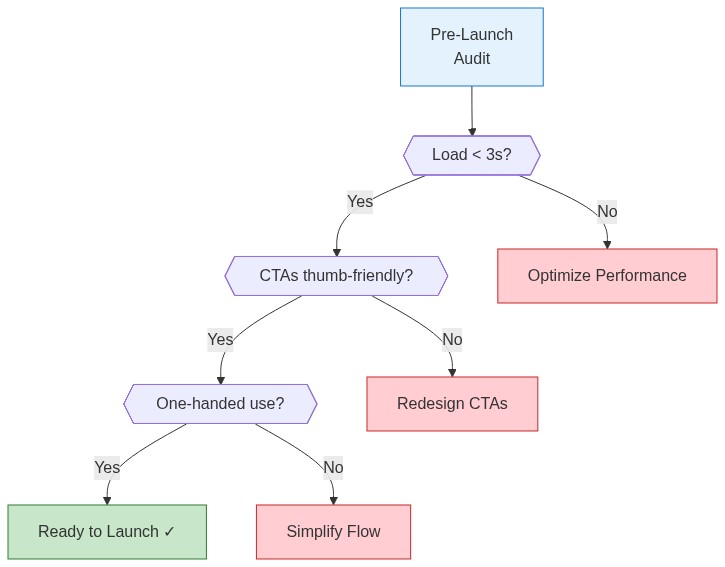
- Audit your conversion moments: Map the three or four specific screens where users convert (lead form, tour scheduling, save property, agent contact) and optimize these relentlessly before adding features.
- Implement sub-3-second load targets: Set performance budgets for critical user paths and treat load time as a conversion metric, not a technical metric.
- Build CRM integration into MVP scope: Given the documented 41% conversion lift from CRM integration, this isn't a phase-two feature—it's core to agent value proposition.
- Design for mobile-specific trust signals: Include agent photos, response time badges, and verified reviews prominently on mobile screens where users decide whether to submit contact information.
- Create data architecture for AI readiness: Track behavioral events (property saves, search refinements, time on listing) in a format that supports future lead scoring models.
- Test progressive conversion paths: Rather than requiring full contact forms, experiment with micro-conversions (save property, get price alerts) that capture intent with lower friction.
- Benchmark against top performers: Use the 5%+ conversion rate achieved by Zillow as your north star, not industry average of 2-4%.
Sources
- Promodo. "2025 Real Estate Marketing Metrics & Benchmarks." https://www.promodo.com/blog/real-estate-benchmarks-2024
- Amra & Elma. "TOP 20 REALTOR MARKETING STATISTICS 2025." https://www.amraandelma.com/realtor-marketing-statistics/
- HomeStack. "Top 7 Tech Features Every Realtor Needs to Convert Leads in 2025." https://www.homestack.com/blog/top-7-tech-features-every-realtor-needs-to-convert-leads-in-2025
Heading 1
Heading 2
Heading 3
Heading 4
Heading 5
Heading 6
Lorem ipsum dolor sit amet, consectetur adipiscing elit, sed do eiusmod tempor incididunt ut labore et dolore magna aliqua. Ut enim ad minim veniam, quis nostrud exercitation ullamco laboris nisi ut aliquip ex ea commodo consequat. Duis aute irure dolor in reprehenderit in voluptate velit esse cillum dolore eu fugiat nulla pariatur.
Block quote
Ordered list
- Item 1
- Item 2
- Item 3
Unordered list
- Item A
- Item B
- Item C
Bold text
Emphasis
Superscript
Subscript










.avif)



.avif)

.avif)