


Mobile App UX Patterns That Drive Property Search Conversion in 2026
Last quarter, a sales ops director at a mid-sized multifamily operator watched her team celebrate hitting their highest-ever lead volume from their property search app. Three weeks later, she was in a budget meeting explaining why cost per lease had nearly doubled despite the "record performance." The leads were there. The conversions weren't. Sound familiar?

The Hidden Problem Nobody Wants to Admit
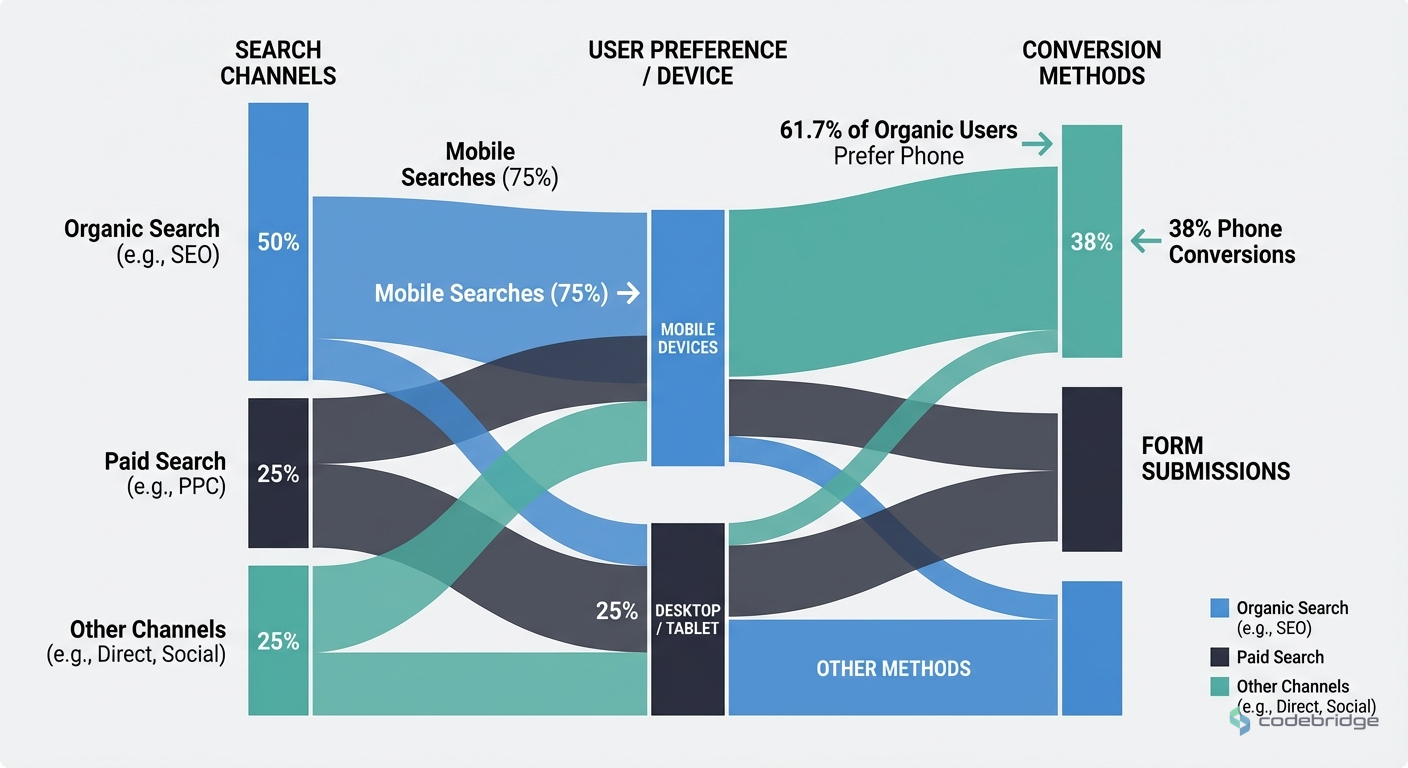
Here's the uncomfortable truth we're all dancing around: 75% of rental searches now happen on mobile devices, according to CallRail's 2026 analysis. Yet most property search apps are still optimized for a desktop-first world that stopped existing three years ago. We've bolted mobile interfaces onto desktop thinking and called it "responsive design."
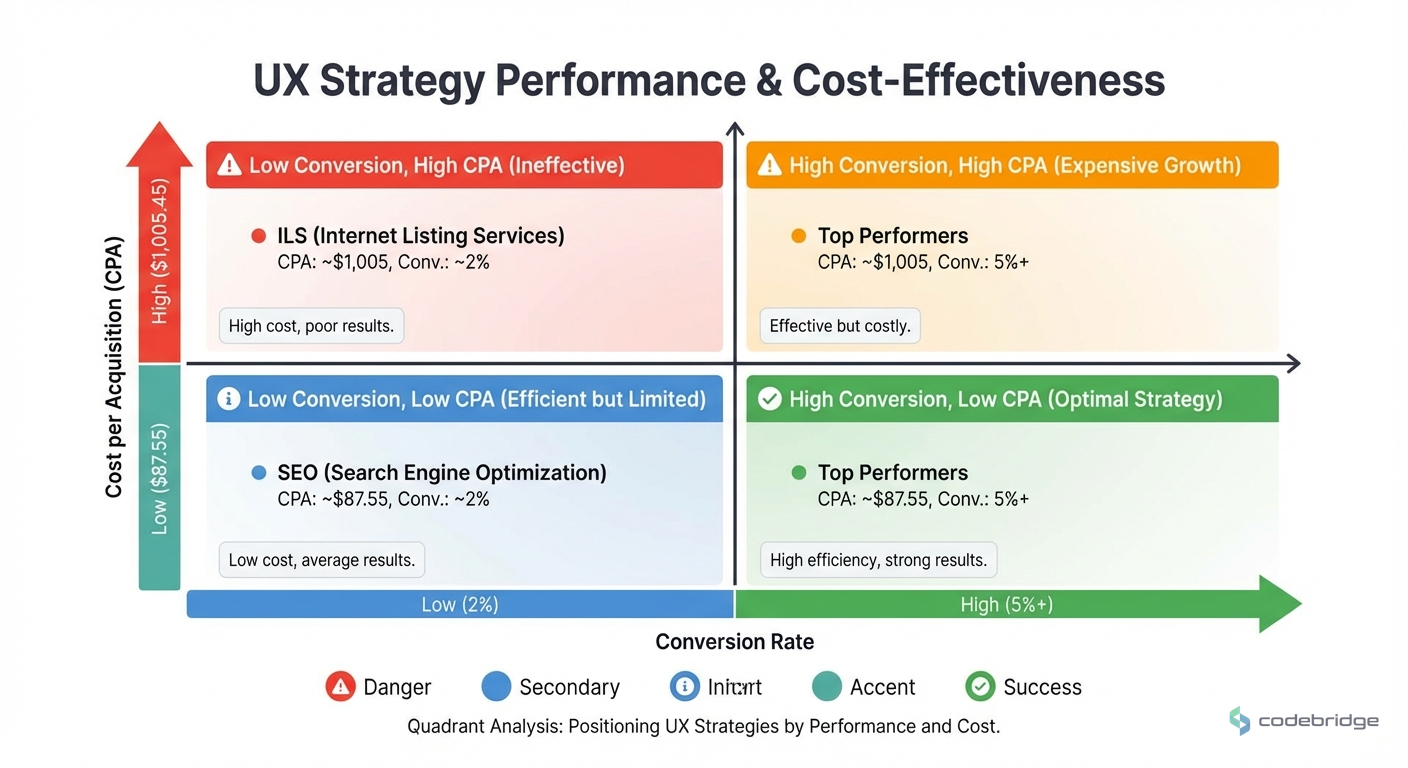
The numbers tell the story. The average real estate digital conversion rate sits at 4.7%, but website conversion rates hover around 2% for most players. Meanwhile, top performers like Zillow and Realtor.com consistently exceed 5%,more than double the industry average. That gap isn't about better listings or bigger marketing budgets. It's about understanding how mobile users actually convert.
The Phone Call Paradox
Here's something that might break your assumptions: despite all our investment in digital forms, chat widgets, and self-service scheduling, phone interactions still account for 38% of all successful real estate conversions. Even more striking? 61.7% of organic search users and 75.4% of ad clickers prefer converting by phone.
We've spent years trying to eliminate phone calls from the funnel, treating them as a legacy channel for people who "don't get" digital. Meanwhile, our highest-intent prospects are desperately looking for a click-to-call button we've buried three taps deep because it didn't fit our "modern" UX vision.
What Top Performers Actually Do Differently
The teams crushing conversion aren't running radically different playbooks. They're executing on fundamentals that most of us know but haven't prioritized. The REACH by RentCafe study across 34 companies and 261 properties revealed something startling: cost per lease through optimized SEO paths (heavily mobile) was $87.55 versus $1,005.45 through Internet Listing Services,an 11x cost advantage. That's not a rounding error. That's a business model difference.
What's driving that gap? Three patterns keep emerging:
1. They've Made Phone Calls a First-Class Citizen
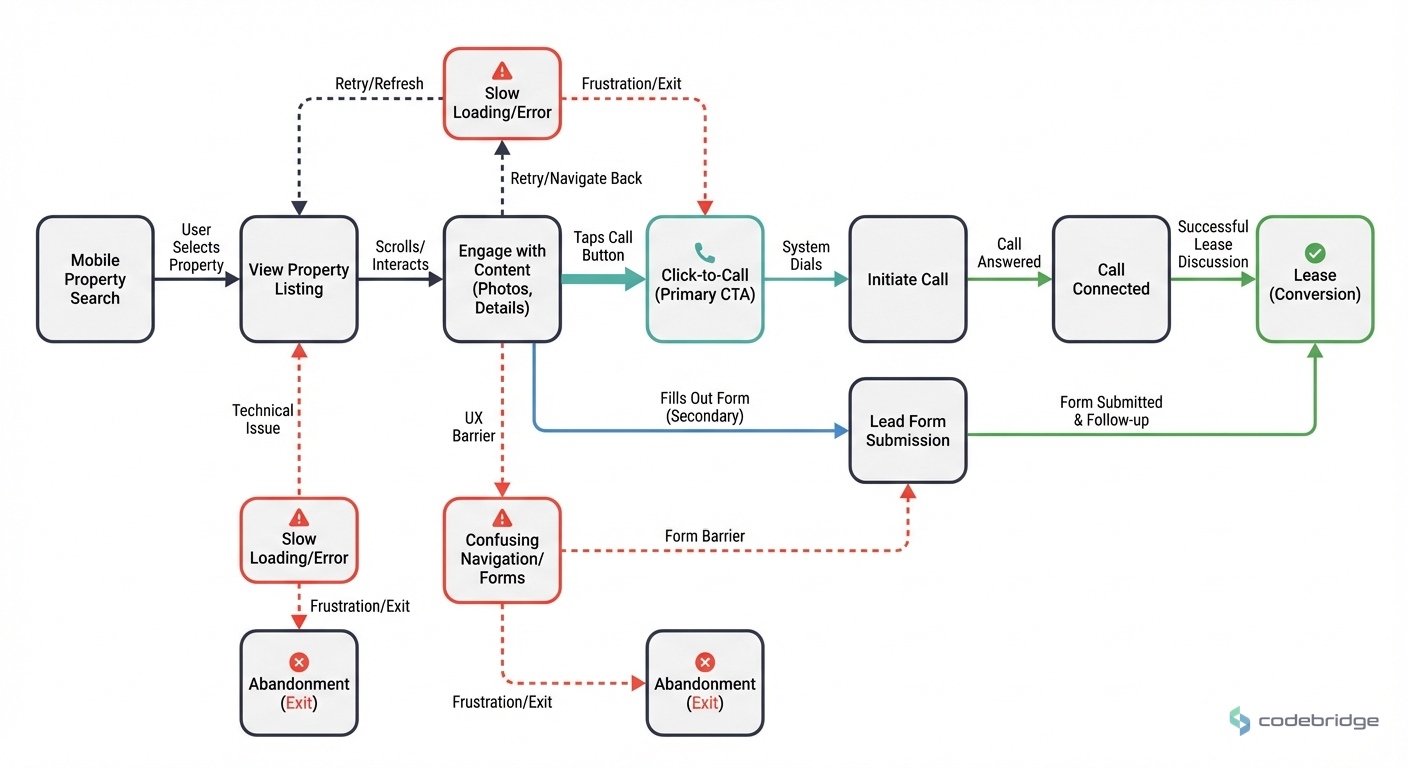
Top-converting apps treat click-to-call as a primary CTA, not an afterthought. They've recognized that someone willing to actually speak to a human is signaling serious intent. The UX reflects this,prominent placement, smart routing, and smooth handoff to leasing teams who know the prospect was looking at Unit 4B before they dialed.
2. They're Obsessive About Micro-Friction
A case from UXCam's research illustrates this perfectly. Placemakers, a building supplies retailer, discovered that a single confusing label on their app,just one piece of UX copy marking temporarily unavailable products,was tanking conversions so badly it would have doubled their acquisition spend if left unfixed. One label. Double the CAC.
In property search, these micro-friction points are everywhere: confusing availability indicators, form fields that don't auto-populate, photo galleries that load slowly on cellular, tour scheduling flows that require too many taps. Each one feels minor. Collectively, they're bleeding conversions.
3. They're Re-Engaging Abandoned Searches Systematically
Push notifications get a bad reputation because most teams use them badly. But the data is clear: abandoned-cart style push notifications generate 3-5% CTR, with overall push conversion rates ranging from 1.5-4%. Applied to property search,alerting users when a saved listing drops in price, when a similar unit becomes available, when their abandoned tour request can still be completed,these touchpoints recover intent that would otherwise evaporate.
The Framework That Actually Works
After analyzing the patterns from top performers and the research data, here's what sales ops teams should be pushing their product counterparts to implement:
Step 1: Audit Your Mobile Conversion Paths With Session Replay
You can't fix what you can't see. Tools that capture actual user sessions reveal where prospects are getting stuck, confused, or abandoning. The Placemakers case wasn't discovered through surveys or A/B testing,it was found by watching real users struggle with a UI element that seemed perfectly clear to the team who built it.
Step 2: Elevate Click-to-Call to Primary CTA Status
Given that three-quarters of ad clickers prefer phone conversion, your mobile UX should make calling as easy as tapping a listing photo. This means persistent call buttons, smart routing based on which property the user was viewing, and CRM integration that gives your leasing team context before they answer.
Step 3: Implement Stage-by-Stage Conversion Tracking
As Realtor.com's 2026 guidance emphasizes, "conversion rates reveal the real story behind your pipeline." Stop celebrating lead volume. Start tracking conversion at each stage: search → save → inquiry → tour → application → lease. This reveals exactly where your mobile UX is failing and where investment will have the highest ROI.
Step 4: Build an Intelligent Re-Engagement System
Map your abandonment points and create targeted push notification sequences for each. Someone who saved a listing but never inquired needs a different message than someone who started a tour request but didn't complete it. The 1-2% install-to-purchase benchmark cited by UXCam is the floor,teams with sophisticated re-engagement consistently exceed it.
Step 5: Treat App Store Listing as Part of Your Conversion Funnel
With 33.7% page-view-to-install conversion on Apple's App Store and 26.4% on Google Play, your app store presence is a critical conversion point. Screenshots, descriptions, and ratings directly impact whether prospects ever enter your funnel. This isn't marketing's problem,it's a sales ops concern because it affects lead quality and volume.
Coming Full Circle
That sales ops director from our opening story? She eventually traced the conversion collapse to a seemingly minor app update that had changed the tour scheduling flow. Three additional taps, a confusing calendar interface, and a form field that didn't remember user information. Nothing that would show up in a feature review. Everything that matters when a prospect is trying to book a tour while standing outside a property they just drove past.
The fix took two weeks. Conversion recovered within a month. The lesson took longer to sink in: in a world where your first impression happens on a smartphone, mobile UX isn't a product team concern you can delegate. It's a sales ops imperative that directly determines whether your pipeline performs or bleeds.
The PropTech market is projected to hit $86.5 billion by 2032, growing at 12.8% CAGR. That growth will flow to teams who understand that mobile conversion isn't about having an app,it's about having an app that converts. The patterns are clear. The question is whether you'll implement them before your competitors do.
Diagnostic Checklist: Is Your Mobile Property Search Underperforming?
- ☐ Your visitor-to-lead conversion rate is below the 2.2% benchmark
- ☐ Click-to-call is buried more than one tap from any listing view
- ☐ You can't tell which property a caller was viewing when they dialed
- ☐ Your tour scheduling flow requires more than 4 taps to complete
- ☐ You have no session replay or heatmap data showing where users abandon
- ☐ Push notifications are either disabled or sent to all users identically
- ☐ You track lead volume but not stage-by-stage conversion rates
- ☐ Your app store listing hasn't been updated in over 6 months
- ☐ Mobile conversion rate is lower than desktop despite higher traffic volume
References
- CallRail, 15 Must-Know Real Estate Marketing Statistics for 2026
- Promodo, Real Estate Marketing Benchmarks 2026
- UXCam, Mobile App Conversion Rate Benchmarks & Tips for 2025
- CMARIX, Mobile App Development Statistics 2026: Usage, Trends & Growth
- Realtor.com, Beyond the Bottom Line: Metrics That Matter Most in 2026
- True Value Infosoft, How Much Does Real Estate App Development Cost in 2026
Heading 1
Heading 2
Heading 3
Heading 4
Heading 5
Heading 6
Lorem ipsum dolor sit amet, consectetur adipiscing elit, sed do eiusmod tempor incididunt ut labore et dolore magna aliqua. Ut enim ad minim veniam, quis nostrud exercitation ullamco laboris nisi ut aliquip ex ea commodo consequat. Duis aute irure dolor in reprehenderit in voluptate velit esse cillum dolore eu fugiat nulla pariatur.
Block quote
Ordered list
- Item 1
- Item 2
- Item 3
Unordered list
- Item A
- Item B
- Item C
Bold text
Emphasis
Superscript
Subscript










.avif)



.avif)

.avif)