


The $3M Microservices Mistake: Why 62% of Fintech Teams Can't Show ROI After Year One
Three years ago, a fintech startup split their working monolith into dozens of microservices to "scale better." The result? Several years of migration yielded slower development and harder debugging, according to engineers who lived through it. When compliance reporting and debugging money-movement flows became so complex that the team partially reverted back to their monolith, they weren't alone.

The Industry's Dirty Secret
Despite microservices being the darling of modern architecture,with 89% of organizations preferring them and a market exploding from $6.5B to a projected $29.94B by 2032,there's a problem nobody talks about. The 2025 O'Reilly Microservices Adoption Survey reveals that 62% of organizations struggle to achieve ROI in the first year, despite massive investment in the transition.
In fintech, where regulatory compliance and transactional integrity are non-negotiable, this problem gets amplified. One team discovered this the hard way when they split customer onboarding, KYC, and transaction processing into separate services, only to create what they called "a distributed monolith with outages from subtle contract changes." The architecture choice, they admitted, "was premature and largely a mistake."
When Microservices Actually Work in Fintech
But here's where it gets interesting. Companies like Monzo Bank are handling millions of read requests per second with hundreds of independently deployable microservices. PayPal processes billions of global transactions using distributed microservices architecture. The difference isn't luck,it's approach.
The pattern among successful fintech microservices adoptions reveals three critical factors that most teams miss:
1. Domain-First, Not Technology-First Decomposition
Monzo's engineering leadership explains: "Microservices allow us to treat each banking capability as a self-contained product with its own reliability, security, and compliance posture, which is critical when you're operating at millions of requests per second." They didn't split services by technical layers,they split by business domains with clear regulatory boundaries.
Compare this to the team that split billing and account services "without clear boundaries" and created "reconciliation nightmares affecting transactional integrity." The lesson: financial systems require careful service boundary design to maintain transactional consistency.
2. Infrastructure Maturity Comes First
One early-stage startup adopted microservices from day one, only to discover their teams "without strong devops expertise faced fragile deployments and high operational overhead." They turned "a simple product into a distributed nightmare." Meanwhile, Square Payroll successfully transitioned from monolith to serverless microservices,but only after building mature operational capabilities.
The operational overhead of microservices grows exponentially with the number of services. Fintech platforms processing thousands of transactions per second succeed because they use microservices primarily to scale high-demand services (like payments) rather than decomposing everything.
3. Compliance-Aware Architecture Decisions
Here's the counter-intuitive insight that catches most fintech teams off guard: monolithic systems can be easier to centralize for compliance. As architecture experts note, this "can make them a better fit for industries like healthcare and finance with stringent data privacy requirements."
Zions Bank chose an incremental modernization strategy, using component-based approaches while retaining much of their monolithic design. They maintained stability of core systems while selectively modernizing, proving that partial modularization can deliver benefits without full microservices adoption.
[DIAGRAM:comparison]The 2026 Fintech Architecture Decision Framework
Based on analysis of successful and failed implementations, here's how to make the monolith vs. microservices decision in 2026:
Choose Microservices When You Have:
- Clear domain boundaries, Services like payments, fraud detection, and KYC that can own their data independently
- Mature DevOps capabilities, Automated deployment, monitoring, and incident response already in place
- Scale requirements for specific components, Need to scale payment processing to thousands of TPS while other services remain stable
- Regulatory compartmentalization needs, Different services must comply with different regulations (GDPR, PCI DSS) independently
Stick With Monolith (or Modular Monolith) When You Have:
- Tightly coupled business processes, Core ledger operations that require ACID transactions across multiple entities
- Limited operational maturity, Small teams without dedicated platform engineering capabilities
- Complex compliance reporting, Auditing requirements that need consistent data views across business processes
- Undefined domain boundaries, Early-stage products where business logic is still evolving
The Hybrid Approach (Winning Strategy for 2026)
The most successful fintech architectures in 2026 will be hybrid: monolithic cores for transactional consistency with microservices for specific capabilities. This aligns with emerging trends:
- Event-driven microservices for real-time risk and fraud detection using Kafka-based architectures
- Serverless microservices for variable workloads like payroll cycles and trading spikes
- AI/ML microservices for credit scoring and analytics that can be deployed and scaled independently
- Composable banking APIs that expose specific capabilities without decomposing the entire core
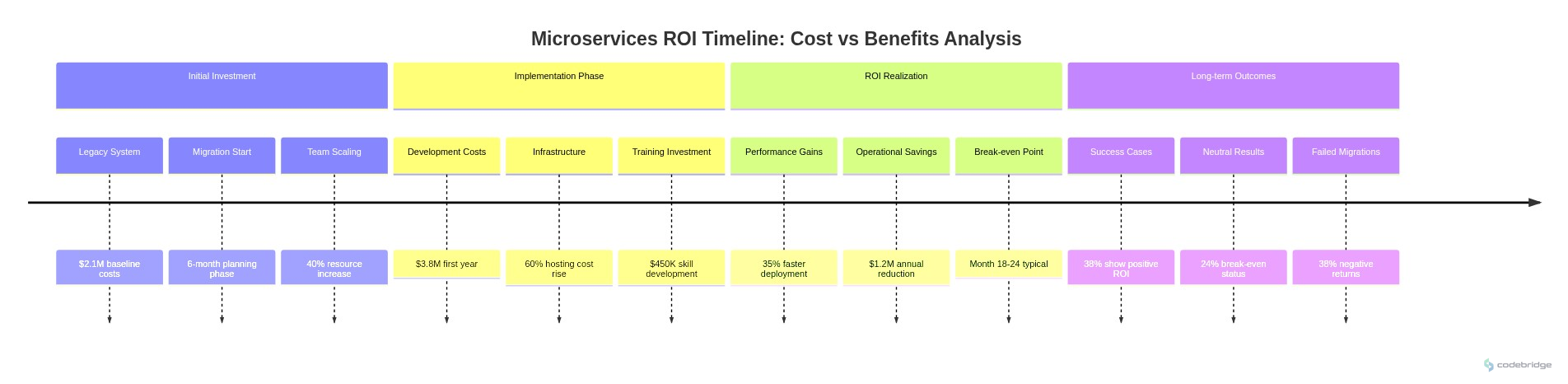
The Real Question Isn't Which Architecture
That fintech startup that split their working monolith? They eventually realized the real issue wasn't their architecture,it was premature optimization without clear business boundaries or operational maturity. The teams succeeding with microservices in 2026 aren't choosing technology first; they're solving specific scaling, compliance, or organizational problems that microservices address better than alternatives.
Before your next architecture decision, ask: What specific problem are we solving that our current architecture can't handle? The answer will tell you whether you need microservices, a better monolith, or something in between.
---Sources
- O'Reilly Microservices Adoption Survey 2025
- Introspective Market Research: Microservices Architecture Market Report
- Zymr: Microservices Architecture for FinTech Applications
- Kitrum: Microservices vs Monolithic Architecture Comparison
- Cohen Circle: Infrastructure and Connectivity Trends in Fintech
- Developer forum discussions from HackerNews, Reddit, StackOverflow, and Quora
Heading 1
Heading 2
Heading 3
Heading 4
Heading 5
Heading 6
Lorem ipsum dolor sit amet, consectetur adipiscing elit, sed do eiusmod tempor incididunt ut labore et dolore magna aliqua. Ut enim ad minim veniam, quis nostrud exercitation ullamco laboris nisi ut aliquip ex ea commodo consequat. Duis aute irure dolor in reprehenderit in voluptate velit esse cillum dolore eu fugiat nulla pariatur.
Block quote
Ordered list
- Item 1
- Item 2
- Item 3
Unordered list
- Item A
- Item B
- Item C
Bold text
Emphasis
Superscript
Subscript












.avif)



.avif)

.avif)