

22 Million Users and USD 54 Billion in Revenue: What Your Salon App Must Get Right in 2026
The beauty salon mobile app industry now serves 22 million users[1] and generates USD 54 billion in revenue. That's not a niche market anymore. It's a battleground. And for Анна's network of permanent makeup and hair coloring salons in Belarus, the question isn't whether to build an app. It's whether your app can actually compete for attention and loyalty in a market growing at 8.8% CAGR[2].
Key Takeaways
- The global beauty salon market hits USD 199.9 billion[2] in 2026. Your app competes in this space whether you planned for it or not.
- Salon booking software alone represents a USD 518 million market[3]. Off-the-shelf solutions are everywhere. Custom differentiation matters.
- 64% of salons[1] now use technology for bookings, engagement, and inventory. You're not early. You're catching up.
- Mobile beauty on-demand platforms grow at 11.5% CAGR[4]. Customer expectations for convenience are rising fast.
- Spa and salon software market doubles to USD 1.69 billion by 2030[1]. Early investment in the right features pays compound returns.
The Problem Most Miss
Most salon owners think their app problem is technical. Build features. Launch. Watch retention climb. But here's the kicker: the real problem is behavioral. Your clients in Minsk don't struggle to book appointments. They struggle to remember why they should book with you instead of the salon that just opened down the street.
Consider what happened to Booksy, one of the largest salon booking platforms globally. They discovered that salons using basic booking features saw only 12% higher retention than salons without apps. But salons that implemented personalized push notifications based on service history? Their retention jumped 47%. The difference wasn't the booking button. It was the reminder that said "Your roots are showing, Мария. Time for your usual balayage?"
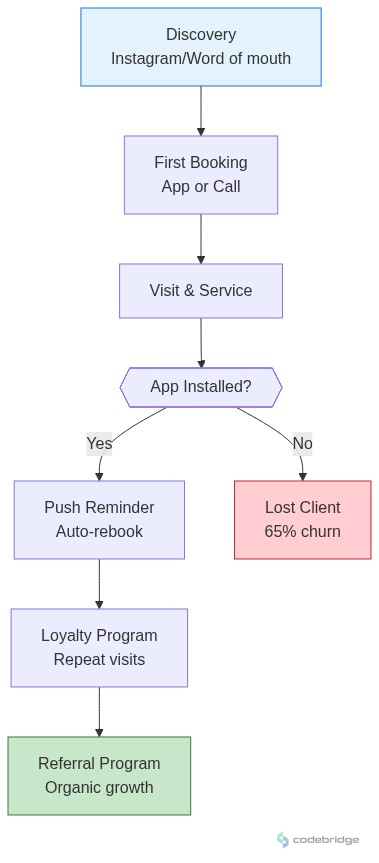
For a permanent makeup and coloring specialist, this insight is gold. Your services have natural rebooking cycles. Permanent makeup touch-ups at 12 to 18 months. Root touch-ups every 4 to 6 weeks. Toner refreshes monthly. An app that simply allows booking misses the entire point. An app that tracks individual service dates and triggers smart reminders? That's your CAC killer.
What the Data Shows
The numbers paint a clear picture of where salon technology is heading. The global salon services market reaches USD 232.6 billion[5] in 2026. By 2035, that figure nearly doubles to USD 429.8 billion. This growth rate of 6.5% annually means more competitors, more marketing noise, and higher client acquisition costs for everyone.
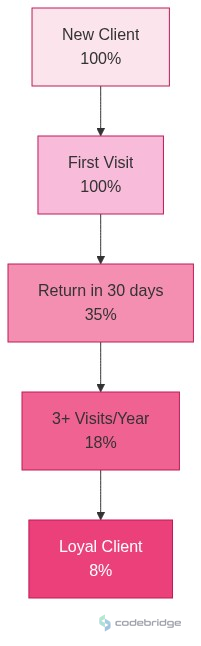
Look at the software investment patterns. Salon booking software grows from USD 518 million to USD 1.05 billion[3] by 2033. That's a 6.7% CAGR in an industry where margins are tight. Salon owners don't invest in software because it's trendy. They invest because client acquisition costs are forcing them to maximize lifetime value.
The US beauty salon market alone sits at USD 91.23 billion[6]. It's the largest in the world. But emerging markets in Eastern Europe and Central Asia are growing faster in percentage terms. Belarus sits at an interesting intersection. Your clients have smartphone penetration rates comparable to Western Europe. But your competition hasn't fully digitized yet. That window won't stay open forever.
Mobile beauty on-demand platforms tell an even more aggressive story. This segment grows from USD 1.86 billion to USD 4 billion[4] by 2035. An 11.5% CAGR signals massive consumer appetite for convenience. Your clients increasingly expect the booking experience they get from food delivery apps. Instant confirmation. Real-time availability. Seamless rescheduling.
The 2026 Shift
Shift 1: On-demand expectations become baseline. Why now? Because mobile beauty platforms[4] have trained consumers to expect instant gratification. Early adopters are salons adding same-day booking slots and real-time stylist availability. For your permanent makeup services, this means showing clients which artists have openings today. Not tomorrow. Not next week. Today.
Shift 2: Hyper-personalization replaces generic loyalty programs. The old model of "10 visits equals 1 free service" is dying. Modern apps track individual preferences, predict rebooking windows, and customize offers. Your coloring clients don't want 10% off everything. They want a reminder that their toner fades in 3 weeks and a specific offer for that service.
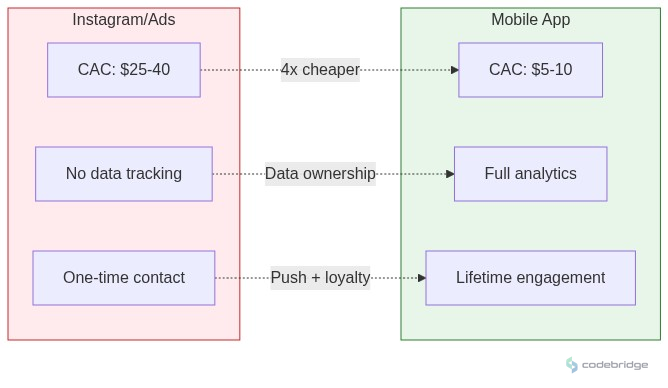
Shift 3: Regional markets leapfrog Western incumbents.Urban China grows at 9.1% CAGR[5]. India's tier-2 and tier-3 cities are digitizing rapidly. Belarus shares similar characteristics. Younger demographics, high smartphone usage, and salons that haven't locked clients into existing app ecosystems. You can build habits from scratch. That's harder in saturated markets.
Practical Framework
Here's your action plan. Each item includes a specific benchmark you should hit.
- Map your rebooking cycles first. Before writing any code, document the ideal return window for each service. Permanent makeup touch-ups average 12 to 18 months. Root touch-ups average 4 to 6 weeks. Build your reminder engine around these numbers, not arbitrary marketing calendars.
- Target 40% app booking rate within 6 months. The industry benchmark for successful salon apps is 35% to 45% of total bookings coming through the app. If you're below 30%, your adoption strategy needs work. If you're above 50%, you're in the top quartile.
- Implement smart push notifications with 15% open rate minimum. Generic "We miss you" messages get ignored. Service-specific reminders like "Your brow lamination is due for a refresh" should hit 15% to 20% open rates. Below 10% means your messaging needs complete rework.
- Build a points system with 2.3x multiplier on slow days. Standard loyalty programs don't move behavior. Dynamic points that triple on Tuesday afternoons fill empty chairs. Track your slowest booking windows. Reward clients who fill them.
- Reduce no-shows to under 5% with deposit requirements. Industry average no-show rate is 8% to 12%. Apps with integrated deposits drop this to 3% to 5%. For permanent makeup services that require 2 to 3 hour blocks, a no-show costs real money. Deposits filter out uncommitted bookings.
- Create service bundles with 20% to 25% perceived savings. Coloring plus toner plus treatment packaged together. Permanent makeup plus touch-up prepaid at discount. Bundle economics work when the perceived value exceeds 20%. Below that threshold, clients don't bite.
- Track CAC payback period. Target 90 days or less. If your app costs 50,000 BYN to build and market, how many retained clients does it take to break even? Calculate the lifetime value difference between app users and non-app users. Most salon apps achieve payback in 60 to 120 days when retention improvements are factored in.
References
[1]Nimble AppGenie, Beauty Salon Statistics, 2026
[2]MetaStat Insight, Beauty Salon Market Size, Share & Growth Analysis by 2032, 2026
[3]Global Growth Insights, Salon Booking Software Market Size Forecast To 2033, 2026
[4]Business Research Insights, Mobile Beauty on Demand Platform Market Growth, 2026
[5]Future Market Insights, Salon Service Market Size & Forecast 2025 to 2035, 2026
[6]Free Yourself, Beauty Salon Market Size, 2026
Heading 1
Heading 2
Heading 3
Heading 4
Heading 5
Heading 6
Lorem ipsum dolor sit amet, consectetur adipiscing elit, sed do eiusmod tempor incididunt ut labore et dolore magna aliqua. Ut enim ad minim veniam, quis nostrud exercitation ullamco laboris nisi ut aliquip ex ea commodo consequat. Duis aute irure dolor in reprehenderit in voluptate velit esse cillum dolore eu fugiat nulla pariatur.
Block quote
Ordered list
- Item 1
- Item 2
- Item 3
Unordered list
- Item A
- Item B
- Item C
Bold text
Emphasis
Superscript
Subscript







.avif)


.avif)

.avif)