22 Million Salon App Users Generate $54B: What Beauty Businesses Can Learn in 2026
Here's a number that should stop every beauty salon owner in their tracks. Salon mobile apps now serve 22 million users and generate $54 billion in revenue[1]. That's not a typo. And it's not just happening in New York or London. While this data comes primarily from mature markets, these patterns are even more pronounced in emerging markets like Eastern Europe, where digital adoption in services is accelerating faster than traditional infrastructure can keep up. The beauty tech market is sprinting toward $79.87 billion by the end of 2026[2]. Salons specializing in technical services like hair coloring and permanent makeup are perfectly positioned to capture this shift. But only if they understand what's actually driving these numbers.
Key Takeaways
About 50% of salon customers[3] now use apps for booking, making mobile the default channel
Most salon chains approach mobile apps backwards. They build booking functionality first and slap on a loyalty program later. The data suggests this sequence destroys value before it's created. Ulta Beauty didn't become the industry benchmark by accident. Their app downloads jumped 9% year-over-year because they built loyalty mechanics into the core experience from day one. Every booking, every purchase, every referral feeds a unified rewards system. The app isn't a convenience layer. It's the business model. Here's the kicker for hair coloring and permanent makeup specialists. These services have natural rebooking cycles of 4 to 8 weeks. That's not a scheduling problem. That's a retention goldmine waiting to be mined through automated reminders and loyalty rewards timed to service intervals. The salons winning right now understand that reducing customer acquisition cost starts with maximizing the value of customers already in the system.
What the Data Shows
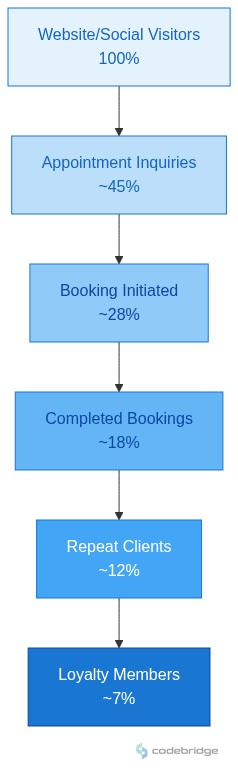
The beauty tech market grew from $68.87 billion in 2024 to $79.87 billion in 2026[2]. That's a 16% compound annual growth rate. Salon booking software specifically tracks at 6.7% CAGR[4], growing from $629 million to over $1 billion in under a decade. Beauty & Wellness / Salons Conversion Funnel But raw market size doesn't pay rent. What matters is conversion. Half of all salon customers already use apps for booking. The other half represents the acquisition opportunity. For Eastern European markets like Belarus, where smartphone penetration is high but salon app adoption lags Western competitors, the runway is even longer. The numbers get more interesting when you look at adjacent behaviors. About 58% of consumers are open to livestream shopping[2] for beauty products. Smart beauty device usage will reach 515.8 million users by 2029[2]. Clients aren't just booking appointments digitally. They're building entire beauty routines around mobile experiences. For specialized services like permanent makeup and professional coloring, this creates a unique advantage. These aren't impulse purchases. Clients research extensively before booking. An app that educates, showcases portfolios, and rewards loyalty captures that research phase instead of losing it to competitors.
The 2026 Shift
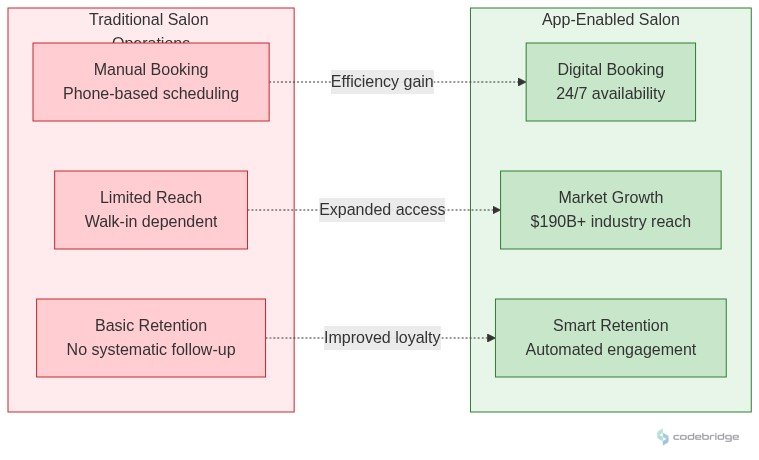
Three trends will reshape salon mobile strategy this year. Understanding the "why" behind each determines whether businesses lead or follow. First, loyalty integration becomes non-negotiable. The $54 billion salon app market[1] proves that transactional booking alone doesn't drive revenue growth. Loyalty mechanics do. Salons without points, tiers, or referral rewards in their apps will see acquisition costs climb while competitors' costs drop. Beauty & Wellness / Salons Before vs After Analysis Second, automated rebooking transforms retention economics. Technical services like balayage or microblading have predictable refresh cycles. Apps that trigger reminders at optimal intervals, say 6 weeks for root touch-ups, convert passive clients into recurring revenue without marketing spend. Third, regional market dynamics favor early movers. In Eastern Europe, the gap between consumer smartphone behavior and business digital capability creates opportunity. Local payment system integration, like ERIP in Belarus, removes friction that Western apps can't address. The salon chains building localized apps now will own their markets before global platforms arrive.
Practical Framework
Building a salon app that reduces CAC and increases retention requires hitting specific benchmarks. Generic "mobile-first" thinking won't cut it. 1. Target 50% booking migration to app within 6 months. Match the industry average from current adoption data[3] or admit the app isn't working. 2. Implement tiered loyalty with at least 3 reward levels. Ulta's model proves multi-tier systems drive engagement. Start with Bronze, Silver, Gold based on annual spend. 3. Set automated reminders at service-specific intervals. Hair color clients need 6 week prompts. Permanent makeup clients need 12 to 18 month refresh reminders. Configure these by service category, not arbitrary timeframes. 4. Integrate local payment systems on day one. For Belarus and Eastern Europe, this means ERIP, local card processors, and cash payment confirmation options. 5. Track CAC separately for app-acquired versus traditional clients. Benchmark should show 30% lower CAC for app users within year one. 6. Measure repeat visit rate by loyalty tier. Gold members should book 4x more frequently than non-members. If the gap is smaller, the rewards aren't compelling enough. 7. Build referral mechanics that reward both parties. Industry data shows referred clients have 25% higher lifetime value. Make referral codes easy to share directly from the app. Beauty & Wellness / Salons Key Metrics Dashboard The bottom line is simple. The salon industry is splitting into app-driven businesses and everyone else. The $1.128 billion booking software market[4] isn't growing because of hype. It's growing because the economics work. Salons that build mobile loyalty into their core operations will acquire customers cheaper, retain them longer, and outcompete chains still relying on walk-ins and phone calls.
Lorem ipsum dolor sit amet, consectetur adipiscing elit, sed do eiusmod tempor incididunt ut labore et dolore magna aliqua. Ut enim ad minim veniam, quis nostrud exercitation ullamco laboris nisi ut aliquip ex ea commodo consequat. Duis aute irure dolor in reprehenderit in voluptate velit esse cillum dolore eu fugiat nulla pariatur.
Cost-Effective IT Outsourcing Strategies for Businesses
Discover cost-effective IT outsourcing services for businesses. Learn how to enhance focus and access expert talent while reducing operational costs today!
Discover the best mobile app development company for your needs. Learn key traits and leading industry teams that can elevate your project and drive success.
Discover the top MVP development agencies to elevate your startup. Learn how partnering with a minimum viable product agencies can accelerate your success.
Discover the top mobile app development languages to choose the best coding language for your project. Learn more about native vs. cross-platform options!
Unlock growth with bespoke application development tailored to your business. Discover the benefits, processes, and competitive edge of creating custom software
Discover how to choose the right custom software partner for your business and understand the key benefits of bespoke software solutions tailored to your needs.
Avoid These 10 MVP Development Mistakes Like the Plague
Avoid the most dangerous MVP development mistakes. Learn the top pitfalls that derail startups and how to build a successful, validated product from day one.
Software Development Outsourcing Rates 2026: Costs and Trends
Explore 2026 software development outsourcing rates, emerging cost trends, regional price differences, and how AI-driven innovation is reshaping global pricing.
AI Business Solutions in 2026: How to Implement AI
Discover how AI business solutions in 2026 are transforming industries. Learn practical steps to implement AI, boost efficiency, and drive digital innovation.
Explore the future of cloud computing security in 2026. Learn expert insights on emerging threats, data protection trends, and best practices for defense.












.avif)



.avif)

.avif)