RecruitAI — Engineering Hiring Automation Platform
Reducing full-cycle hiring time from 24 days to 10–12 days while saving 200–300 engineering hours monthly through AI-assisted validation.


A US-based technology enterprise with over 1,000 employees reached a recruitment scaling inflection point: engineering applications had grown to 1,500–3,000 per month, while hiring targets increased to 120–200 engineers annually. Senior engineers were spending 200–400 hours monthly reviewing test assignments, and fragmented tools across sourcing, scheduling, and evaluation were causing response delays exceeding 24 hours. The result was rising hiring costs, slower cycle times, and growing risk of missed high-quality candidates.
Codebridge was engaged to design and deliver a production-grade, AI-assisted recruitment platform that would augment — not replace — human decision-making. The mandate was clear: automate early-stage screening, technical validation, and structured interview synthesis while preserving human-in-the-loop control at all final decision points. The system needed to integrate with existing HR workflows without requiring a full ATS replacement.
Over a 3-month engagement, a dedicated 5-person Codebridge team delivered a scalable multi-agent platform built on LangGraph and LangChain. The system unified data from 20+ sourcing channels, implemented structured technical test evaluation with confidence-based routing, and introduced AI-assisted interview synthesis grounded in internal hiring standards.
As a result, full-cycle hiring time decreased from 24 days to approximately 10–12 days, manual engineering test review workload dropped by 60% (saving 200–300 hours per month), and candidate response time was reduced to under 2 minutes. The system achieved break-even within the first year of operation and has been operating in production without critical disruptions since launch.
Client Profile & Context
The client is a prominent American technology company with an engineering-heavy culture and over a thousand employees. The business was scaling aggressively, with demand for new engineering hires outpacing the HR team's capacity to process applicant volume. All details are anonymized under NDA.
The company operated several disconnected tools: an ATS for tracking, Calendly for scheduling, Fireflies for call recording, and LinkedIn Recruiter for sourcing. The absence of a unified platform created information silos: recruiters lacked full candidate context in one place, and response times regularly exceeded 24 hours — long enough to lose top candidates to competitors.
The Challenge: Anatomy of a Talent Bottleneck
Before the project began, recruitment had systemic bottlenecks at every stage of the funnel. A detailed process audit uncovered five root-cause problems.
Superficial Automated Screening (AI Cheating)
Existing auto-screening tools relied on keyword matching. Candidates had learned to circumvent this by embedding relevant terms in PDF documents using invisible text (white text on a white background). The result: the ATS passed unqualified candidates and rejected strong ones — a fundamental breakdown in screening accuracy.
Real Audit Finding
During the pre-project audit, over 12% of applications contained hidden keyword stuffing. A significant portion were for roles where candidates lacked even baseline qualifications — yet they passed the initial automated filter.
Assessment Overload for Senior Engineers
Senior designers and engineers were spending 200 to 400 hours per month manually reviewing early-stage test assignments. This represented a direct productivity drain on the company's most expensive specialists — people who should have been building product, not reviewing code submissions from candidates who hadn't yet been properly screened.
Direct cost calculation: 250 hours/month x $120/hour = $30,000/month. Annualized:$360,000/year lost to manual review alone.
Credential Bias — Fixation on the Perfect Resume
Recruiters gravitated toward candidates with flawless credentials and elite university backgrounds, systematically overlooking candidates with non-traditional profiles but strong practical skills. This narrowed the talent pool, introduced structural bias, and led to missed hires who would have performed exceptionally.
Fragmented Candidate Context
Candidate data lived in disconnected systems: LinkedIn, job boards, email threads, ATS records, and Calendly. Recruiters had to manually aggregate information before every interview. The 24-hour average response time put the company at direct risk of losing top-tier candidates to competitors who moved faster.
No Assessment of Human Qualities
None of the existing tools could evaluate resilience, judgment, decision-making style, or cultural fit. This failure cascaded to the bottom of the funnel: an interview-to-offer ratio of just 12%, meaning 88% of final-stage interviews ended in rejection — identifying mismatches that could have been caught weeks earlier.
Scope of Work
Multi-Agent Orchestration (LangGraph)
The system's core is a central Orchestrator Agent built on LangGraph — a library for stateful agent workflow management with native support for conditional transitions, retries, and observability. The orchestrator coordinates five specialized agents, each responsible for a distinct stage of the funnel.
Agent Architecture:
• Intent Detection Agent —analyzes application relevance and classifies each candidate by a proprietary Relevance Index based on career progression patterns, not just keyword presence.
• Screening Agent —automatically validates CV fit against role requirements, grounded in the company's internal hiring standards via RAG to prevent hallucinated feedback.
• Assessment Agent —generates personalized test assignments with embedded marker questions designed to detect AI-generated submissions and reveal genuine problem-solving capability.
• Interview Agent —synthesizes call transcripts from Fireflies.ai, analyzing tone, speech patterns, and response consistency to build a structured psychological profile of the candidate.
• Onboarding Agent — creates personalized Just-in-Time learning paths for new hires based on ingested Confluence documentation, role requirements, and the hire's technical profile.
The 90% Confidence Threshold
Agents make autonomous decisions only when confidence exceeds 90%. Borderline cases are automatically escalated to human recruiters. Final-stage candidates are never rejected autonomously — that decision always remains with a person.
AI-Driven Sourcing & CV Screening
The system aggregates data from 20+ sources into a single unified candidate profile: LinkedIn, Jooble, Indeed, Stack Overflow Jobs, GitHub, Behance (for designers), the corporate careers page, and others. The Intent Detection Agent evaluates every profile across three dimensions:
• Technical fit: hard skills, technology stack alignment, depth of hands-on experience.
• Career progression: is this candidate growing in their field? What scope of projects have they led or contributed to?
• Soft signals: open-source contributions, public speaking, published writing — indicators of initiative, depth, and intellectual curiosity that keyword tools miss entirely.
The Relevance Index — aproprietary score from 0 to 100 — allows direct comparison of candidates from different sources on a single scale. Weighting criteria adapt in real time based on seniority level (Junior, Middle, Senior, or Lead), giving HR leads control over business logic without requiring engineering changes.
Anti-AI Cheating & Technical Assessment Layer
One of the most technically innovative components of the system is the Protection Layer, designed to detect both hidden keyword stuffing in CVs and LLM-generated responses in test assignments. This addressed a widespread problem that no existing tool in the client's stack could handle.
Detection Methods:
• Document metadata analysis: creation timestamps, authoring software, font anomalies, and invisible-layer detection.
• Statistical text analysis: perplexity and burstiness scores — metrics by which AI-generated text differs measurably from human writing.
• Marker questions: task elements specifically designed to require contextual reasoning and practical intuition that an LLM without domain understanding cannot reproduce reliably.
• Cross-section style comparison: detecting inconsistencies in writing style across different parts of a submission — a strong signal of patchwork LLM generation.
Test assignments are generated dynamically and personalized: the system factors in the technology stack listed in the candidate's CV, the seniority level of the role, and real problem contexts from the company's own codebase (surfaced via RAG). This makes copy-paste of generic internet solutions ineffective.
Validation Against Senior Engineers
Before production launch, all historical test tasks were re-graded manually. AI scores were compared against senior engineer scores across the same submissions. Agreement rate observed: approximately 90%. This validated system reliability and minimized the risk of unfair rejection of qualified candidates.
Autonomous Interview Analysis
Following integration withFireflies.ai (or equivalent meeting recorder), the Interview Agent receives the transcript of every candidate call and generates a structured debrief report —available in the Recruiter Dashboard before any human reviews the recording.
What the Agent Analyzes:
• Answer content: technical depth, accuracy, clarity of reasoning, and alignment with role requirements.
• Speech patterns: confidence indicators, hesitation markers, tone consistency — behavioral signals correlated with resilience and stress tolerance.
• Mimicry and adaptability: does the candidate adjust their communication style to context? A signal of emotional intelligence and team fit.
• Red flags: contradictions between CV claims and interview answers, evasiveness around specific topics, inconsistent technical claims.
The output is a structured psychological portrait of the candidate, rendered in the Recruiter Dashboard alongside the technical assessment summary. Recruiters arrive at every final-stage conversation with full context and a clear, evidence-backed perspective on each candidate's strengths and risks.
Seamless Onboarding & Knowledge Ingestion
The system extends beyond the hire decision. Once an offer is signed, the Onboarding Agent automatically activates and begins preparing the new hire's ramp-up experience:
• Ingests current documentation from Confluence: architecture docs, team wikis, coding standards, and internal tooling guides.
• Builds a personalized Just-in-Time learning path based on the new hire's technical profile, seniority, and assigned team.
• Generates a first-week starter assignment tailored to the company's actual tech stack.
• Compiles a role-specific FAQ drawn from the most common questions asked by previous new hires in similar positions.
This reduces time-to-productivity — the period before a new engineer begins making meaningful independent contributions. Internal estimates project onboarding acceleration of 20 to 30% compared to the company's prior standard process.
Technical Architecture & AI Stack
Token Optimization Strategy
A core architectural decision is hierarchical LLM usage based on task complexity — routing work to the smallest model that can handle it reliably:
• Small / fast models: syntax checking, basic candidate classification, routing decisions between agents.
• Mid-tier models: CV screening, response letter generation, standard test task analysis.
• Heavy models (GPT-4, ClaudeOpus, Gemini Ultra): code architecture analysis, psychological portrait synthesis, full interview debrief generation.
The result is a 40% reduction in LLM operating costs compared to a naive approach of routing all tasks through the most capable (and most expensive) model. Cost per evaluated candidate: $1.50 to $3.00. At 2,000 candidates per month, total monthly LLM spend runs $3,000 to $6,000.
RAG Grounding & Hallucination Prevention
Every agent is grounded via Retrieval-Augmented Generation on the company's internal knowledge base: technical requirements by role, hiring standards, annotated examples of strong and weak candidate responses. This eliminates hallucinated feedback — cases where AI invents evaluation criteria that do not exist in the company's actual process — which was a critical requirement for the client's trust in AI-generated outputs.
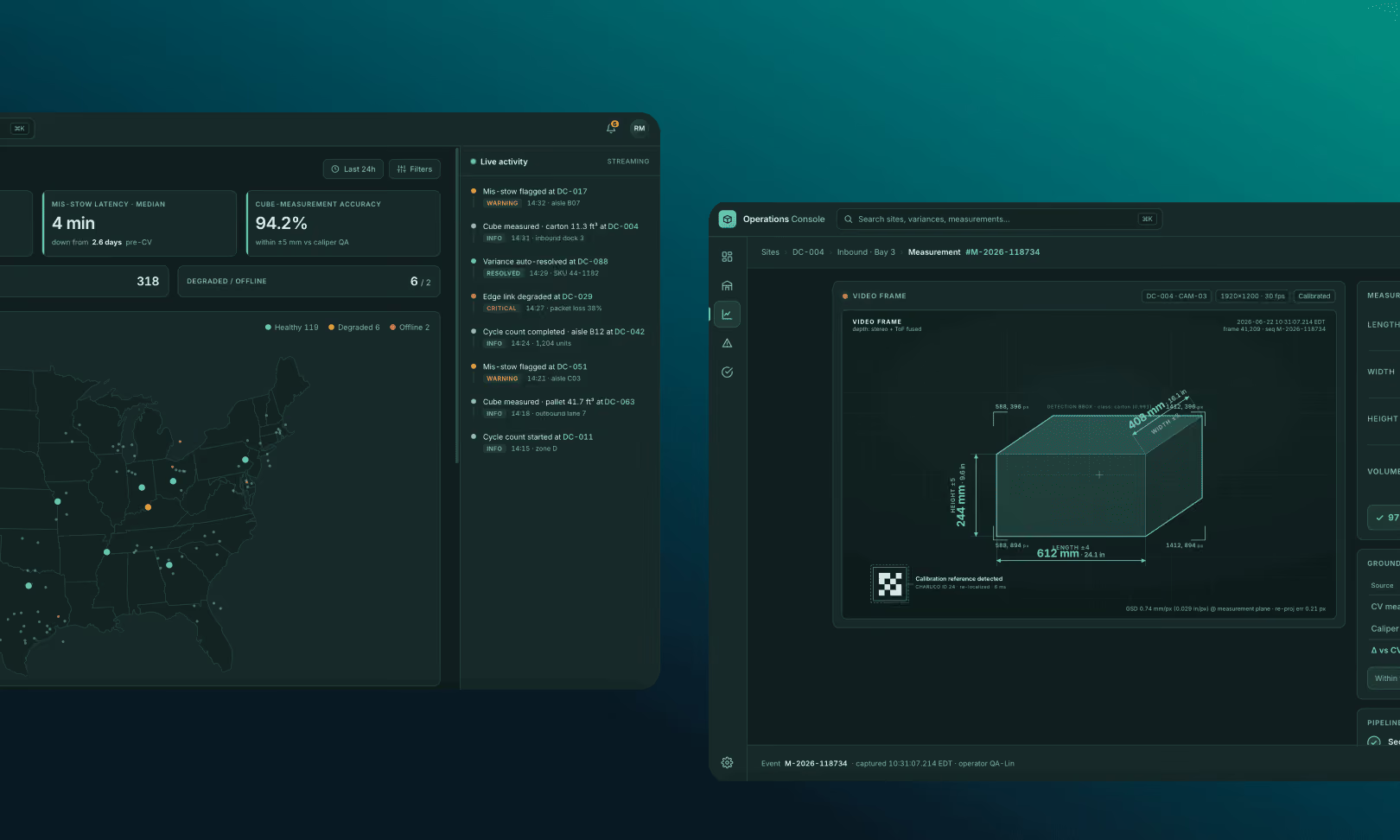
Recruiter Reasoning Dashboard
The React frontend gives recruiters complete candidate context in a single interface, purpose-built to support decision-making rather than information retrieval:
• Aggregated candidate profile from all sources, with Relevance Index score and source breakdown.
• Test assignment summary with the agent's scoring rationale explained in plain language.
• Psychological portrait from interview analysis, structured by dimension.
• Risk heat map: AI cheating signals, credential-to-interview mismatches, red flags from transcript analysis.
• One-click actions: advance the candidate, escalate to senior reviewer, or flag for further human review.
Critically, the Dashboard surfaces not just the agent's decision but its chain-of-thought reasoning. Recruiters always understand why the system reached a given conclusion. This transparency was a deliberate design principle: it builds warranted trust in the AI outputs and enables confident human override when needed.
Team Composition & Roles
The project was executed by adedicated team of five specialists over three months. Each role was scoped to aspecific technical challenge within the system.
Technologies We Use in This Project
Measured Results & Business Impact
Operational Metrics
Impact on Hire Quality
The increase in Interview-to-Offer Ratio from 12% to 38% is the most telling quality indicator. It means the system is far more effective at identifying fit earlier in the funnel — before candidates reach the final interview stage. Hiring managers now spend their time exclusively on candidates who have already been validated across technical, psychological, and cultural dimensions.
In parallel, the rate of bad hires decreased significantly. Each incorrect hire carries a hidden cost estimated at three or more months of fully-loaded salary: onboarding time, manager attention, re-recruitment, and lost team productivity. Preventing even five bad hires per year delivers $150,000 to $300,000 in avoided costs — independently of the operational savings.
Recruiter Productivity Shift
The system delivered on the "25 squared" strategy: a 25% increase in candidate throughput capacity alongside a 25% reduction in administrative overhead. Recruiters moved up the value stack — from manually processing applications and checking test submissions to strategic relationship-building with top talent and high-intent candidate engagement.
Firm-Wide Scaling Projection
When extended across all business units, the estimated recruiter time savings reach 1.5 million hours annually. Even at conservative utilization assumptions, this represents tens of millions of dollars in freed productivity across the organization.
Want to achieve similar results? Let’s develop your idea!


oTHER case studies