NEW YEAR, NEW GOALS:   Kickstart your SaaS development journey today and secure exclusive savings for the next 3 months!
Check it out here >>
White gift box with red ribbon and bow open to reveal a golden 10% symbol, surrounded by red Christmas trees and ornaments on a red background.
Unlock Your Holiday Savings
Build your SaaS faster and save for the next 3 months. Our limited holiday offer is now live.
White gift box with red ribbon and bow open to reveal a golden 10% symbol, surrounded by red Christmas trees and ornaments on a red background.
Explore the Offer
Valid for a limited time
close icon
Logo Codebridge
UI/UX

5 mistakes killing your UX Design

July 15, 2022
|
2
min read
Share
text
Link copied icon
table of content
photo of Myroslav Budzanivskyi Co-Founder & CTO of Codebridge
Myroslav Budzanivskyi
Co-Founder & CTO

Get your project estimation!

Creating an exceptional UI/UX design is a challenging task that requires careful consideration of various factors to ensure a seamless and engaging user experience. However, certain mistakes can undermine your efforts, leading to a design that frustrates rather than delights users. Here are some common pitfalls to avoid in your UI/UX design process:

Overloading with Animations

Animations can significantly enhance the visual appeal of your interface. They can guide users, provide feedback, and create a more engaging experience. However, excessive or slow animations can have the opposite effect, making your interface feel sluggish and distracting.

Recommendation: Use animations sparingly and ensure they are fast enough to keep the user experience smooth. Aim for subtle, purposeful animations that enhance usability without overwhelming the user.

Missing Contrast

One of the most common UI design mistakes is insufficient contrast between text and background colors. Poor contrast can make your content difficult to read, particularly for users with visual impairments.

Recommendation: Always check your color combinations using contrast checkers like the A11y – Color Contrast Checker plugin for Figma. Ensure your text is easily readable against its background to improve accessibility and user experience.

Excessive Notifications

Notifications are essential for keeping users informed and engaged. However, sending too many notifications can annoy users and lead them to disable notifications or even abandon your app.

Recommendation: Send only relevant notifications to specific users and be mindful of the frequency. Prioritize the most critical updates and ensure each notification provides real value to the user.

Overloading with Content

While it's important to provide users with the information they need, too much content on a single screen can be overwhelming and difficult to navigate. A cluttered interface can obscure the content hierarchy and make it challenging for users to find what they're looking for.

Recommendation: Use sufficient white space and limit the amount of content on each screen. Break up information into digestible chunks and create a clear content hierarchy to guide users through your interface.

Ignoring Feedback

Constructive feedback is invaluable in the design process. Ignoring user feedback can lead to a design that fails to meet the needs and expectations of your audience.

Recommendation: Actively seek and work with feedback from your users. Use this feedback to refine and improve your design, ensuring it evolves to better serve your users' needs.

Great design is not just about aesthetics, but how well it meets the needs and expectations of users. Avoid common UI/UX mistakes to ensure a seamless and engaging experience.

Conclusion

By avoiding these common mistakes, you can create a more effective and user-friendly UI/UX design. Remember, the key to great design is not just in the aesthetics but in how well it meets the needs and expectations of your users. Stay attentive to these pitfalls, and you'll be well on your way to crafting outstanding user experiences.

FAQ

What is the most common mistake that harms UX design?

One of the most common mistakes is designing based on assumptions instead of real user research. This often leads to solutions that don’t align with actual user needs.

How does poor navigation impact user experience?

Confusing or inconsistent navigation frustrates users and makes it difficult to complete tasks. This increases bounce rates and reduces overall satisfaction.

Why does ignoring mobile users damage UX design?

Ignoring mobile optimization leads to poor usability on smaller screens. Since many users access products via mobile devices, this significantly impacts engagement and retention.

How can excessive complexity hurt UX?

Overloading interfaces with too many features or visual elements increases cognitive load. Simplicity helps users focus and complete actions more efficiently.

What happens when accessibility is overlooked in UX design?

Overlooking accessibility excludes users with disabilities and can lead to usability issues for all users. It also increases legal and reputational risks.

How can teams avoid these UX design mistakes?

Teams can avoid common mistakes by conducting user research, testing designs regularly, simplifying interfaces, and prioritizing accessibility from the start.

Heading 1

Heading 2

Heading 3

Heading 4

Heading 5
Heading 6

Lorem ipsum dolor sit amet, consectetur adipiscing elit, sed do eiusmod tempor incididunt ut labore et dolore magna aliqua. Ut enim ad minim veniam, quis nostrud exercitation ullamco laboris nisi ut aliquip ex ea commodo consequat. Duis aute irure dolor in reprehenderit in voluptate velit esse cillum dolore eu fugiat nulla pariatur.

Block quote

Ordered list

  1. Item 1
  2. Item 2
  3. Item 3

Unordered list

  • Item A
  • Item B
  • Item C

Text link

Bold text

Emphasis

Superscript

Subscript

UI/UX
Rate this article!
Thank you! Your submission has been received!
Oops! Something went wrong while submitting the form.
37
ratings, average
4.7
out of 5
July 15, 2022
Share
text
Link copied icon

LATEST ARTICLES

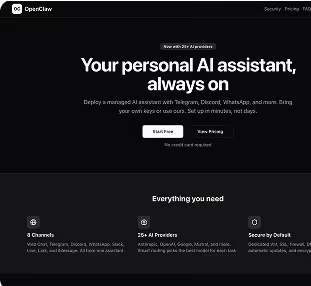
OpenClaw and the future of personal AI infrastructure with user-controlled systems, local deployment, and workflow ownership
April 7, 2026
|
6
min read

What OpenClaw Reveals About the Future of Personal AI Infrastructure

What the rise of OpenClaw reveals for businesses about local-first AI agents, personal AI infrastructure, runtime control, and governance in the next wave of AI systems.

by Konstantin Karpushin
AI
Read more
Read more
OpenClaw vs SaaS automation comparison showing differences in control, deployment architecture, and workflow execution
April 6, 2026
|
10
min read

OpenClaw vs SaaS Automation: When a Self-Hosted AI Agent Actually Pays Off

We compared OpenClaw, Zapier, and Make to see when self-hosting delivers more control and when managed SaaS automation remains the smarter fit for businesses in 2026.

by Konstantin Karpushin
AI
Read more
Read more
secure OpenClaw deployment with configuration control, access boundaries, and operational safeguards for agent systems
April 2, 2026
|
12
min read

Secure OpenClaw Deployment: How to Start With Safe Boundaries, Not Just Fast Setup

See what secure OpenClaw deployment actually requires, from access control and session isolation to tool permissions, network exposure, and host-level security.

by Konstantin Karpushin
AI
Read more
Read more
Office scene viewed through glass, showing a professional working intently at a laptop in the foreground while another colleague works at a desk in the background.
April 1, 2026
|
6
min read

AI Agent Governance Is an Architecture Problem, Not a Policy Problem

AI agent governance belongs in your system architecture, not a policy doc. Four design patterns CTOs should implement before shipping agents to production.

by Konstantin Karpushin
AI
Read more
Read more
Modern city with AI agent guardrails for production systems. Kill switches, escalation paths, and recovery controls that reduce risk and improve operational resilience.
March 31, 2026
|
8
min read

AI Agent Guardrails for Production: Kill Switches, Escalation Paths, and Safe Recovery

Learn about AI agent guardrails for production systems. Kill switches, escalation paths, and recovery controls that reduce risk and improve operational resilience.

by Konstantin Karpushin
AI
Read more
Read more
CEO of the business company is evaluating different options among AI vendors.
April 3, 2026
|
10
min read

Top 10 AI Development Companies in USA

Compare top AI development companies in the USA and learn how founders and CTOs can choose a partner built for production, governance, and scale. See how to evaluate vendors on delivery depth and maturity.

by Konstantin Karpushin
AI
Read more
Read more
AI agent access control with permission boundaries, tool restrictions, and secure system enforcement
March 30, 2026
|
8
min read

AI Agent Access Control: How to Govern What Agents Can See, Decide, and Do

Learn how AI agent access control works, which control models matter, and how to set safe boundaries for agents in production systems. At the end, there is a checklist to verify if your agent is ready for production.

by Konstantin Karpushin
AI
Read more
Read more
AI agent development companies offering agent architecture, workflow design, and production system implementation
March 27, 2026
|
8
min read

Top 10 AI Agent Development Companies in the USA

Top 10 AI agent development companies serving US businesses in 2026. The list is evaluated on production deployments, architectural depth, and governance readiness.

by Konstantin Karpushin
AI
Read more
Read more
single-agent vs multi-agent architecture comparison showing differences in coordination, scalability, and system design
March 26, 2026
|
10
min read

Single-Agent vs Multi-Agent Architecture: What Changes in Reliability, Cost, and Debuggability

Compare single-agent and multi-agent AI architectures across cost, latency, and debuggability. Aticle includes a decision framework for engineering leaders.

by Konstantin Karpushin
AI
Read more
Read more
RAG vs fine-tuning vs workflow logic comparison showing trade-offs in AI system design, control, and scalability
March 24, 2026
|
10
min read

How to Choose Between RAG, Fine-Tuning, and Workflow Logic for a B2B SaaS Feature

A practical decision framework for CTOs and engineering leaders choosing between RAG, fine-tuning, and deterministic workflow logic for production AI features. Covers data freshness, governance, latency, and when to keep the LLM out of the decision entirely.

by Konstantin Karpushin
AI
Read more
Read more
Logo Codebridge

Let’s collaborate

Have a project in mind?
Tell us everything about your project or product, we’ll be glad to help.
call icon
+1 302 688 70 80
email icon
business@codebridge.tech
Attach file
By submitting this form, you consent to the processing of your personal data uploaded through the contact form above, in accordance with the terms of Codebridge Technology, Inc.'s  Privacy Policy.

Thank you!

Your submission has been received!

What’s next?

1
Our experts will analyse your requirements and contact you within 1-2 business days.
2
Out team will collect all requirements for your project, and if needed, we will sign an NDA to ensure the highest level of privacy.
3
We will develop a comprehensive proposal and an action plan for your project with estimates, timelines, CVs, etc.
Oops! Something went wrong while submitting the form.